
$700.00 Original price was: $700.00.$600.00Current price is: $600.00.
Join us in Beautiful Knoxville, Tennessee on April 16 – 18, 2027!
One of two companion workshops required for the N.A.R.K. Personal Trainer Certification, alongside Pain, Posture & Performance. These independent courses may be completed in either order and, together with an online examination, establish the foundation for certification in the N.A.R.K. approach to personal training.
While it is not mandatory, if you haven’t already taken our ‘Advanced Assessments’ (1 Day) Course, we highly recommend that you get our previous recording of that class HERE
Otherwise, please consider taking time before the workshop to study up on assessments, gait analysis, landmarks, etc. so that you are better prepared.
Location: Temple Human Performance, 2099 Thunderhead Rd, STE 205, Knoxville TN 37922
Full Course Descriptions below.
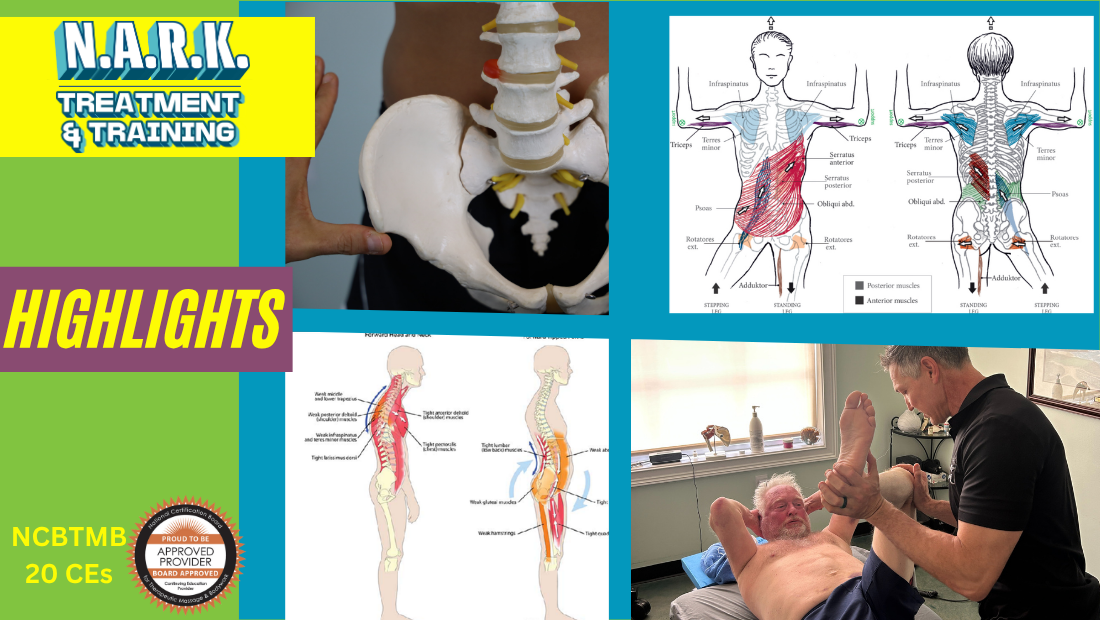
In this intensive 2½ day workshop, explore the neurological, biomechanical, and physiological principles that influence pain, movement dysfunction, and physical performance. Develop a deeper understanding of how the nervous system, joints, muscles, and kinetic chains interact to influence movement efficiency, postural control, force production, and overall functional capacity.
The first half-day focuses on understanding pain patterns, performing systematic assessments, and developing individualized treatment protocols using the Neuro Articular Regenerative Kinetics (N.A.R.K.) system. Participants will learn to interpret assessment findings, select appropriate hands-on manual therapy interventions, and establish a framework for reassessment and continued care.
The following two days transition into the personal training application of the N.A.R.K. system, focusing on neuromuscular retraining, corrective movement, progressive loading, and performance development. Participants will learn how to translate assessment findings and manual therapy strategies into purposeful training programs that develop mobility, stability, strength, muscular endurance, and power.
A central focus is bridging the gap between the treatment table and the training floor. This integrated approach emphasizes how hands-on manual therapy, active participation, and progressive exercise can work together to improve functional capacity, build resilience, and support long-term performance. The course also examines the relationship between physical activity, neuromuscular health, and all-cause mortality risk, emphasizing the importance of maintaining strength, balance, and physical capacity throughout the lifespan.
Essential knowledge:
• Understanding pain patterns, pain modulation, and the neurological influences on movement and muscular function.
• The relationship between the nervous system, joint mechanics, muscular function, and kinetic chain interactions.
• Principles of neuromuscular assessment, movement analysis, and functional baseline development.
• Developing individualized treatment protocols using N.A.R.K. assessment and manual therapy principles.
• Integrating hands-on manual therapy with active movement and progressive personal training.
• Principles of progressive loading, including intensity, volume, frequency, recovery, and adaptation.
• The relationship between physical activity, cardiorespiratory fitness, muscular strength, and all-cause mortality risk.
Medial knowledge:
• The role of the central and peripheral nervous systems in sensory integration, proprioception, and motor control.
• Mechanoreception and the influence of sensory input on neuromuscular coordination.
• The relationship between joint mobility, muscular tone, force production, and movement efficiency.
• Understanding regional interdependence and compensatory patterns throughout the kinetic chain.
• Progressive development of mobility, stability, strength, muscular endurance, and power.
• The influence of aging, deconditioning, and reduced physical activity on neuromuscular capacity.
Additional knowledge:
• Integrating general physical preparedness (GPP) with specific physical preparedness (SPP) and performance goals.
• Applying assessment findings to individualized manual therapy and personal training protocols.
• The role of active participation, motor learning, and neuroplasticity in movement retraining.
• Developing strategies for transitioning clients from hands-on interventions to active self-management.
• Understanding the relationship between physical capacity, functional independence, and long-term health outcomes.
• Case-based protocol development involving common musculoskeletal complaints, recurring pain patterns, and performance limitations.
Delivery: 70% Hands-On; 30% Lecture w/ Presentation
Presentation: Interactive with Case Studies, breakout sessions and videos.
Videos: Instructor-created videos as well as fun and informative videos from within and out of the industry.
Production: State of the art audio and visual equipment; multi camera setup (when applicable)
Hours: 8:30am Setup; 9am Start; 6pm End; 1 Hour Lunch & Breaks Included
Level: Entry – Intermediate
Language: English
Credits: NCBTMB Approved 8 CEs Per Day
This Physiokinetix workshop will honor a 50% refund from the time of cancellation 30 days prior to the event. After 30 days, there will be NO REFUNDS granted. However, a 100% transfer credit to any future Paul Kelly Workshop will be honored, for up to 1 year of original, registered workshop. The value of the original, registered workshop will be applied for transfer credit. Price of workshop is subject to change. After 1 year, there will be NO TRANSFER CREDIT applied.
| Type | 2 Day: In-Person, Mobility: In-Person, Stability: In-Person |
|---|
Only logged in customers who have purchased this product may leave a review.


International orders are arranged manually. To ship outside the US, contact our team at info@templehp.com.
International packages may be subject to import taxes, customs duties, and fees set by the destination country. These are usually due when the package arrives, are not included in the product price or shipping cost, and are the buyer's responsibility. We charge only the transportation fee for international orders.
Purchases may be returned within 10 days of delivery, provided that:
Items that have been assembled may incur a restocking charge of at least 20% of the retail price. No returns on digital content. Subject to change.
Sales tax applies only to purchasers who legally reside in Tennessee, where this business operates. For Tennessee residents, sales tax is already included in the product prices shown.
Workshop prices are subject to change.
Reviews
There are no reviews yet.