

Sometimes the body knows what to do, but the joint does not feel ready to do it. Pain, guarding, or a stuck sense of motion can shrink the window for useful practice. In Physiokinetix, hands-on joint work is not the destination. It is often the door that opens so active movement can walk through.
Joint mobilization—skilled, graded movement applied to a joint and the tissues around it—fits that job when it is used as preparation. The goal is simple and practical: make the next reach, squat, rotation, or loaded pattern more available, then train that availability while it is fresh.
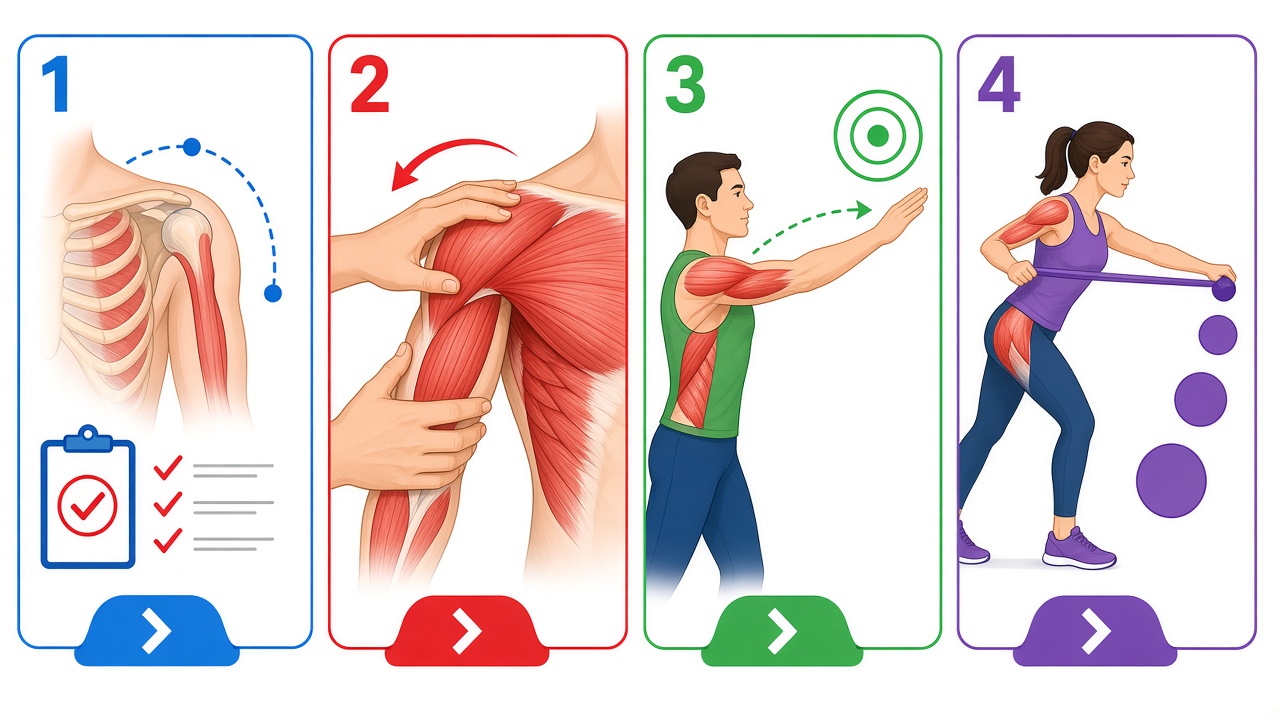
Assess, mobilize when needed, move right away, then build load.
What the evidence supports (and what it does not)
Across shoulders, knees, and other peripheral joints, systematic reviews of mobilization and mobilization-with-movement (MWM) point to a consistent short-term picture. Pain often eases. Active range often improves. Function scores can move in the right direction. Those changes matter when they help someone participate in the work that actually builds capacity.
A 2026 systematic review and meta-analysis of joint mobilization for shoulder impingement-type presentations (19 randomized trials, 956 participants) found better pain, active range, and common shoulder function scores when mobilization was added to physical therapy programs. Importantly, mobilization did not clearly outperform exercise-based physiotherapy alone, and study quality and heterogeneity limited how firmly we can generalize. In Physiokinetix language: useful adjunct, not a standalone fix.
MWM reviews tell a similar story. Compared with sham, passive care, or no treatment, short-term pain and disability often improve. Compared with other active physiotherapy approaches, superiority is much less clear, and durable long-term advantage is not established. Knee osteoarthritis trials and reviews report immediate pain reduction, higher pressure-pain thresholds locally and remotely, and better knee-flexion range after MWM—again, strongest in the near term.
For chronic nonspecific low back pain, a 2026 systematic review found that adding joint-based manual therapy to exercise did not clearly add short-term pain relief beyond exercise alone, while disability improvements at short- and long-term follow-up were more promising—though certainty was only low to moderate and sample sizes were modest. Neck research combining manual therapy with exercise shows function gains that can outpace placebo, with pain results depending heavily on the comparison group. The practical reading is the same: pair hands-on input with movement, measure what changes, and do not oversell either tool alone.
Occupational-medicine guidance on early care also lines up with Physiokinetix priorities: emphasize functional recovery, prefer active participation and exercise, and keep passive methods time-limited when they help someone engage more fully and objective function improves.
How mobilization may work (honest mechanism language)
What is reasonably established is immediate hypoalgesia—reduced pain sensitivity—linked to mechanoreceptor input and central modulation, including segmental and descending inhibitory processes. That is a sensory-motor story, not a carpentry story.
What remains proposed or inferential includes lasting cartilage “nutrition” claims, permanent positional-fault correction, and “breaking adhesions” as the primary explanation for clinical change. Those ideas show up in older teaching. They are not what we need to justify good session design. In Physiokinetix we can say this cleanly: graded joint input can change how the system feels and moves right now. We then use that window.
How Physiokinetix uses the window
The educational sequence is deliberate:
- Screen and baseline. Note pain behavior, available range, and a meaningful task (reach overhead, sit-to-stand, rotate to look, load a pattern you care about).
- Prepare only when needed. Use targeted, appropriately dosed joint mobilization when pain or restriction is limiting active participation—not as a default ritual for every visit.
- Move immediately. Follow with active, task-relevant practice while the window is open: isometrics, controlled concentrics/eccentrics, or simple pattern work matched to the person’s capacity.
- Progress load. Build toward functional loading and organized movement, the same table-to-movement transfer Physiokinetix trains throughout the curriculum.
- Keep or change based on function. Continue the approach when objective gains show up. Modify or stop when they do not.
Clients at Temple Human Performance often experience this as sessions that clear a path and then ask the body to walk it. Students of Physiokinetix learn it as methodology: manual input as sensory and mechanical preparation, then organization, load, and transfer—never passive care as an end state.
Hands-on joint preparation on the table, followed right away by active reaching and loading.
Safety, expectations, and scope
Mild soreness or transient discomfort after mobilization can occur. Serious events are uncommon, and reporting standards in the literature are still catching up—which is why careful screening, clear communication, and professional judgment matter. Red-flag presentations, recent trauma or surgery, suspected fracture, infection, inflammatory disease, or neurological compromise sit outside massage/manual-therapy scope and need appropriate medical referral.
This work is educational and session-based. It is not a diagnosis of arthritis, impingement, or any disease, and it is not a substitute for medical or rehabilitative care when those are indicated. Physiokinetix and Temple Human Performance stay in their lane: movement organization, load, sensory input, and honest progression.
What we are still learning
Useful questions keep the method sharp:
- Does mobilization immediately before exercise add benefit over well-dosed exercise alone for a given person?
- How durable are short-term gains beyond the session or the early weeks?
- What dose, frequency, and technique fit which presentations?
- Which people benefit most—and who does better going straight to active work?
- When disability improves, is it always through pain change, or can function rise on a somewhat separate track?
Those questions refine programming. They do not change the central Physiokinetix idea: when a joint feels unavailable, skilled hands-on work can open a short window—and the skilled therapist uses that window to train real movement.
Closing
Joint mobilization in Physiokinetix is a door, not a destination. Open it when pain or restriction is blocking practice. Step through with active, organized, progressively loaded movement. Keep what improves function. That is how table work earns its place in a method built for people who want to move better—not just feel worked on.
References
- Lee G, Woo H, Han Y, et al. Clinical efficacy of joint mobilization for shoulder impingement syndrome: a systematic review and meta-analysis. PLoS One. 2026. doi:10.1371/journal.pone.0352260
- Stathopoulos N, Dimitriadis Z, Koumantakis GA. Effectiveness of Mulligan’s mobilization with movement techniques on pain and disability of peripheral joints: a systematic review with meta-analysis between 2008–2017. Physiotherapy. 2019;105(1):1-9. doi:10.1016/j.physio.2018.10.001
- Westad K, Tjoestolvsen F, Hebron C. The effectiveness of Mulligan’s mobilisation with movement (MWM) on peripheral joints in musculoskeletal (MSK) conditions: A systematic review. Musculoskeletal Science & Practice. 2019;39:157-163. doi:10.1016/j.msksp.2018.12.001
- Weleslassie GG, Temesgen MH, Alamer A, et al. Effectiveness of Mobilization with Movement on the Management of Knee Osteoarthritis: A Systematic Review of Randomized Controlled Trials. Pain Research and Management. 2021;2021:8815682. doi:10.1155/2021/8815682
- Alkhawajah HA, Alshami AM. The effect of mobilization with movement on pain and function in patients with knee osteoarthritis: a randomized double-blind controlled trial. BMC Musculoskeletal Disorders. 2019;20:452. doi:10.1186/s12891-019-2841-4
- Dos Santos ECS, Dos Santos AT, da Silva NA, et al. Effectiveness of adding manual therapy to exercise for pain and disability in chronic non-specific low back pain: A systematic review and meta-analysis. Musculoskeletal Science & Practice. 2026. doi:10.1016/j.msksp.2026.103508
- Klees JE, Milek D, Hegmann KT; ACOEM Evidence-based Practice Initial Treatment Panel. Initial Approaches to Treatment. Journal of Occupational and Environmental Medicine. 2026;68(2):e187-e195. doi:10.1097/JOM.0000000000003606
- Chacko N, Gross AR, Miller J, et al. Manual therapy with exercise for neck pain. Cochrane Database of Systematic Reviews. 2025;(12):CD011225. doi:10.1002/14651858.CD011225.pub2
- Funabashi M, Gorrell LM, Pohlman KA, Bergna A, Heneghan NR. Definition and classification for adverse events following spinal and peripheral joint manipulation and mobilization: A scoping review. PLoS One. 2022;17(7):e0270671. doi:10.1371/journal.pone.0270671
- Funabashi M, Gorrell LM, Pohlman KA, Bergna A, Heneghan NR; on behalf of the AdEMMo Group. Defining and classifying adverse events following joint manipulation and mobilization: An international e-Delphi study and focus groups. PLoS One. 2025;20(11):e0334151. doi:10.1371/journal.pone.0334151