Pregnancy reshapes the body over a few months. Body mass rises and shifts forward, the pelvis and lower back carry load in new ways, sleep becomes harder to come by, and the weeks after birth bring their own physical demands: feeding, lifting, carrying, and very little rest. Massage during pregnancy and after birth has a research history of more than 25 years, and that work gives a fairly clear picture of what skilled touch can offer women through this period and how it can be adapted safely.
For nearly 30 years, Temple Human Performance has combined massage and osteopathic-based manual therapy with movement training, physical preparation, and nutrition in one approach to treatment and training. Pre and postnatal work is one of the services within that approach. This article looks at the physical load of pregnancy, what trials and reviews report about massage before and after birth, how the research describes positioning and pressure, and how we apply those findings with clients.
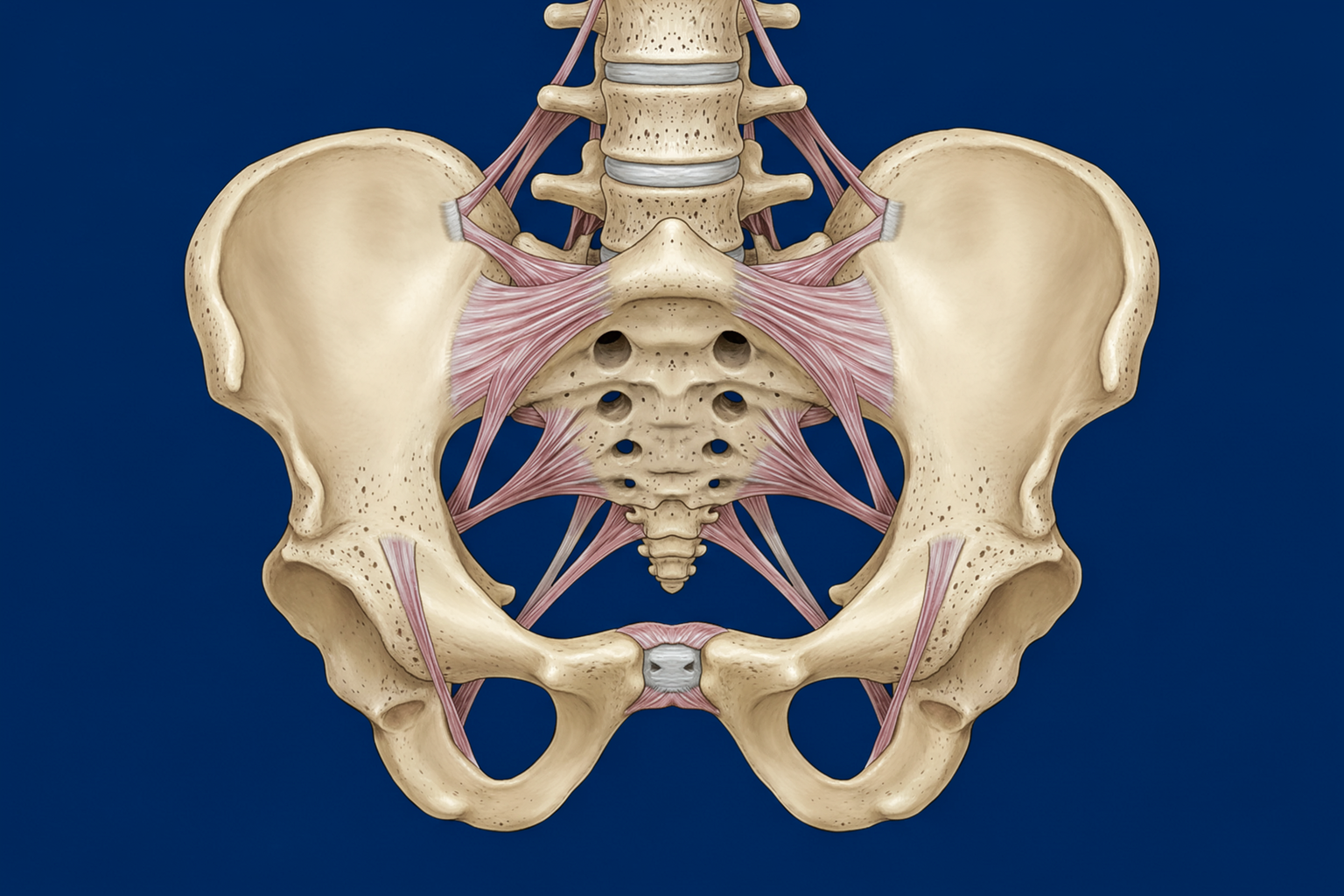
The pelvic girdle is a ring made of the two hip bones and the sacrum, joined at the sacroiliac joints in the back and the pubic symphysis in the front, and held together by some of the strongest ligaments in the body. During pregnancy this ring and the lumbar spine above it carry a growing and forward-shifting load while the surrounding muscles adapt their activity.
Wu and colleagues (2004) reviewed the research on pregnancy-related pelvic girdle pain and pregnancy-related low back pain, which together make up lumbopelvic pain. Across the published studies, about 45 percent of pregnant women and about 25 percent of women after birth reported pelvic girdle pain, low back pain, or both. The review also described changes in muscle activity and altered motor coordination in women with pelvic girdle pain. That point matters to how we think about this work: the discomfort of pregnancy is tied to how the body organizes movement under a changing load, not only to one sore spot.
Some of the earliest controlled work came from Field and colleagues (1999). Twenty-six pregnant women received either massage or relaxation therapy in 20-minute sessions twice a week for five weeks. Both groups reported less anxiety after the first session and less leg pain. By the last day of the study, only the massage group reported reduced anxiety, improved mood, better sleep, and less back pain, and their urinary norepinephrine, a stress hormone, decreased.
A later trial by Field and colleagues (2008) asked whether partners could provide the massage. Forty-seven pregnant women with prenatal depressive symptoms were randomly assigned either to receive massage from their partners twice a week from the 20th week of pregnancy until birth or to a control group. The massaged women reported larger decreases in leg pain, back pain, depressive symptoms, anxiety, and anger than the control group. The partners who gave the massage also reported less depressed mood, anxiety, and anger, and relationship scores improved for both the women and their partners.
Swelling in the lower legs is common late in pregnancy. Coban and Sirin (2010) randomly assigned 80 women in late pregnancy with normal, physiological lower leg swelling to a 20-minute foot massage each day for five days or to standard prenatal care alone. After five days, the massage group had a significantly smaller lower leg circumference, measured at the ankle, the instep, and the base of the toes, on both sides.
Mueller and Grunwald (2021) systematically reviewed 12 randomized controlled trials of relaxation massage during pregnancy, with all women at least 12 weeks pregnant when the studies began. The main benefits they reported included reduced stress, back pain, leg pain, depressive symptoms, and anxiety. Only two trials reported potential side effects, and these were minor and transient. The authors concluded that in healthy pregnant women without complications, relaxation massage has positive effects throughout pregnancy.
Hall and colleagues (2020) focused on mood. In a meta-analysis of trials comparing massage with usual care, massage had a moderate effect on pregnant women’s self-reported depressive symptoms across four studies and a moderate effect on anxiety across five studies. The authors described massage as an acceptable and feasible approach for pregnant women and called for further high-quality trials. In a narrative review, Pachtman Shetty and Fogarty (2021) summarized the field in similar terms: massage is increasingly used for stress relief, relaxation, and wellbeing during pregnancy, and it has been shown to be valuable for anxiety, depressive symptoms, and leg and back pain.
Trials tell only part of the story, so it is useful to see what happens when pregnant and postpartum women book massage in ordinary practice. Fogarty and colleagues (2019) followed 101 women at two massage clinics in Australia. Low back pain was the most common reason for booking, followed by hip, shoulder, and neck pain and mental wellbeing. From before the massage to afterward, and again one week later, the women reported significantly less stress and pain, more range of motion, and better sleep. Some women reported at least one side effect after the massage, and no physical harm to mother or child was recorded. Nearly all of the women received a full-body massage that included the feet, which the authors noted gives little support to the old belief that massaging the feet during pregnancy is harmful.
The early weeks after birth bring their own pattern of fatigue and upper-body tension. In a randomized controlled trial, Yamasaki and colleagues (2026) studied 112 women on the second day after a vaginal birth. Half received a 40-minute massage of the upper body, shoulders and arms, back, legs, and head, and half rested in bed for the same time. Compared with rest, the massage produced larger improvements in several physical symptoms, including stiff shoulders, fatigue, arm fatigue, and leg swelling, along with decreases in negative mood states and increases in positive ones such as vigor and friendliness. The authors concluded that massage in the early postpartum period is effective in easing these unpleasant symptoms while supporting emotional wellbeing.
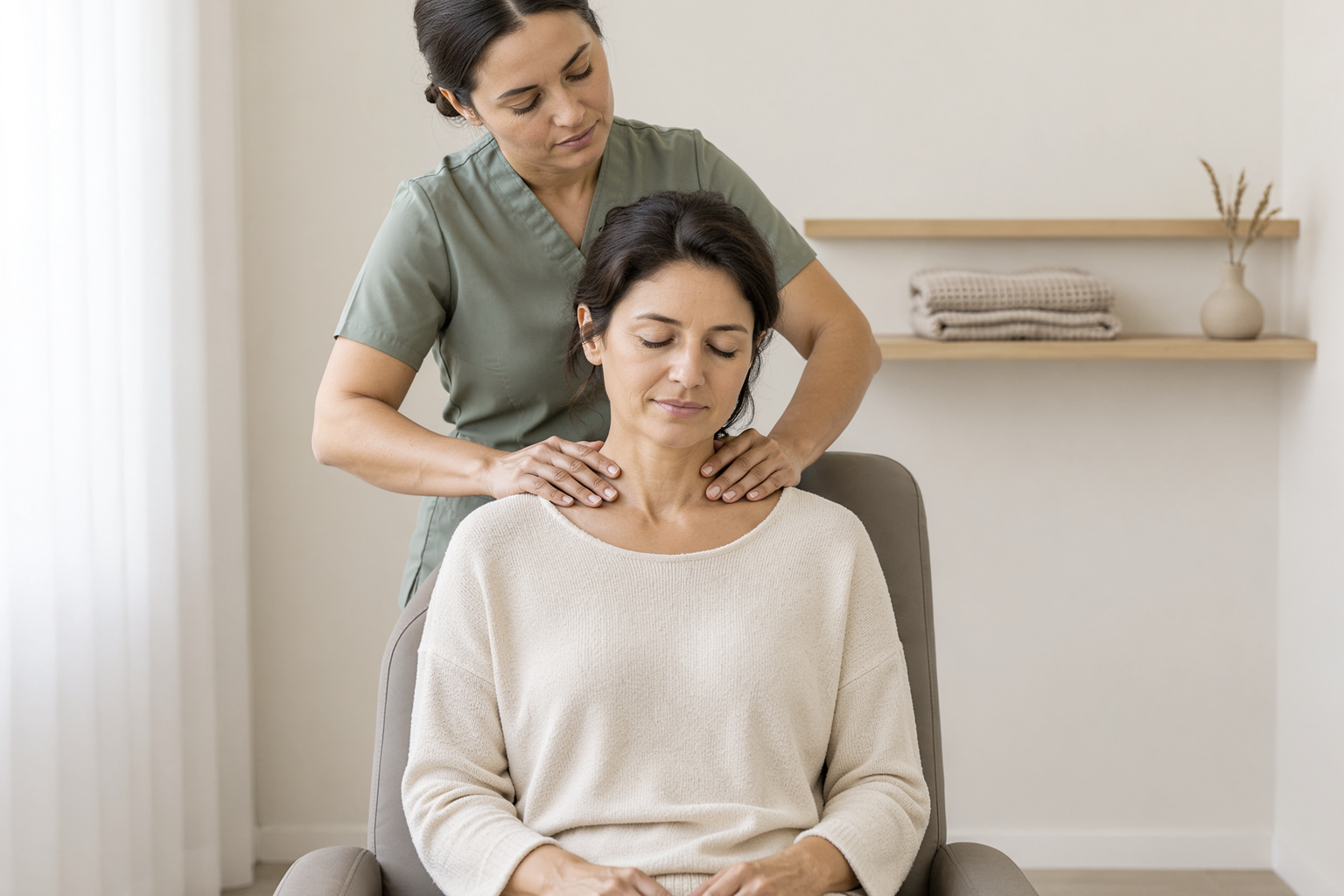
The same reviews describe how massage is adapted during pregnancy. Mueller and Grunwald (2021) note that massage should be given with the woman lying on her side or seated, rather than lying face down, which many women find uncomfortable. They advise against deep pressure into the muscles of the legs, while gentle stroking to ease swelling is considered acceptable. All of the women in the trials they reviewed were at least 12 weeks pregnant at the start, and most of the trials excluded complicated pregnancies.
At Temple, pre and postnatal sessions sit within the same hands-on work as the rest of our practice, adapted for a body that is changing week to week. Members of our team are trained in pregnancy massage, and the side-lying and seated positions described in the research shape how each session is set up. The goals line up with the outcomes the studies measured: easing back, hip, and leg discomfort, easing lower leg swelling, settling the stress response, and helping sleep.
The research also explains why we look beyond the sore area. Pelvic girdle and low back discomfort in pregnancy come with changes in muscle activity and coordination, so the table work attends to the whole region: the hips, pelvis, lower back, and upper back that adapt as posture and load change. After birth, the work often shifts toward the shoulders, neck, and arms, which carry most of the feeding, lifting, and holding.
Movement belongs in the same plan. The 2019 Canadian guideline for physical activity throughout pregnancy (Mottola et al., 2018) concluded that the benefits of prenatal physical activity are moderate and that no harms were identified. Coached training can be scaled to each stage of pregnancy and the months after, and nutrition coaching supports the same goals from another side. Medical care during pregnancy belongs with each client’s obstetric provider. Our role is the hands-on work, the movement, and the education that support a client alongside that care.
Physiokinetix, the education and movement system I developed, views movement as the product of many interacting factors, including sensory input, joint mechanics, tissue loading, motor control, breathing and pressure relationships, and the demands of the task. Pregnancy changes nearly all of them at once. The pelvis carries load differently, breathing and trunk pressure change as the abdomen grows, balance shifts, and daily tasks change shape. The finding that lumbopelvic discomfort in pregnancy comes with altered motor coordination fits this view well.
PKT also emphasizes what happens after hands-on input. A session can change comfort, tension, and the ease of a position, and the next step is to let the client use that change actively. The PKT framework moves through Mobility, Stability, Power, and Performance. The needs this research describes map most directly onto Mobility and Stability: comfortable access to positions, control around the pelvis and trunk, and steady balance as the body changes. Power and Performance carry that capacity back into lifting, carrying, and the daily demands of life with a new baby, with load progressing as the body is ready. The levels build on one another, but they are not a rigid protocol, and where a client works depends on the individual.
Physiokinetix holds to the principle of knowledge, not diagnosis, and it links professional sessions with self-care so clients take an active part between visits. The partner-massage trial is a good example of that idea at home: skilled touch from someone close, given regularly, carried benefits for both people. In our work, that means explaining what the research shows, teaching simple positions and movements, and helping clients carry the practice into their PKT Self-Care routine through pregnancy and the months after.
Pregnancy and the period after birth place real demands on the lower back, pelvis, legs, and shoulders, and lumbopelvic discomfort is common among pregnant women and new mothers. Controlled trials report that massage during pregnancy reduces anxiety, back and leg pain, and lower leg swelling while improving mood and sleep, and that partner-given massage benefits both partners. Reviews describe positive effects throughout pregnancy for healthy women, moderate effects on self-reported anxiety and depressive symptoms, and only minor, transient side effects. In everyday practice, women report less stress and pain, more range of motion, and better sleep, and after birth massage eases stiff shoulders, fatigue, and leg swelling while supporting mood. At Temple, we bring these findings into pre and postnatal hands-on work that respects positioning and pressure, connects to movement and nutrition, and carries into self-care, so that treatment and training support women through each stage.