

Tissue Capacity, Load Sharing, and the Envelope of Function in Physiokinetix
Most clients do not fail because they lack a single “tight” tissue. They struggle when the demands of life, sport, or training sit outside what their tissues and movement system can currently tolerate. In Physiokinetix (PKT) education, that idea sits close to the center of progressive work: build capacity, share load across kinetic relationships, and use manual input as preparation for active movement—not as a stand-alone finish line.
This post walks through established loading science, what remains inferential, and how those ideas map onto PKT framing of load, capacity, and table-to-movement transfer.
Capacity is trainable—and structure-specific
A useful clinical education model is Physical Stress Theory paired with Dye’s “envelope of function.” In plain terms, tissues adapt along a continuum: underuse and reduced capacity, a homeostatic zone where demand matches tolerance, adaptive overload that can build capacity when recovered from, and overload that exceeds recovery and produces injury-level stress.
That framing is a conceptual map, not a precise diagnostic tool. What it does well for practitioners is shift the question from “What is the painful structure?” to “What is this person’s current envelope—and how do we widen it without repeatedly overshooting it?”
PKT language fits that shift. Sessions and programming care about tissue tolerance, joint control, and progressive capacity across mobility, stability, power, and performance—not symptom chasing alone.
What the loading literature actually supports
Several themes show up consistently enough to teach with confidence, while still leaving room for uncertainty.
1. Controlled loading generally beats prolonged immobilization for healing tissues (with context).
Animal-model systematic review evidence favors post-injury mechanical loading over unloading for restoring ligament strength and stiffness in experimental models, while immobilization tends to degrade tissue properties in broader loading reviews. That does not mean “load everything hard immediately.” It means thoughtful, graded exposure usually preserves and restores mechanical capacity better than rest alone. Optimal loading dose remains unclear, and animal findings do not automatically generalize to every human tissue.
2. For tendons, strain magnitude often matters more than the contraction label.
Reviews of tendon cell biology and human tendon adaptation suggest remodeling responds strongly to the mechanical strain environment. In reported Achilles work, adaptation appeared around higher strain (~4.5%) but not lower (~3%). Patellar tendon adaptation likewise favored higher-load stimuli. Eccentric-only, combined eccentric/concentric, and isometric tendinopathy programs have shown broadly similar effectiveness in many comparisons. Mode can still matter for comfort, adherence, and local tissue stress—but it is a weak foundation for dogma.
3. Hypertrophy can be similar across eccentric and concentric work when load and work are matched.
Eccentric loading still has distinct architectural and metabolic features, but “eccentric equals hypertrophy” is an oversimplification when total stimulus is equated.
4. Load changes how the kinetic chain shares work.
Biomechanical studies of loaded jumps show that as external load rises, joint contributions redistribute—often with greater proximal (e.g., hip) contribution under heavier demands. That supports a practical PKT idea: you can bias stress toward or away from a region by changing load magnitude, joint angles, range, and synergist demand—not only by “working the sore spot.”
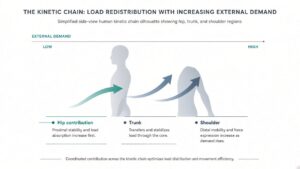
Illustrative kinetic-chain load redistribution schematic. Generated educational graphic; not clinical evidence.
5. Pain-only progression rules are weakly supported.
Pain-guided progression is common in practice. Systematic review work on lower-limb tendinopathy progression criteria finds pain-based rules predominate but with weak scientific support. Monitoring next-day response, effusion, and return to baseline remains wiser than treating a single pain number as law.
Mechanisms: keep them labeled as mechanisms
Mechanotransduction—the idea that tension, compression, shear, and fluid forces become cellular remodeling signals—is a plausible bridge from “we loaded it” to “it adapted.” Integrin/focal-adhesion signaling, MAPK/ERK and PI3K/Akt pathways, and PIEZO1-related calcium signaling appear in tendon and mechanobiology literature as proposed contributors.
A “mechanostat” or homeostatic set-point story is often borrowed from bone biology. It is useful as metaphor. It is not firmly established as a clinical control system you can dial like a thermostat in a massage or movement session.
PKT education should sound like an experienced practitioner: mechanism-aware, not mechanism-theatrical.
Manual input as a short-term window—not the whole intervention
Manual therapy’s average added benefit over exercise, in conditions such as rotator cuff disease or chronic non-specific low back pain, is often modest in systematic reviews. That does not make table work irrelevant. It reframes it.
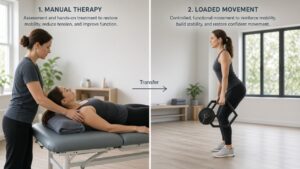
Illustrative table-to-movement transfer from manual input to active loading. Generated educational graphic; not clinical evidence.
A defensible PKT inference—clearly labeled as inference—is that skilled manual input may create a short-term window of reduced guarding, improved joint play, or easier sensory-motor access. The educational priority is what happens next: transfer into active movement and progressive loading while that window is open.
In other words, articular and soft-tissue input are part of organizing the system to accept load—not a promise that passive work alone expands the envelope of function.
Practical PKT application (education, not protocols)
Without inventing fixed protocols, practitioners studying Physiokinetix can organize decisions around a few durable principles:
1. Assess capacity, not only irritation. Where does quality degrade under load or repetition? What compensations appear when demand rises?
2. Use manual input to organize, then load. Follow table work with active strategies that ask the same regions to share force under control.
3. Progress by stimulus and recovery, not fashion. Prefer sufficient load magnitude, adequate frequency, and multi-week timelines (tendon-oriented programs often need on the order of 12 weeks) over chasing a favorite contraction mode. Some Achilles stiffness adaptations appear early (within about eight weeks in one controlled loading study), with diminishing returns from simply adding more volume.
4. Redistribute stress along kinetic relationships. Hip-biased versus more distal-biased loading, trunk contribution, and range constraints can protect a recovering tissue while maintaining broader conditioning—an application of load sharing rather than isolation-only thinking.
5. Watch the next-day envelope. Soreness that settles, preserved quality, and stable swelling/response markers matter more than finishing a prescribed set at all costs.
6. Protect when needed without shutting the system down. Temporary offloading or range restriction can be a capacity strategy, not a failure—especially when the rest of the chain keeps training.
What remains open
Several questions are honest teaching points rather than settled science:
– Does capacity-based progression outperform pain-only rules in real practice populations?
– Are strain thresholds for adaptation graded and tissue-specific rather than binary?
– Do tendon stiffness gains plateau such that more volume adds risk without further adaptation?
– Can deliberate kinetic-chain redistribution (for example, hip- versus knee-biased strategies) protect a healing region while capacity rebuilds?
– Does manual therapy meaningfully increase the tolerable active-loading dose in the hours after a session, or is that mostly clinical folklore?
Holding those as open keeps PKT education scientifically literate.
Closing for practitioners
Widening a client’s envelope of function is less about finding a magic tissue and more about dosing mechanical stress the system can adapt to—then sharing that stress across Primary Kinetic Links and related movement relationships. Manual therapy can help organize the system. Progressive loading builds the capacity that lasting movement change requires.
That is Physiokinetix framing at its most practical: input, organization, load, and transfer—from table to movement—without overclaiming what the literature has not yet settled.
References
1. Logerstedt DS, Ebert JR, MacLeod TD, et al. Effects of and Response to Mechanical Loading on the Knee. Sports Medicine. 2022;52:201-235. doi:10.1007/s40279-021-01579-7
2. Bleakley C, Netterström-Wedin F. Does mechanical loading restore ligament biomechanics after injury? A systematic review of studies using animal models. BMC Musculoskeletal Disorders. 2023;24:511. doi:10.1186/s12891-023-06653-x
3. Franchi MV, Reeves ND, Narici MV. Skeletal Muscle Remodeling in Response to Eccentric vs. Concentric Loading: Morphological, Molecular, and Metabolic Adaptations. Frontiers in Physiology. 2017;8:447. doi:10.3389/fphys.2017.00447
4. Mattiussi AM, Shaw JW. From Evidence to Application: An Operational Extension of Existing Sports Injury Frameworks for Sports Medicine Practitioners. Sports Medicine. 2026. doi:10.1007/s40279-026-02496-3
5. Zhang X, Zhang X, Lu B, et al. Biomechanical and neuromuscular adaptations in joint contributions during loaded countermovement jumps. Scientific Reports. 2025. doi:10.1038/s41598-025-03887-8
6. Escriche-Escuder A, Casaña J, Cuesta-Vargas AI. Load Progression Criteria in Exercise Programmes in Lower Limb Tendinopathy: A Systematic Review. BMJ Open. 2020;10:e041433. doi:10.1136/bmjopen-2020-041433
7. Stańczak M, Kacprzak B, Gawda P. Tendon Cell Biology: Effect of Mechanical Loading. Cellular Physiology and Biochemistry. 2024;58:677-701. doi:10.33594/000000743
8. Passini FS, Jaeger PK, Saab AS, et al. Shear-stress sensing by PIEZO1 regulates tendon stiffness in rodents and influences jumping performance in humans. Nature Biomedical Engineering. 2021. doi:10.1038/s41551-021-00716-x
9. Kjaer M, Langberg H, Heinemeier K, et al. From mechanical loading to collagen synthesis, structural changes and function in human tendon. Scandinavian Journal of Medicine & Science in Sports. 2009;19:500-510. doi:10.1111/j.1600-0838.2009.00986.x
10. Page MJ, Green S, McBain B, et al. Manual Therapy and Exercise for Rotator Cuff Disease. Cochrane Database of Systematic Reviews. 2016. doi:10.1002/14651858.CD012224
11. Klees JE, Milek D, Hegmann KT, ACOEM Evidence-based Practice Initial Treatment Panel. Initial Approaches to Treatment. Journal of Occupational and Environmental Medicine. 2026;68:e187-e195. doi:10.1097/JOM.0000000000003606
12. Dos Santos ECS, Dos Santos AT, da Silva NA, et al. Effectiveness of Adding Manual Therapy to Exercise for Pain and Disability in Chronic Non-Specific Low Back Pain: A Systematic Review and Meta-Analysis. Musculoskeletal Science & Practice. 2026. doi:10.1016/j.msksp.2026.103508
13. Oranchuk DJ, Storey AG, Nelson AR, Cronin JB. Isometric training and long-term adaptations: Effects of muscle length, intensity, and intent: A systematic review. Scandinavian Journal of Medicine & Science in Sports. 2019;29:484-503. doi:10.1111/sms.13375
14. Yoshida R, Sato S, Kasahara K, et al. Greater effects by performing a small number of eccentric contractions daily than a larger number of them once a week. Scandinavian Journal of Medicine & Science in Sports. 2022. doi:10.1111/sms.14220
15. Yoshida R, Murakami Y, Kasahara K, et al. Minimum Intensity of Daily Six Eccentric Contractions to Increase Muscle Strength and Size. Scandinavian Journal of Medicine & Science in Sports. 2024. doi:10.1111/sms.14683
16. Tsai MS, Domroes T, Pentidis N, et al. Effect of the temporal coordination and volume of cyclic mechanical loading on human Achilles tendon adaptation in men. Scientific Reports. 2024. doi:10.1038/s41598-024-56840-6
Conceptual frameworks referenced in the narrative (not primary experimental sources): Dye’s envelope-of-function model; Physical Stress Theory.
Note on citation verification: The 2016 Keene et al. Cochrane item returned by research tools was a protocol only (not a completed systematic review) and was removed from the formal reference list per Head’s verification condition.