Walking speed is more than a metronome. When a person walks faster or slower, the hip, knee, and pelvis do not simply scale the same pattern up or down. Joint excursions change, and the way those joints share a step can change with them. At very slow speeds, the coordination itself can shift into a different pattern, not a slowed-down copy of a preferred walk.
That distinction matters in a session. A careful step on the table or in a hallway is useful, but it is not automatically the same organization the person will use at a brisk walking speed. Comparing two walks, or judging whether a change has transferred, requires attention to the speed at which the movement was performed.
For nearly 30 years, Temple Human Performance has combined massage and osteopathic-based manual therapy with movement training and physical preparation in one plan. Speed research helps us decide how to look at walking, how to follow table work with real movement, and how to progress practice without treating a single speed as the whole picture.
Fukuchi, Fukuchi, and Duarte (2019) reviewed 20 studies of walking in 587 healthy children, young adults, and older adults, including 16 studies of 310 young adults. Compared with a comfortable speed, most of the spatiotemporal measures, joint motions, joint kinetics, and ground reaction forces they analyzed decreased at slower speeds and increased at faster speeds, with moderate-to-large effects. The review is a description of how gait mechanics change with speed, not a test of a training method. The practical implication the authors drew is that speed should be considered when gait patterns are compared, because a slower walk is not a fair match for a faster one.
Jung and Kang (2026) measured three-dimensional joint motion in 155 healthy adults walking and running at a preferred speed, a faster speed, and a still faster speed. Range of motion increased with speed at every joint they reported except pelvic rotation in the transverse plane. The authors interpreted the coordinated changes in the upper and lower limbs as an active strategy for stability and efficiency. That reading is an inference from the kinematics, not a direct test of a control mechanism.
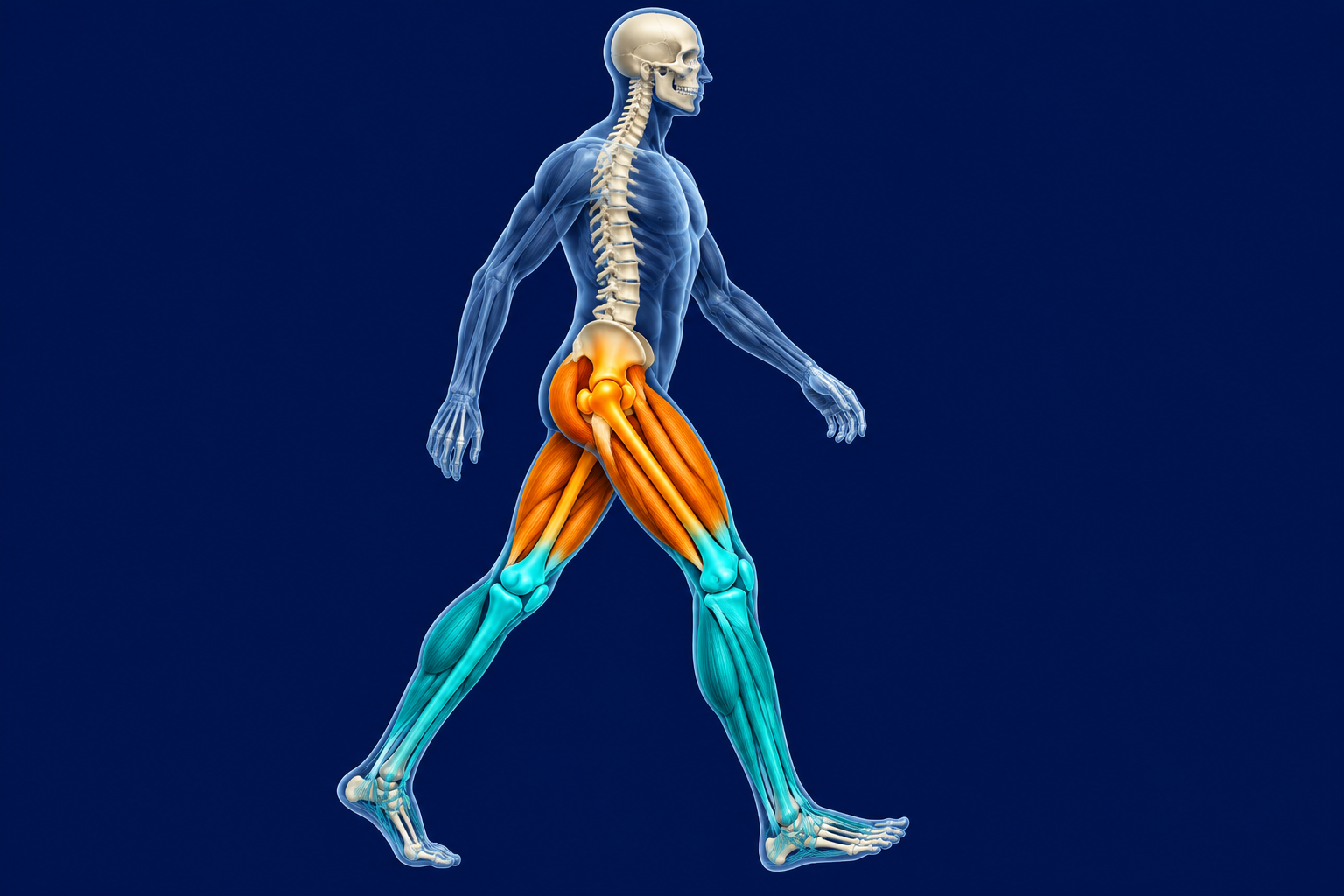
Chiu and Chou (2012) studied inter-joint coordination in 10 young and 10 older adults walking at a preferred speed, a faster speed, and a slower speed. They used continuous relative phase, a measure of how two neighboring joints organize their motion together across the stride. In the young adults, the hip-knee pattern differed more between the slower walk and the preferred walk than between the faster walk and the preferred walk. That difference was not found in the older adults, and the knee-ankle pattern did not show a clear speed or age effect. The authors suggested that the two age groups used different neuromuscular strategies to change speed.
Little, McGuirk, and Patten (2019) asked a sharper question: does the way the joints contribute to clearing and shortening the swing limb stay the same when walking gets slower than a typical preferred speed? In 17 healthy adults walking overground, the size of the hip, knee, and ankle contributions fell as speed fell, which is the expected scaling. The timing did not simply scale. Below typical self-selected speeds, the temporal order of peak hip and knee influences on limb clearance reversed. For limb shortening, the knee and ankle contributions came later in the gait cycle as speed decreased. The authors concluded that temporal coordination of limb clearance is altered when walking drops below the usual preferred range.
Farivar and King (2026) described walking speed as a control parameter that reorganized both the coordination within a limb and the timing between limbs. Twenty healthy young adults walked forward and backward on a treadmill at six speeds. In forward walking, faster speeds were associated with longer steps, less time in double-limb support, and more consistent left-right timing. Changes in segmental phase relationships were specific to stance and swing, and the couplings that included the thigh and pelvis were especially sensitive to speed in both directions.
Taken together, these studies support a clear finding: speed changes both the amount of motion at the joints and, at least in some pairings and phases, the coordination pattern itself. The idea that very slow walking is a different coordination state, rather than a slower copy of a preferred walk, is the most direct reading of the Little findings and is consistent with the larger hip-knee change Chiu and Chou observed between slow and preferred walking in young adults. Explanations that invoke distinct neuromuscular strategies, or speed as a control parameter, are the authors’ interpretations of those measured patterns. None of the studies tested a causal neural mechanism, and none tested whether practicing at several speeds improves transfer to daily walking.
Akl, Conceição, and Richards (2023) add a related observation from muscle and joint mechanics. In 27 healthy adults, hip and ankle stiffness during the weight-acceptance phase of walking increased with speed, and muscle co-activation around the joints changed with speed as well. That is another way the organization of a step can change when the tempo changes, not only the size of the joint motion.
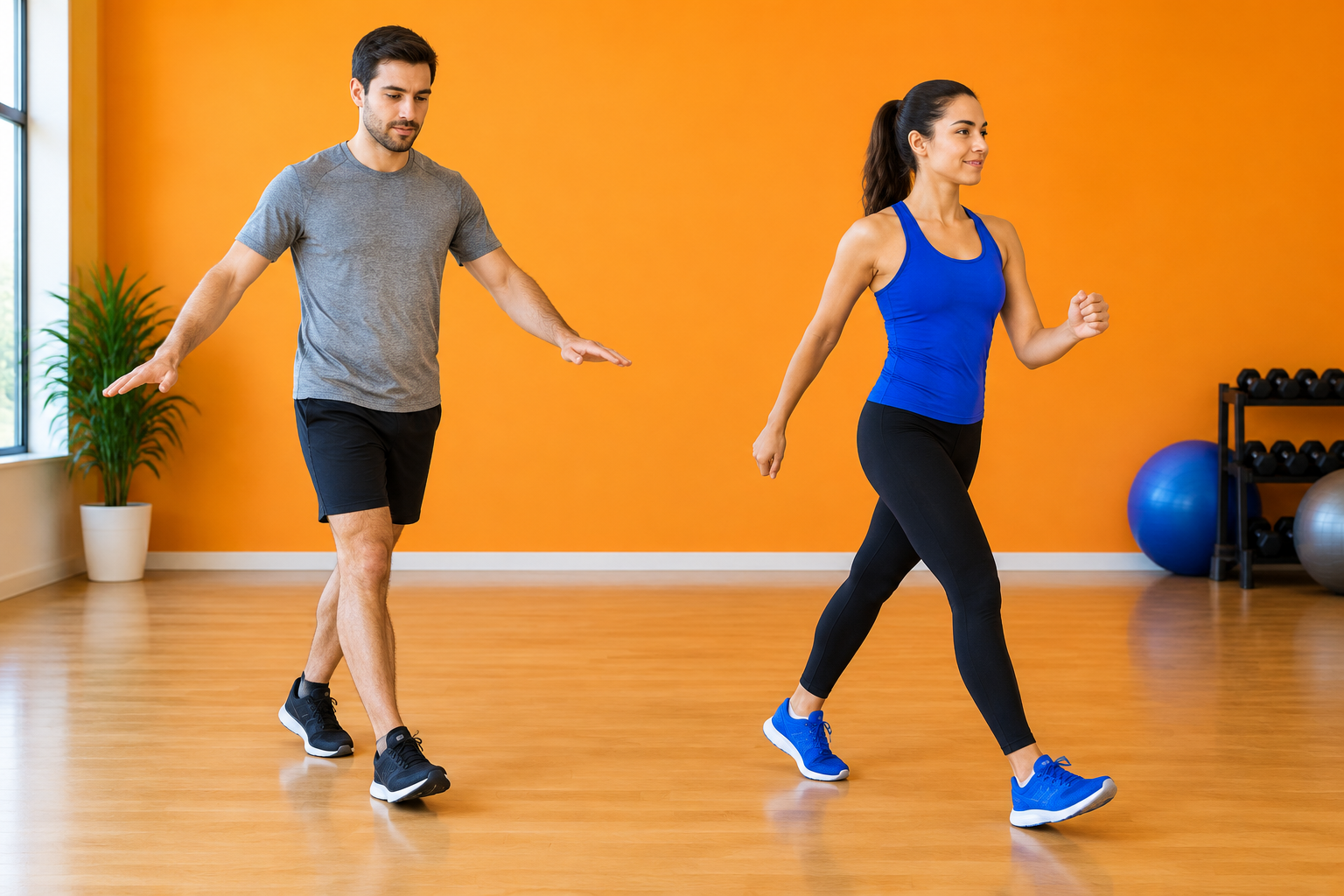
We treat speed as a variable that organizes coordination, not as a simple volume knob.
When we assess walking or a stepping task, we compare movement at matched speeds. A person who walks slowly on one day and more quickly on another may look different because the coordination has changed with speed, not only because the session has changed the person. The Fukuchi review supports that caution. If the goal is to see whether a pattern holds up in real life, we also look at the speeds the person actually uses, rather than judging everything from a single careful pace.
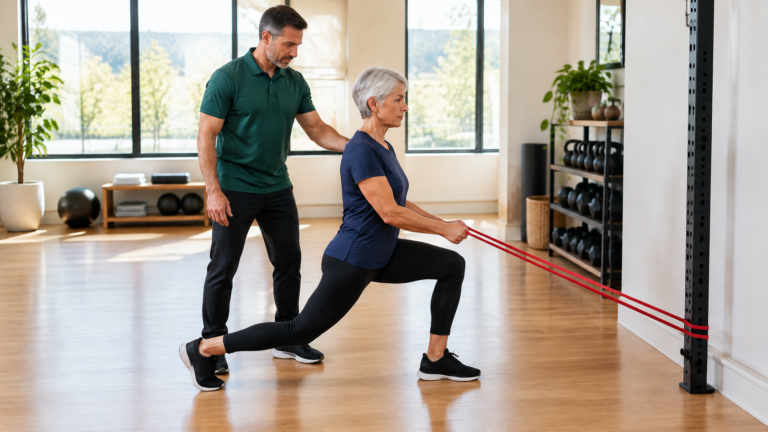
The same logic shapes what happens after the table work. Hands-on input can change how a joint moves or how a step feels. The next task is to let the person use that change in motion. Because a slow, deliberate step is not the same coordination as a brisk walk, we do not assume that a clean slow movement has already transferred. We have the person walk or step at more than one speed and watch how the hip, knee, and pelvis share the work as the tempo changes.
We also vary speed on purpose in practice. Spending all of the movement work at one careful pace can leave the preferred and faster patterns under-practiced. Spending all of it at a brisk pace can hide what happens when the person has to move slowly and with more control. The research does not set a sequence or a list of speeds. It gives a reason to include more than one.
Physiokinetix is a professional education and movement system built on the view that movement comes from interacting systems, including joint mechanics, motor control, and task demand. Speed is one of those task demands. The Self-Care framework progresses through Mobility, Stability, Power, and Performance. Those levels are a guide, not a rigid protocol, and a person’s needs determine where the work begins.
Speed has a place at each level. Mobility is about having options in range and using them with control, which often starts at a pace the person can organize clearly. Stability is about controlling the pattern while moving, including when the tempo changes. Power places more emphasis on producing force with speed and intent. Performance is where those capacities meet the speeds a task actually requires, whether that is a slow, precise step or a brisk walk across a parking lot. Progressive loading belongs at every level; speed is one of the ways load and demand can change.
This is distinct from treating movement variability as the main topic. Variability across repetitions can be a feature of skilled movement, and it can also change with speed, depending on the measure and the phase of the step. The point here is narrower: speed itself reorganizes how the joints work together, and practice should reflect that.
In healthy adults, walking faster or slower changes the amount of motion at the hip, knee, ankle, and pelvis, and it can change the coordination among those joints. The strongest evidence is descriptive. Below typical preferred speeds, the timing of hip and knee contributions to limb clearance can reverse, which is a different pattern rather than a scaled-down copy of a preferred walk. We use these findings to compare movement at matched speeds, to follow table work with walking at more than one tempo, and to vary speed as practice progresses through Mobility, Stability, Power, and Performance, without treating any one pace as the complete picture.