The sole of the foot is one of the nervous system’s main contacts with the ground. A textured surface under the foot can change how a person stands and how the lower-leg muscles work during walking. The contact is a source of sensory information, not a device that holds the body in place.
That effect is easy to overstate. In healthy adults, the changes are typically small, short-lived, and condition-dependent. They appear more clearly when the eyes are closed than when the eyes are open. They can vary with the region of the sole that is stimulated and with the phase of gait. A surface that is too coarse can make quiet stance less stable, not more. The studies reviewed here used textured insoles, mats, or floor coverings during standing or walking. They were not tests of table work, and they do not show that a textured product produces a lasting change in balance or gait once it is removed.
For nearly 30 years, Temple Human Performance has combined massage and osteopathic-based manual therapy with movement training and physical preparation in one plan. We read this literature as evidence that plantar texture is one sensory input among many. We do not read it as a reason to rely on a gadget.
Kenny and colleagues (2019) pooled ten crossover studies in 318 healthy young and older adults. Compared with control surfaces, textured materials had a small-to-moderate effect on center-of-pressure displacement with the eyes closed, with a standardized mean difference of 0.75 (95% confidence interval 0.18 to 1.33). With the eyes open, the corresponding effect was 0.29 and was not statistically significant (confidence interval -0.06 to 0.64). Effects on sway velocity were smaller still: 0.20 with the eyes closed and 0.14 with the eyes open, the latter not significant. Every 95% prediction interval crossed zero, which means a future study of the same kind could reasonably find no benefit, or even a change in the opposite direction. The authors described the overall result as an improvement in static balance that was heterogeneous.
That heterogeneity shows up in individual experiments. Hatton, Dixon, Martin, and Rome (2009) had 24 young adults stand quietly for 30 seconds with the eyes open on a control surface and on two textured surfaces. Texture did not significantly change anteroposterior or mediolateral sway, and it did not significantly change activity in eight lower-limb muscles.
Bonardet and colleagues (2023) tested 48 healthy adults on a control surface and on five coverings: foam, silicone, ethyl vinyl acetate, a mat with 2 mm raised nubs, and a mat with 7 mm raised nubs. With the eyes open, average center-of-pressure velocity increased, meaning stance was less stable, on foam, on silicone, and especially on the large-nub mat. With the eyes closed, none of the coverings differed from the control surface. A coarser texture, in this study, did not help quiet standing. It made eyes-open stance worse.
These are acute, laboratory effects in quiet standing. They describe what happens while the person is in contact with the surface. They do not describe what happens after the texture is removed, and most of them do not describe a moving task.
The same research group later recorded the electroencephalogram during quiet standing. Kenny, Eaves, Martin, Behmer, and Dixon (2020) tested 15 healthy young adults in textured and smooth insoles, with and without vision. Textured insoles reduced anterior-posterior sway range and standard deviation compared with smooth insoles. Upper-alpha power was also lower with textured insoles, an effect that exploratory analyses found with and without vision and that was more pronounced over parietal than central, and central than frontal, scalp sites. The reduction in sway is a measured finding. The authors suggested that the cortical change may reflect more information becoming available at the cortical level and a clearer representation of the body in space. That reading is an interpretation of the EEG change, not a direct measure of body representation.
Static sway is not the only relevant task. Park, Benson, Morgan, Matharu, and Block (2023) tested 20 healthy young adults in cushioned shoes with regular insoles, cushioned shoes with textured insoles, barefoot, and minimalist shoes. Footwear influenced a dynamic reach test, the Y-Balance Test, but not a quiet-stance error score with the eyes closed. Textured insoles produced significantly better reach performance than barefoot and minimalist conditions. The abstract does not report effect sizes, and it does not state that textured insoles outperformed regular insoles inside the same cushioned shoes. The authors suggested that tactile stimulation from the insoles may have offset any dampening of proprioception caused by shoe cushioning. Proprioception itself was not measured, and that suggestion is an inference.
Muscle activity during walking gives a more local picture of the same idea. Trotman, Ha, Tucker, Cattagni, and Hatton (2025) reviewed 17 studies, selected from 2,773 records, of plantar stimulation through footwear, inserts, or floor surfaces in healthy adults and in other groups. The review was not pooled. The authors judged the evidence that such stimulation changes muscle activity as limited for standing balance and moderate for gait, and they noted that the effects depend on the population, the location of the stimulus under the foot, and the complexity of the task. Our interest here is that pattern in healthy movement, not a claim about those other groups.
Robb and Perry (2022) made that location dependence concrete. Fifty-five healthy adults walked on the level and up an incline in textured and non-textured orthoses, with texture applied to five distinct regions of the sole. Texture under the lateral forefoot consistently suppressed electromyographic activity, and texture under the lateral midfoot consistently facilitated it. In early stance, texture under the medial midfoot or the heel facilitated extensor activity and suppressed flexor activity. Texture under the lateral midfoot or the medial forefoot facilitated tibialis posterior. The finding is that tactile stimulation of the sole can change lower-leg muscle activity in a site- and phase-specific way during walking. It is not a finding that one insole design improves gait quality in general.
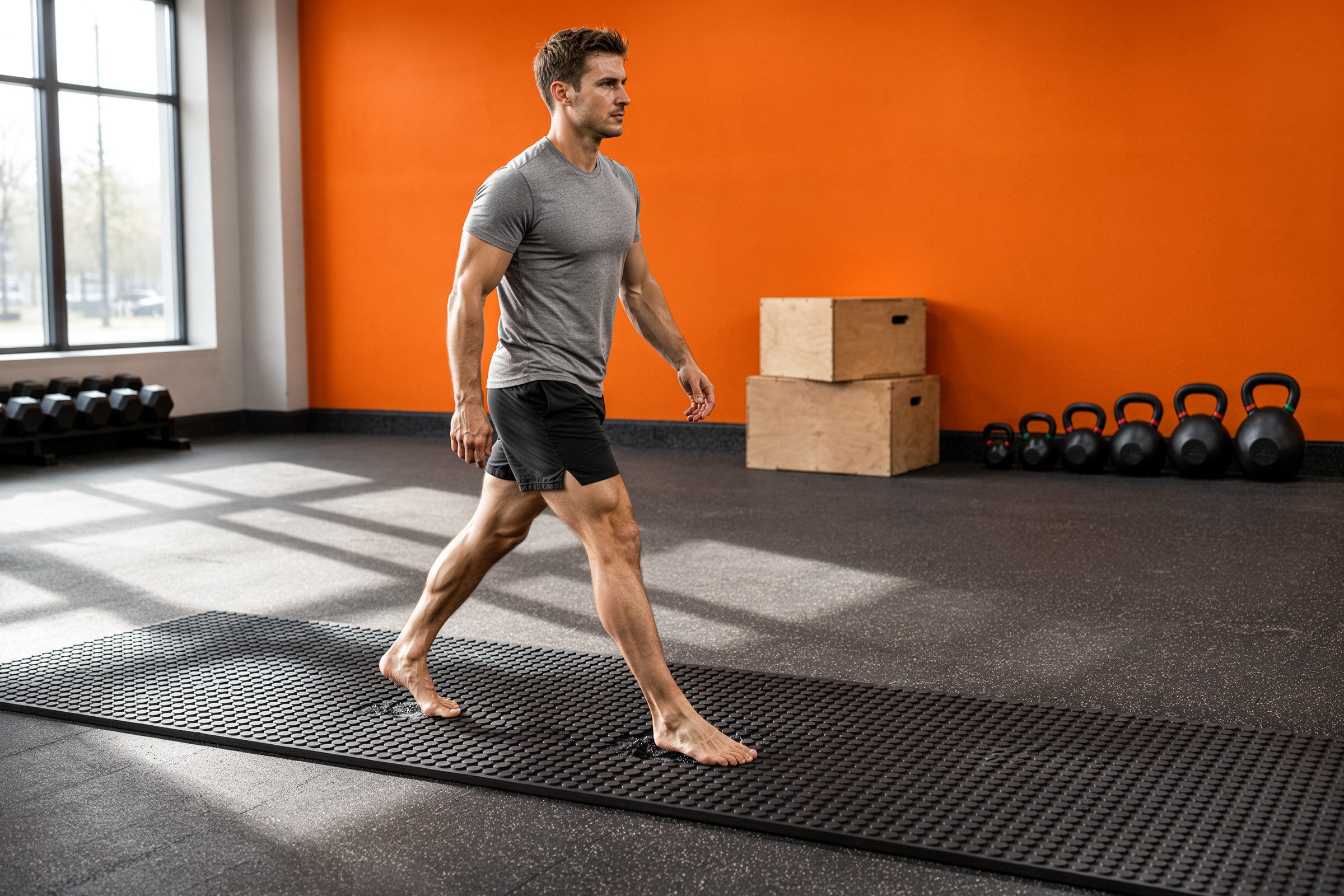
We use this work as evidence that the sole is an informative surface, and that the quality of the contact can change how quiet stance and gait are organized in the moment. We do not use it as evidence that a textured insole, mat, or other product produces a lasting change in balance, or that table work has been shown to produce these effects.
In practice, that distinction changes what we do with a textured surface. A mat, a textured insert, or even a change in footwear can be a temporary source of information while a person organizes a stance or a step. It is not the training. After a brief period with the added cue, we ask the person to organize the same stance, and then a step or a reach, without it. Transfer comes from that practice, not from leaving a product under the foot. The laboratory effects were measured while the texture was present. There is no evidence in this set of studies that the same change carries over once the surface is removed.
We also respect the limits of the stimulus. A surface that is too coarse can worsen eyes-open stance. A change under one part of the sole is not the same as a change under another. We watch the person’s organization, rather than assuming that more texture is better.
Physiokinetix is an education and movement system, spanning self-care and professional continuing education, built on the view that movement comes from interacting systems, including sensory information, motor control, and joint mechanics. Plantar texture is one example of how a change in sensory input can alter the way a position or a step is organized, even when the surface does not support the body mechanically.
The Self-Care framework progresses through Mobility, Stability, Power, and Performance. Those levels are a guide, not a rigid protocol. Stability is the level most directly involved here: the ability to control a position, including while the information coming from the feet changes. A textured surface may help a person sense the ground more clearly in a quiet stance or an early step. Removing the extra cue, and then taking that control into a step, a reach, or a more demanding task, is how the session moves from a quiet position toward control in movement, and later toward the speed and specificity of Power and Performance. Power emphasizes force with speed and intent. Progressive loading belongs at every level. The point is not to turn a textured mat into a formula. It is to treat sensory information as part of how movement is organized, and to let the person keep that organization when the surface is ordinary again.
This is a narrower question than a general account of proprioception, and it is distinct from training the small muscles that control the arch. It is also distinct from using a light fingertip or partner contact as a sensory cue during quiet standing. The channel in these studies is texture under the sole, and the finding is about that channel.
In healthy adults, textured materials under the foot can reduce postural sway in quiet standing, especially with the eyes closed, and can change lower-leg muscle activity in a site- and phase-specific way during walking. The effects are typically small, acute, and inconsistent. They can fail to appear with the eyes open, and a surface that is too coarse can make eyes-open stance less stable. These were not tests of table work, and they do not show carry-over once the texture is removed. We use them to treat the sole as an informative surface, to keep a textured cue from becoming a substitute for practice, and to ask the person to organize the same stance, and then movement, on ordinary ground.