

Clinical context
A heel slides on a wet tile. A toe catches the edge of a rug. A crowded train lurches as it pulls away. None of these moments gives the body time to plan. Recovery has to happen within a fraction of a second, usually through a fast step, a reach, or a sudden shift of the trunk. The capacity to do this is called reactive balance, and it is different from the steady, deliberate balance most people picture when they think of balance training. Over the past decade, a growing body of research has examined whether reactive balance can be trained directly, and the answer has practical consequences for how sessions are built.
At Temple Human Performance, we combine massage and osteopathic-based manual therapy with movement training and physical preparation in one plan. Reactive balance sits naturally inside that plan, because the hands-on work, the control we build afterward, and the loading that follows all feed the same goal: a body that can respond well when movement does not go according to plan.
Scientific background
Balance control is often divided into two broad modes. Proactive balance relies on anticipation. Before reaching overhead, lifting a foot to climb a stair, or starting to walk, the nervous system adjusts posture in advance so the movement does not destabilize the body. Reactive balance relies on feedback. When an unexpected slip, trip, or push moves the center of mass toward or beyond the edge of the base of support, the body has to detect the disturbance and respond after it has already begun. Small disturbances can be handled at the ankle or hip. Larger ones call for a change in the base of support itself, most often a rapid recovery step, sometimes a grab for a rail or wall.
These reactions are fast, and they are shaped strongly by spinal and brainstem circuits rather than by conscious planning. That speed is useful, but it also means a reaction cannot simply be talked into place. It improves through repeated exposure to the kind of disturbance it is meant to handle.
Perturbation-based balance training, sometimes called reactive balance training, is built on that principle. It exposes a person to repeated, controlled losses of balance in a safe setting so the recovery reactions themselves are practiced. Perturbations can come from a treadmill belt that suddenly speeds up or slows down, a moving platform, a cable or harness pulling at the waist, an unstable surface, or a practitioner who gives a push or releases a lean. The training is deliberately task specific. It trains the response to the disturbance rather than a general quality such as leg strength.
A basic question is whether the aging nervous system still adapts to this kind of practice. Bohm and colleagues (2015) pooled 18 studies with 1,009 participants, 613 of them older adults with a mean age of 70, that exposed people to repeated mechanical perturbations during walking and other locomotor tasks. Older adults adapted with large effect sizes, both by adjusting in advance to expected disturbances and by improving their feedback responses when an unexpected disturbance recurred. The differences from younger adults were small and not statistically significant. Their review measured adaptation in the laboratory rather than falls, but it established that the capacity to learn from repeated perturbations remains strong with age.
What the research shows
The first meta-analysis focused on falls in daily life came from Mansfield and colleagues (2015). Across 8 randomized trials and 404 participants, including older adults and people with Parkinson disease, those who completed perturbation-based training were less likely to report a fall (risk ratio 0.71) and reported fewer falls overall (rate ratio 0.54) than control groups. The authors described the trials as preliminary, and the designs were too varied for subgroup analysis.
Devasahayam and colleagues (2022) updated that work with 29 trials, 17 reporting falls and 21 monitoring adverse events, in older adults and people with balance impairments. Participants in reactive balance training were less likely to fall (risk ratio 0.76) and reported fewer falls (rate ratio 0.61) than controls, who in many trials performed more traditional balance training. Heterogeneity for the fall rate estimate was high. The review also recorded more adverse events with reactive training than with control activities, 29 percent compared with 20 percent, a point we return to below.
The most recent synthesis, by Sharma and colleagues (2026), was limited to community-dwelling adults aged 65 and older and graded the certainty of the evidence. Perturbation-based training reduced fall rates by 23 percent (rate ratio 0.77) and injurious falls by 24 percent (rate ratio 0.76). It improved reactive balance, measured for example by falls induced in the laboratory, but had limited effects on other fall risk factors such as gait. The authors concluded that the benefit likely comes through better reactive balance rather than broader physical changes. In a dose analysis, only programs totaling at least 6 hours reduced falls, by 33 percent, while most programs in the literature delivered about 2 hours. The certainty for the fall rate finding was rated low.
Wang and colleagues (2026) took a wider view in a network meta-analysis of 423 randomized trials and 33,901 adults aged 60 and older, comparing 19 exercise types for balance. Perturbation training had the largest overall estimate (Hedges’ g 0.66), followed by sensory training, dance, and agility stepping, all of which also performed well. Perturbation training showed larger estimates in groups at increased fall risk and when supervised. The authors were explicit that these rankings do not establish superiority, and that the best choice depends on which aspect of balance is the target.
Individual trials show where the benefit is clear and where it is not. In the REACT trial, Rieger and colleagues (2024) randomized 70 community-dwelling older adults at risk of falling to 4 weeks of dual-task treadmill training with or without perturbations. Both groups improved balance, gait performance, and confidence, and the perturbation group showed a larger drop in concern about falling. Neither group changed the quality or amount of walking in daily life, which was the primary outcome, yet the perturbation group had significantly fewer falls and fewer fallers in daily life.
Nørgaard and colleagues (2023) tested a brief program in 140 highly functioning older adults: four 20-minute treadmill sessions with 40 slip and trip perturbations each, three in the first week and a fourth after six months, compared with plain treadmill walking. Laboratory falls dropped sharply and stayed lower at 12 months (incidence rate ratio 0.37), but the 22 percent reduction in daily-life falls was not statistically significant. Read alongside Sharma’s dose finding, this suggests that around 80 minutes of exposure can reliably change the reaction in the laboratory without being enough to clearly change what happens on the sidewalk.
Brüll and colleagues (2023) compared two delivery formats in 71 fall-prone older adults over 6 weeks of three sessions per week. Treadmill perturbations produced the larger gain on a reactive stepping test, while training on unstable surfaces such as balance pads produced broader improvements in a clinical balance measure and limits of stability. Both were feasible, adherence was high, and no severe adverse events occurred. The effects were task specific: each format improved most what it most resembled.
Finally, Nachmani and colleagues (2026) used meta-regression across 32 trials to ask which training details matter. Programs using manual perturbations, delivered by a practitioner, were associated with lower fall rates than those using waist-pull systems (rate ratio 0.45). No other parameter, including number of sessions or perturbations, showed a consistent relationship with outcomes, and certainty was very low for falls. The honest summary is that the field does not yet know the optimal dose, intensity, or perturbation type.
Functional significance
Several points from this literature shape how we think about balance work.
Reactive balance is its own capacity. The most consistent finding across trials is that perturbation training improves the reaction to perturbations, while effects on gait and general fitness are limited. Strength, range, and steady standing balance support recovery, but they do not automatically produce a fast, well-placed step when the floor moves. If the reaction matters for a person, the reaction has to be practiced.
Specificity cuts both ways. Each training format improved most what it resembled, which argues for variety in direction, surface, and timing rather than a single repeated drill.
Dose and context matter. Low-dose programs change laboratory responses, while the clearest reduction in real-world falls appeared with longer cumulative exposure. Supervision was associated with larger effects, and minor adverse events, such as soreness or brief discomfort, were more common than with conventional training. These findings argue for graded, supervised exposure that builds over weeks rather than for avoiding the work.
Most of this research involved older adults, many at increased fall risk. The principle of training the reaction applies more broadly, to athletes changing direction and to anyone who works on uneven ground, but the fall outcomes themselves come from older populations.
Application at Temple Human Performance
In our sessions, reactive balance is a layer of stability work that we add once a client has the mobility and control to use it.
Assessment comes first. We look at ankle and hip range, how weight moves over the foot, single-leg control, and how quickly and how far a client steps when asked to step in different directions. A short or slow step, a reluctance to step toward one side, or a stiff ankle that leaves the hip doing all the work tells us something specific about what a recovery step would have to overcome.
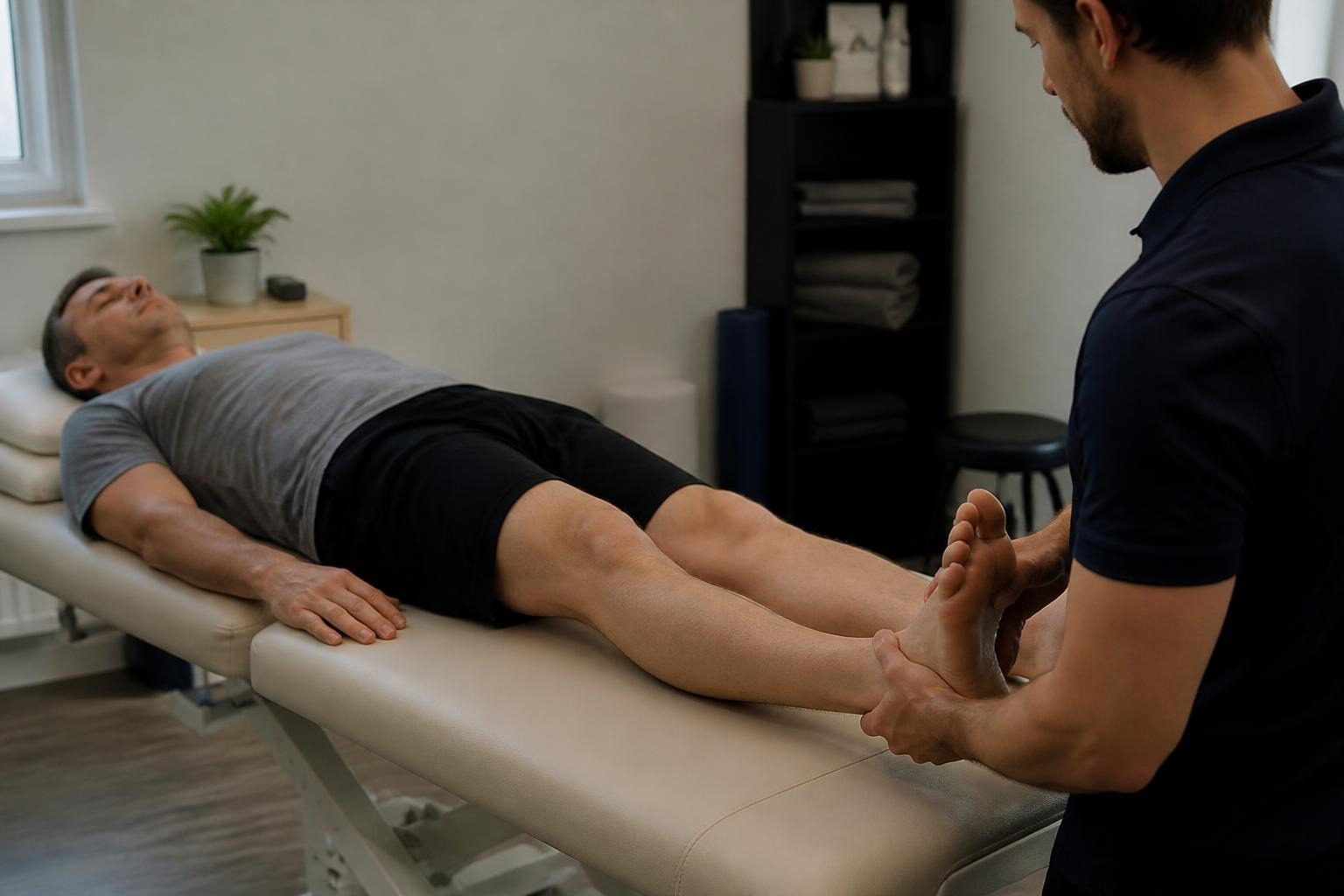
The table work often starts at the foot and ankle, the hips, or the trunk, depending on what the assessment shows. A recovery step needs an ankle that can accept load as the foot lands and a hip that can swing the leg through quickly. When hands-on work changes how a joint moves or how a region feels, we do not leave the change on the table. The client moves into it right away, first with slow weight shifts and controlled steps, so the nervous system has a chance to use the new option while it is fresh.
From there, steady balance comes before reactive balance. Single-leg stance, reaching, and stepping on firm and then softer surfaces build control the client can direct. We then introduce perturbations in graded steps, consistent with how trial protocols progressed: announced and predictable at first, in one direction, small enough that the client recovers without strain. Over sessions, we vary direction, add side to side challenges, reduce warning, and increase size. Manual perturbations suit our setting well. A light push at the pelvis or shoulders, or a forward lean that we hold and then release, lets us scale the challenge to the person in front of us from one repetition to the next. We keep a hand ready, a stable surface within reach, and stop or step back when anxiety or fatigue starts to degrade the response.
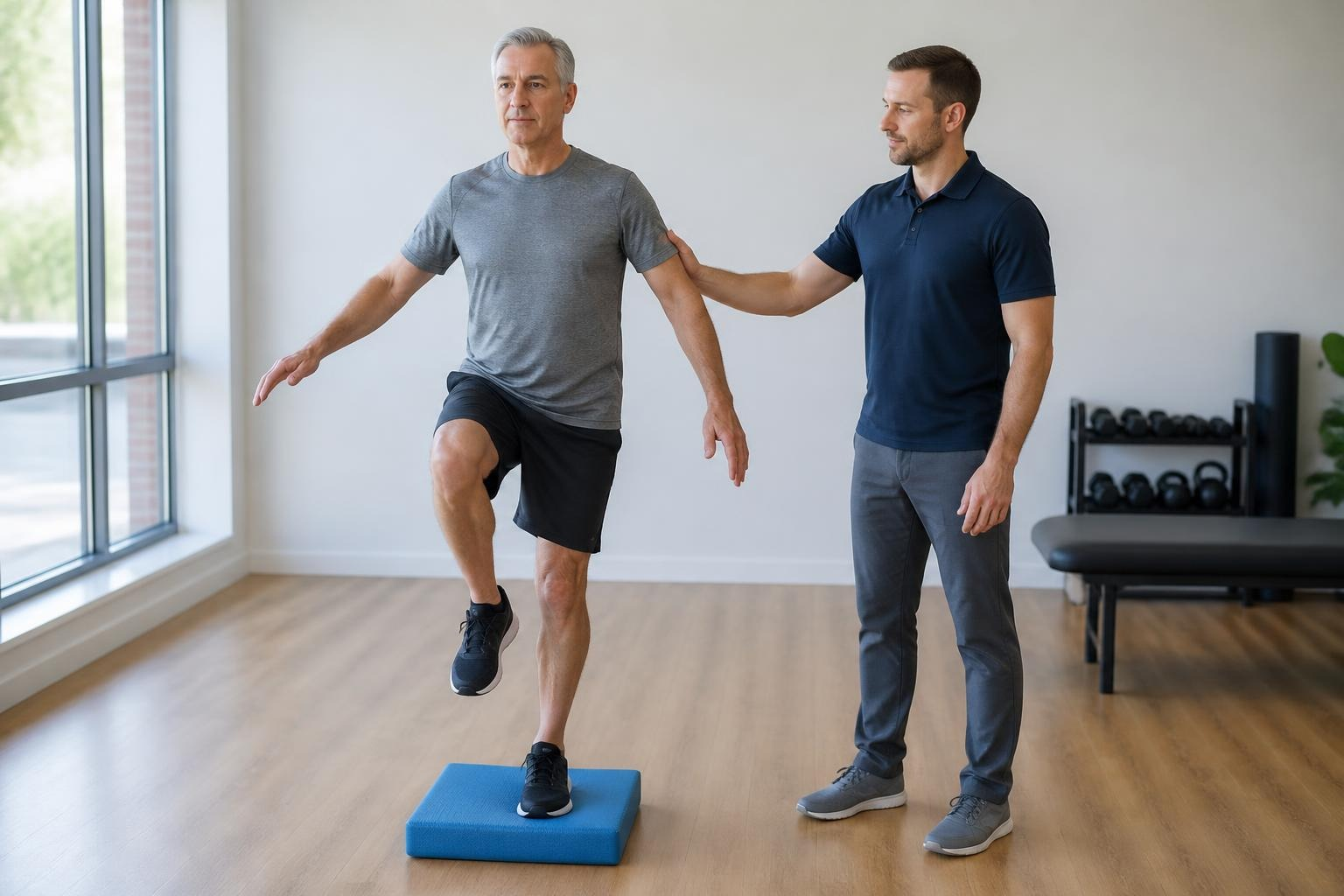
Power belongs in the same picture. A recovery step is a fast, forceful action, so quick stepping, rapid weight shifts, and short bursts of force production support the reaction once control is in place. Performance then puts the response into the contexts that matter: uneven trails for a hiker, crowded sidewalks for a commuter, change of direction for a field athlete.
The Physiokinetix perspective
Physiokinetix organizes training through four levels: Mobility, Stability, Power, and Performance. Mobility gives the body options for movement. Stability is the ability to control movement, including balance and the ability to manage a position while moving. Power develops greater force and rate of force. Performance applies those capacities to real activities. The levels are progressive, but they are not a fixed sequence that every person must follow in the same way. Reactive balance draws on all four. It needs range at the ankle and hip, it is a form of stability under disturbance, it depends on producing force quickly, and it matters most in real settings.
Within PKT, the idea of Rescue Strategies addresses this directly. Rescue Strategies is framework language for what happens when movement goes wrong: a loss of balance, a near fall, an unexpected load. Rather than building a system around avoiding every disruption, the aim is a body and nervous system that can respond when one arrives. The perturbation research gives that principle a clear evidence base. Practicing controlled disruption improves the response to real disruption, especially when the practice is sufficient in amount and varied in kind.
Table Neuro Training, the flagship PKT professional workshop, was developed to complement the Mobility and Stability levels of PKT Self-Care. It teaches practitioners to use the table as a place where hands-on input is combined with active movement and sensory input, which is how we prepare the ankle, hip, and trunk before a client stands up to work. The reactive work itself happens on the floor, and it extends naturally into Power and Performance. Between sessions, PKT Self-Care gives clients practical ways to keep developing steady balance and control at home, while the larger perturbations stay in supervised sessions, consistent with the larger effects seen under supervision.
Conclusion
Reactive balance is the capacity to recover after the body has already been disturbed, and it responds to training that reproduces disturbance. Meta-analyses from 2015 to 2026 show that perturbation-based training improves recovery reactions and reduces falls in older adults, with low certainty, high variability between protocols, more minor adverse events than conventional training, and the clearest fall benefit at higher cumulative doses. Within our approach, we prepare the ankles, hips, and trunk through hands-on work and active movement, build steady control, introduce graded and varied perturbations under supervision, and connect the response to the speed and real tasks it serves. The goal is a body that is better prepared for the moments that cannot be planned.
References
- Bohm S, Mademli L, Mersmann F, Arampatzis A. Predictive and reactive locomotor adaptability in healthy elderly: a systematic review and meta-analysis. Sports Medicine. 2015;45(12):1759 to 1777. https://doi.org/10.1007/s40279-015-0413-9
- Mansfield A, Wong JS, Bryce J, Knorr S, Patterson KK. Does perturbation-based balance training prevent falls? Systematic review and meta-analysis of preliminary randomized controlled trials. Phys Ther. 2015;95(5):700 to 709. https://doi.org/10.2522/ptj.20140090
- Devasahayam AJ, Farwell K, Lim B, Morton A, Fleming N, Jagroop D, et al. The effect of reactive balance training on falls in daily life: an updated systematic review and meta-analysis. Phys Ther. 2022;103(1):pzac154. https://doi.org/10.1093/ptj/pzac154
- Sharma S, Szabo IZ, Danielsen MB, Andersen S, Nørgaard JE, Lord SR, et al. Perturbation-based balance training reduces falls and fall injuries in older people: insights on mechanisms and training parameters from a systematic review. Journal of the American Medical Directors Association. 2026;27(8):106316. https://doi.org/10.1016/j.jamda.2026.106316
- Wang J, Guo S, Yang Y, Liang Y, Guo C, Cheng Y, et al. Exercise modalities for overall and domain-specific balance performance in older adults: a systematic review and Bayesian network meta-analysis. Ageing Research Reviews. 2026;121:103303. https://doi.org/10.1016/j.arr.2026.103303
- Rieger MM, Papegaaij S, Steenbrink F, van Dieën JH, Pijnappels M. Effects of perturbation-based treadmill training on balance performance, daily life gait, and falls in older adults: REACT randomized controlled trial. Phys Ther. 2024;104(1):pzad136. https://doi.org/10.1093/ptj/pzad136
- Nørgaard JE, Andersen S, Ryg J, Stevenson AJT, Andreasen J, Oliveira AS, et al. Effect of treadmill perturbation-based balance training on fall rates in community-dwelling older adults: a randomized clinical trial. JAMA Network Open. 2023;6(4):e238422. https://doi.org/10.1001/jamanetworkopen.2023.8422
- Brüll L, Hezel N, Arampatzis A, Schwenk M. Comparing the effects of two perturbation-based balance training paradigms in fall-prone older adults: a randomized controlled trial. Gerontology. 2023;69(7):910 to 922. https://doi.org/10.1159/000530167
- Nachmani H, Langer LK, Devasahayam AJ, Mansfield A. Influence of reactive balance training program characteristics on reactive balance control and fall risk: a systematic review and meta-regression. Gerontology. 2026. Online ahead of print. https://doi.org/10.1159/000552354