

Clinical context
Two people can finish a session with similar range of motion and similar strength, and one will take the stairs at home without a second thought while the other avoids them. Part of that difference can lie in what each person believes they are able to do. Psychology calls this belief self-efficacy, and in musculoskeletal pain research it is one of the psychological factors most often studied in relation to how people function over time.
At Temple Human Performance, we combine massage and osteopathic-based manual therapy with movement training and physical preparation in one plan. Confidence is not a separate module within that plan. It rises or falls with each attempt a client makes on the table, on the training floor, and at home. Self-efficacy theory explains why some attempts build confidence more than others, and the research on musculoskeletal pain shows what confidence predicts, how much it changes with exercise, and where the evidence is still unsettled.
Scientific background
Albert Bandura introduced self-efficacy theory in 1977. He separated two kinds of expectation. An outcome expectation is a person’s estimate that a behavior will lead to a certain result. An efficacy expectation is the conviction that one can successfully carry out that behavior. The two can diverge. A person can be fully convinced that walking is good for the back and still doubt being able to walk for twenty minutes, and in Bandura’s account it is the second belief that shapes behavior. Efficacy expectations influence whether a person attempts an activity at all, how much effort goes into it, and how long that effort is sustained when the activity becomes difficult.
Bandura described four sources of information from which these expectations are formed. The first, performance accomplishments, he grounded in personal mastery experience and considered especially influential: successes raise expectations, and repeated failures lower them, particularly when the failures come early. The second is vicarious experience, which comes from seeing others perform an activity without adverse consequences. Because it depends on comparison rather than direct evidence, it is less dependable, although it carries more weight when the person observed is similar to the observer and visibly succeeds through effort. The third is verbal persuasion. It is widely used because it is easy, but expectations raised by persuasion alone tend to be weaker than those built on accomplishment and can be undone by the next difficult experience. The fourth is the person’s physiological and emotional state. People read tension and anxiety as signs of vulnerability, and they are more likely to expect success when they are not braced against the task.
Bandura added several refinements that matter for movement practice. Success at an easy task provides little new information, while mastery of a challenging task is salient evidence of capability. Success credited to external aids does less for self-efficacy than success a person credits to their own skill. People who see relative progress, even with setbacks, raise their confidence more than people whose improvement has leveled off. His original work concerned fear and avoidance, and he described a sequence for building lasting confidence: use strong supportive procedures first to develop the capability, then withdraw the aids so the person can verify it, and then arrange self-directed practice to strengthen and generalize it. Gains in confidence generalize most predictably to activities similar to the ones in which they were built.
In musculoskeletal pain research, the construct is usually measured as pain self-efficacy, a person’s confidence in carrying out activities despite pain. The most common measure is the Pain Self-Efficacy Questionnaire, a 10-item scale scored from 0 to 60. Dubé and colleagues (2021) reviewed 28 studies with 9,853 participants. Test-retest reliability was high (weighted mean intraclass correlation 0.86), and the questionnaire showed only low to moderate correlations with pain, disability, anxiety, depression, and catastrophizing. Confidence is therefore related to, but distinct from, how much something hurts and how fearfully a person thinks about it. The same review reported a minimal detectable change of 11.52 points and a minimal clinically important difference of 5.5 to 8.5 points in chronic low back pain, which matters when interpreting the size of group changes.
What the research shows
The largest synthesis is a meta-analysis by Martinez-Calderon and colleagues (2020) of 60 randomized controlled trials with 12,415 people with chronic musculoskeletal pain. Exercise, psychological, and multicomponent interventions produced small improvements in pain self-efficacy at follow-ups of up to three months. Exercise and multicomponent programs still showed small effects at four to six months, and only multicomponent programs did so at seven to twelve months. No intervention improved pain self-efficacy beyond twelve months, and self-management interventions did not improve it at any follow-up. The certainty of evidence was low for every intervention, and no trial described its intervention in enough detail to allow full replication.
Gilanyi and colleagues (2023) examined exercise in adults with nonspecific chronic low back pain. Across eight pooled trials with 1,121 participants, exercise increased pain self-efficacy by 3.02 points on the 60-point questionnaire (95% confidence interval 1.72 to 4.32). The certainty was rated moderate, although every trial was at high risk of bias. That average gain sits below the 5.5 to 8.5 point range reported as clinically important in chronic low back pain, and the authors called for research on whether the effect is meaningful and whether more targeted approaches enlarge it. The fair reading is that exercise moves confidence in the right direction, but the average shift across trials is modest.
Baseline confidence also carries prognostic information. Chester and colleagues (2019) recruited 1,030 adults referred for care of musculoskeletal shoulder pain, with 810 providing data at six months. Baseline pain and disability were the strongest predictors of outcome, but high pain self-efficacy reduced the likelihood of continued pain and disability. People with low baseline pain and low pain self-efficacy had outcomes similar to people with high baseline pain and high pain self-efficacy. The authors suggested treating low pain self-efficacy as a target in its own right.
Mediation analyses ask whether a change in confidence helps explain why a program works. Cashin and colleagues (2023) analyzed a trial in which 276 people with chronic low back pain were allocated to 12 weekly sessions of education and graded sensorimotor retraining or to a sham and attention control. Pain self-efficacy was among the three largest mediators of the effect on both pain and disability, alongside beliefs about the consequences of back pain and pain catastrophizing. Schütze and colleagues (2025) analyzed the RESTORE trial, which compared cognitive functional therapy, a biopsychosocial approach, with usual care in 492 adults with disabling chronic low back pain. Earlier changes in self-efficacy, fear, catastrophizing, and pain intensity together explained up to 61 percent of the effect on disability, both at the end of treatment and at 12 months, and self-efficacy, fear, and catastrophizing explained up to 62 percent of the effect on pain. These mediators were estimated jointly, so the share belonging to self-efficacy alone is not isolated, and the authors noted that the role of movement changes still needs study.
The direction of influence is not settled. Shinohara and colleagues (2022) compared 49 people with chronic low back pain who took part in exercise with 49 propensity-matched people who did not, over three months. Gains in pain self-efficacy were correlated with reductions in pain in both groups, and in the exercise group the improvement in disability fully mediated the link between greater confidence and less pain. One interpretation is that confidence works partly through what a person then does: more confident people do more, function improves, and pain eases alongside it. The study was small and observational, so it cannot establish that sequence.
Functional significance
Three points from this research shape how we think about confidence in practice.
First, confidence is built most dependably by doing. Encouragement has a place, but Bandura placed it below personal accomplishment, and persuasion offered without the conditions for success risks a failure that undermines both the person’s confidence and the credibility of the encouragement. The practical question for any session is what the client will actually accomplish, not only what the client will be told.
Second, difficulty needs a dose. Early failures weigh heavily, yet easy successes carry little information. A useful progression starts at a level the client can complete with control and moves in steps that are challenging enough to count as evidence. Once a record of success exists, an occasional miss does less damage, and visible progress over weeks matters as much as any single session. This is where graded practice and progressive loading meet. The same progression that develops physical capacity also produces a running record of what the person has done.
Third, confidence is specific. Because it generalizes most readily to similar activities, practice needs to resemble the tasks a person wants to return to, and a general sense of being stronger may not carry over to a particular staircase, lift, or sport. Group-level gains on questionnaires are also modest and fall below the threshold of individually meaningful change, so each person’s own record of tasks completed is more informative than an average from the literature.
Application at Temple Human Performance
In our sessions, confidence is built through how the hands-on work, the movement, and the loading are sequenced rather than through a separate conversation about mindset.
Assessment includes finding out which tasks a client doubts, not only which ones hurt. A client may describe hesitating on stairs, avoiding lifting a grandchild, or putting off a return to running. We then look for a version of that task the client can complete successfully in the session, even a small one, so the first entry in the record is a success.
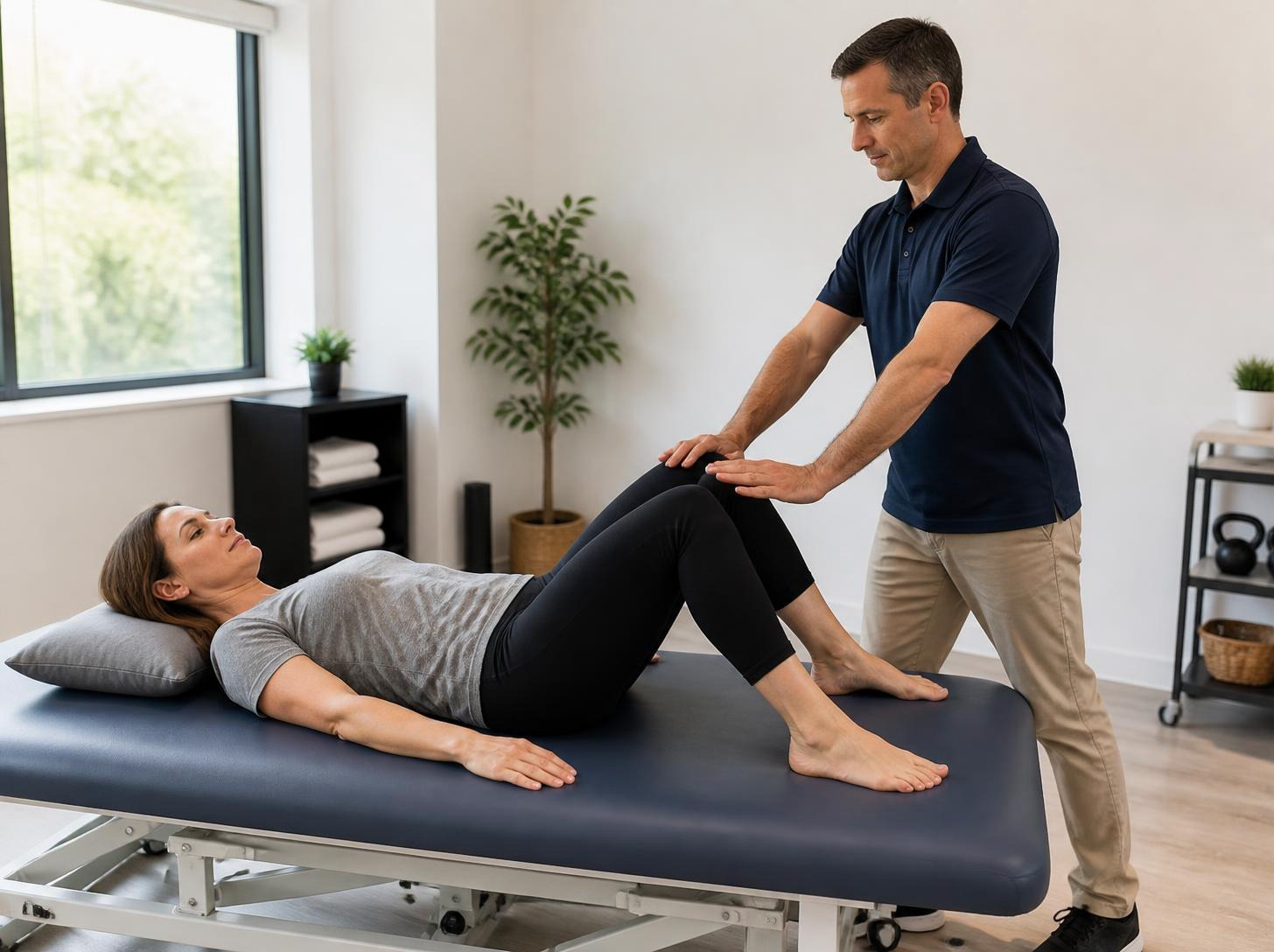
On the table, the client is an active participant. The hands-on work influences movement, comfort, and sensation, and while our hands guide and support a region the client produces the effort: pressing, holding, or moving through a range that has felt guarded. The guidance plays the part Bandura assigned to supportive aids. It makes success likely before the client can achieve it unassisted, and we reduce it as control improves so that the client experiences the movement as their own work rather than ours.
Off the table, the same reasoning sets the progression. We begin where the client can move with good control and then change one variable at a time, such as range, load, speed, or the demand on balance. When a step proves too hard, we scale back to a version the client can complete, so a difficult attempt is followed by a successful one rather than left as the last word. We also watch how a client reads their own body. Breath-holding, bracing, or a guarded expression during an attempt often signals that the task feels threatening. Slowing the movement, changing position, or reducing load until the attempt feels controlled speaks to that fourth source of confidence.
Encouragement is tied to evidence. We point to what the client has just done, such as the step completed without the rail or the extra repetitions compared with last week, rather than offering general reassurance. Seeing others in the training space work through similar progressions can add vicarious evidence, especially when those people resemble the client.
Physiokinetix perspective
Physiokinetix Training is the professional education and movement system Paul developed, and Temple Human Performance is where we apply it with clients day to day. Individuals use it through the PKT Self-Care program, and manual therapists, bodyworkers, trainers, and a wide range of healthcare and movement practitioners learn it through professional and continuing education. Physiokinetix treats movement as the product of many interacting influences. Sensory input, joint mechanics, motor control, strength, task demands, and previous movement experience all contribute, and so does a person’s confidence in what they can do.
The general logic of the system runs from assessment, to influencing the system, to active participation, to progressive loading, and then to integration into meaningful tasks. Self-efficacy theory offers one explanation for why the active steps matter. A change in comfort or range produced during hands-on work gives the client new options, and using those options under their own control is what turns the change into evidence of capability.
Progression in Physiokinetix is organized across four levels: mobility, stability, power, and performance. Mobility gives a person access to movement options. Stability is active control of movement and position. Power adds greater force production and progressive loading, and performance applies those capacities to the activities that matter to the individual. The levels build on one another without acting as a fixed protocol, and each person’s needs decide where we work on a given day. Viewed through self-efficacy theory, each level is a set of tasks that can be mastered, and success at one level supplies the evidence that makes the next feel achievable. General physical preparation, which develops broad capacities such as strength, balance, coordination, and work capacity, and specific physical preparation, which applies them to the demands of a particular activity, follow the same reasoning. Because confidence generalizes most readily to similar tasks, specific preparation is where a client gathers evidence for the activity they actually care about.
Table Neuro Training, the first and flagship Physiokinetix workshop for practitioners, was developed to complement the mobility and stability levels of the PKT Self-Care program. It teaches practitioners to use the table as a place where hands-on input is combined with active movement, which links what a client experiences in the session with what the client can continue independently.
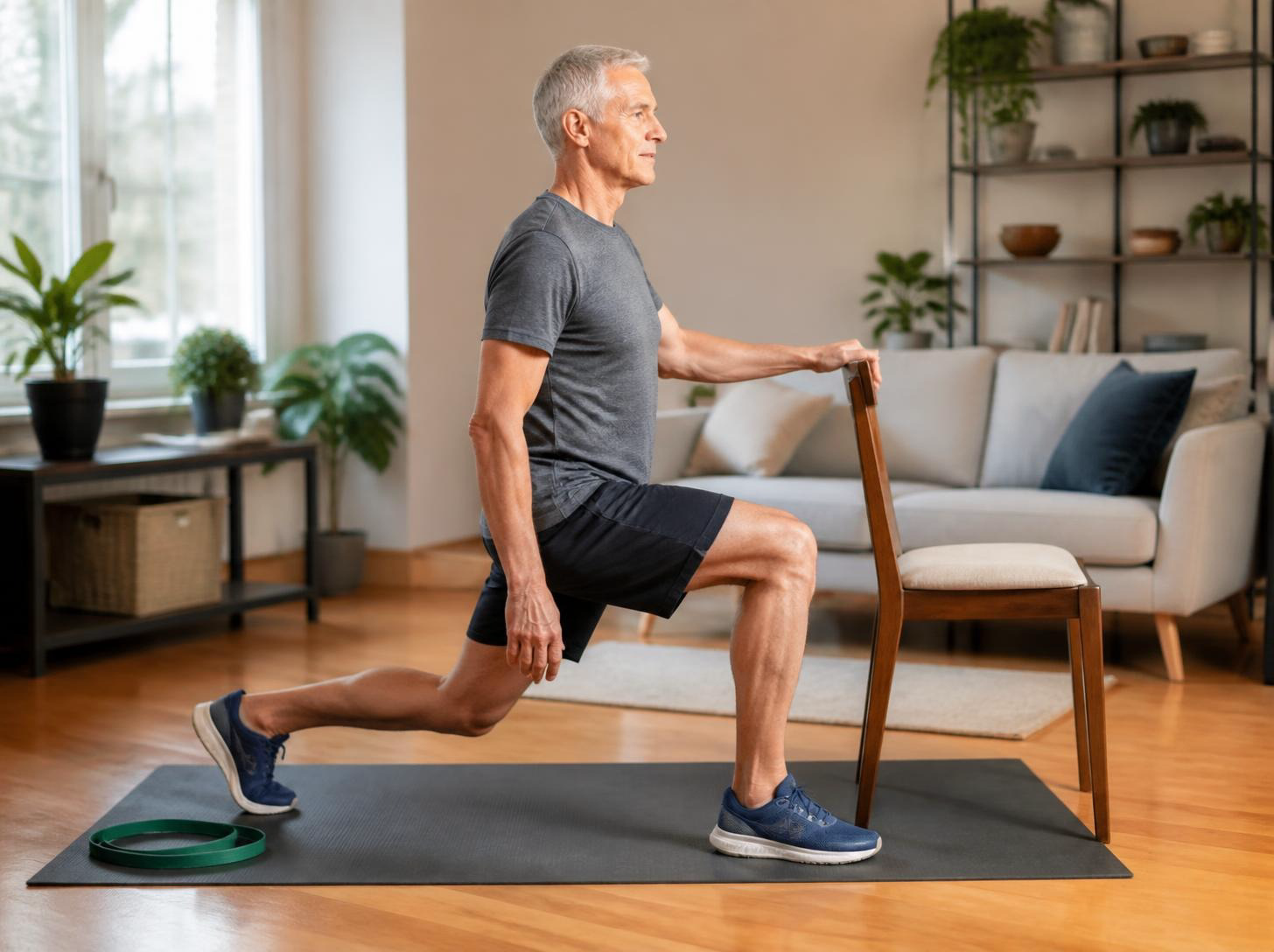
The PKT Self-Care program carries the same progression into the time between sessions, using simple tools and body positions, such as a mat and a resistance band. This mirrors the last stage of Bandura’s sequence. Once supportive aids have been withdrawn, practice the client completes independently, at home, before training, or while traveling, adds successes the client can credit to their own capability. The aim is greater independence and movement capacity rather than reliance on the session.
Conclusion
Self-efficacy is a person’s confidence in carrying out a specific task. Bandura identified four sources of that confidence and gave the greatest weight to personal accomplishment, especially success at tasks that are challenging and credited to one’s own skill. In musculoskeletal pain research, exercise and multicomponent programs raise pain self-efficacy by small amounts, baseline confidence carries prognostic information, and mediation analyses suggest that changes in confidence are part of how effective programs work. The direction of influence among confidence, function, and pain is not fully resolved.
Within our approach, these findings shape how a progression is built. Hands-on work and active effort on the table make early success possible. Graded movement and loading add a growing record of tasks completed, guidance is reduced as control improves, and practice continues independently between sessions. Confidence develops alongside capacity, drawn from the client’s own record of what they have done.
References
1. Bandura A. Self-efficacy: toward a unifying theory of behavioral change. Psychological Review. 1977;84(2):191 to 215. https://doi.org/10.1037/0033-295X.84.2.191
2. Dubé MO, Langevin P, Roy JS. Measurement properties of the Pain Self-Efficacy Questionnaire in populations with musculoskeletal disorders: a systematic review. Pain Reports. 2021;6(4):e972. https://doi.org/10.1097/PR9.0000000000000972
3. Martinez-Calderon J, Flores-Cortes M, Morales-Asencio JM, Fernandez-Sanchez M, Luque-Suarez A. Which interventions enhance pain self-efficacy in people with chronic musculoskeletal pain? A systematic review with meta-analysis of randomized controlled trials, including over 12 000 participants. J Orthop Sports Phys Ther. 2020;50(8):418 to 430. https://doi.org/10.2519/jospt.2020.9319
4. Gilanyi YL, Wewege MA, Shah B, Cashin AG, Williams CM, Davidson SRE, McAuley JH, Jones MD. Exercise increases pain self-efficacy in adults with nonspecific chronic low back pain: a systematic review and meta-analysis. J Orthop Sports Phys Ther. 2023;53(6):335 to 342. https://doi.org/10.2519/jospt.2023.11622
5. Chester R, Khondoker M, Shepstone L, Lewis JS, Jerosch-Herold C. Self-efficacy and risk of persistent shoulder pain: results of a Classification and Regression Tree (CART) analysis. British Journal of Sports Medicine. 2019;53(13):825 to 834. https://doi.org/10.1136/bjsports-2018-099450
6. Cashin AG, Lee H, Wand BM, Bagg MK, O’Hagan ET, Rizzo RRN, et al. Mechanisms of education and graded sensorimotor retraining in people with chronic low back pain: a mediation analysis. Pain. 2023;164(12):2792 to 2800. https://doi.org/10.1097/j.pain.0000000000002978
7. Schütze R, Liew B, Caneiro JP, O’Sullivan P, Kent P, Hancock M, et al. Mechanisms of change in cognitive functional therapy: a longitudinal mediation analysis of the RESTORE clinical trial for disabling chronic low back pain. Behaviour Research and Therapy. 2025;193:104853. https://doi.org/10.1016/j.brat.2025.104853
8. Shinohara Y, Wakaizumi K, Ishikawa A, Ito M, Hoshino R, Tanaka C, et al. Improvement in Disability Mediates the Effect of Self-Efficacy on Pain Relief in Chronic Low Back Pain Patients with Exercise Therapy. Pain Research and Management. 2022;2022:4203138. https://doi.org/10.1155/2022/4203138