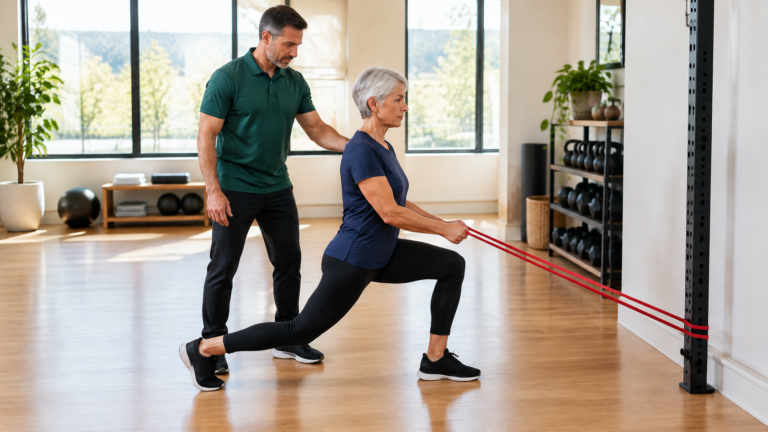
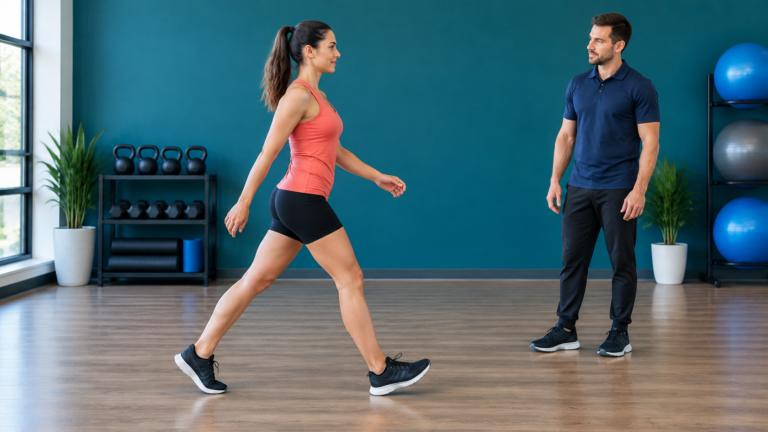
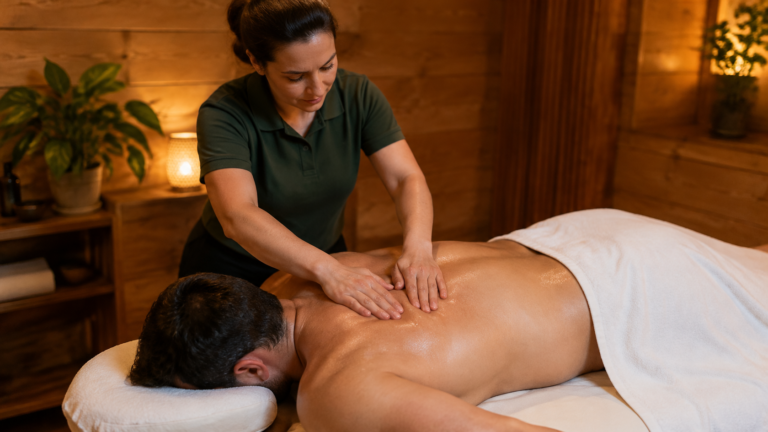
Most of a session is practice. A client learns to produce force through a range that has felt guarded, to control a step down, or to keep a reach steady while holding a load. How that practice is arranged affects what the client keeps after leaving the room, not only how the movement looks while we are watching.
At Temple Human Performance, we combine massage and osteopathic-based manual therapy with movement training and physical preparation in one plan. A single session can include table work in which the client actively produces effort, unloaded movement practice, and loaded training. Each is a practice environment. Motor learning research offers three principles that shape how we arrange them: how tasks are scheduled, where attention is directed, and how often feedback is given.
Motor learning research separates two things that are easy to confuse. Acquisition is performance during practice. Learning is a relatively lasting change in capability, inferred from retention tests after a delay and from transfer tests on a related task. A practice schedule can make a session look better while leaving less behind.
Contextual interference is the interference that comes from practicing one task in the context of others. In blocked practice, one task is repeated before moving to the next, which keeps interference low. In random or interleaved practice, tasks are mixed, which raises it. The classic pattern is a paradox: high interference tends to lower performance during practice while improving retention and transfer. One explanation holds that comparing tasks produces richer processing. Another holds that switching forces the learner to rebuild the movement plan on each attempt. Both are inferences from behavior rather than measured mechanisms.
Focus of attention describes what the learner attends to while moving. An internal focus directs attention to body parts, such as the knee or the hip. An external focus directs attention to the effect of the movement, such as a target on the floor or the path of a weight. The constrained action hypothesis proposes that an internal focus encourages conscious control that interferes with more automatic coordination.
Augmented feedback is information from an outside source, either about the outcome of an attempt (knowledge of results) or about the quality of the movement (knowledge of performance). It can follow every attempt, follow a reduced schedule, arrive as a summary, or be given when the learner asks for it, which is called self-controlled feedback. The guidance hypothesis proposes that very frequent feedback helps performance during practice but encourages reliance on it, which can weaken retention once it is removed.
Czyż and colleagues published two meta-analyses on contextual interference in 2024. The first examined retention across 54 studies. High contextual interference had a medium beneficial effect overall, with a standardized mean difference (SMD) of 0.63 in their main model. The benefit was clear in laboratory settings and almost negligible in applied settings. It was large in older adults, medium in adults, and negligible and not statistically significant in young participants, who in that analysis were children and adolescents. The second meta-analysis examined transfer across 34 studies. The overall effect favored random practice (SMD 0.55). It was 0.75 and statistically significant in laboratory studies, but 0.34 and not significant in applied studies, and it was 0.12 in young participants. These limits change the meaning of the finding. Interleaving helps most in controlled tasks and in adult and older learners, and its advantage is smaller and less certain in applied practice and in young learners.
The attention literature contains a real disagreement. Chua and colleagues (2021) pooled 73 studies with 1,824 participants for performance and 40 studies with 1,274 participants for learning. An external focus outperformed an internal focus for performance (Hedges’ g 0.264), retention (g 0.583), and transfer (g 0.584), and age, health status, and skill level did not moderate these differences. Smaller analyses linked an external focus with more efficient neuromuscular processing and found a more distal external focus better than a closer one.
McKay and colleagues (2024) reanalyzed those data with robust Bayesian meta-analysis that modeled publication bias. They found moderate to strong evidence of publication bias in every analysis. After correction, the estimated effects were negligible: g 0.01 for performance, 0.15 for retention, and 0.09 for transfer. The analysis leaned toward little or no average effect, while the wide spread between studies suggested that attentional focus matters under conditions not yet identified. Their conclusion was that the effects of focus are varied and, on average, small to nil. The external focus advantage is therefore not settled. A fair reading is that the average benefit may be much smaller than earlier reviews suggested and likely depends on the task and the learner.
Feedback research does not support the idea that less is always better. Hebert and Coker (2021) gave learners knowledge of results after 25, 50, or 100 percent of 50 practice trials of a soccer overhead throw, or when learners asked for it. Retention was highest in the self-controlled and 50 percent groups, which the authors described as an inverted U-shaped effect of feedback frequency. Jimenez-Diaz and colleagues (2021) pooled 18 studies and concluded that self-controlled feedback enhances learning. Van der Veer and colleagues (2022) reviewed 13 studies of low methodological quality in children learning gross motor tasks. Evidence on accuracy was mostly conflicting or absent, with moderate evidence favoring self-controlled feedback for retention and limited evidence favoring continuous feedback for the quality of movement. The guidance hypothesis describes a real risk, but the evidence points toward moderate, well-timed feedback rather than a fixed rule.
Measurement is a further limit. Shishov and colleagues (2017) reviewed motor learning studies of upper limb training after stroke and in cerebral palsy and found that most did not assess retention or transfer, even though learning is defined by lasting change. Claims about learning are strongest when a delayed test was actually performed.
Three points from this research shape how we design practice.
First, a session should be judged by what holds after a delay. A clean set at the end of a session shows acquisition. Returning to the same task at the start of the next session, before any cueing, shows something closer to retention.
Second, variation has a dose and a timing. Because the benefit of interleaving is smaller in applied settings and in young learners, we do not treat it as automatic. When a movement is still being organized, more blocked repetition and clearer guidance make sense. Interleaving becomes useful once the client can produce the basic movement.
Third, cues and feedback should fit the learner and the task. Given the disagreement over attentional focus, an external cue is a reasonable default rather than a guarantee, and an internal cue still has a place when a specific joint action has to be found. Gokeler and colleagues (2019) described how external focus, self-controlled practice, and contextual interference can be combined in applied training after knee ligament injury, which is close to how we think about organizing them together.
In our sessions, the table work, the active movement, and the loaded training form one practice sequence rather than three separate parts of a visit.
On the table, the client produces force while our hands guide the region. Early in a plan this is usually blocked practice: the same direction and effort, repeated, with more frequent feedback while the client is still finding the action. We use external reference points where we can, such as pressing into the therapist’s hand or moving toward a fixed point, and a more internal cue when a client needs help locating a particular joint action.
Away from the table, once the basic movement is in place, we interleave two or three related tasks or load conditions. A client might alternate a step-up, a single-leg reach to a floor target, and a split-stance hold, or perform one pattern with body weight, then with a resistance band, then with a held weight. We explain in advance that this kind of practice often looks less polished, so a less tidy set is understood as part of the process.
Feedback tapers as competence grows. We give more early, then shift to brief summaries after a short block, and we often ask how an attempt felt before offering our own view. Floor targets give the client knowledge of results without depending on our voice.
Loaded training follows the same reasoning with one adjustment. When the goal is force production, blocked sets remain useful because a consistent pattern allows load to be progressed with confidence. Variation is placed around those sets, in the skill work that connects strength to the client’s actual tasks.
Physiokinetix Training is the professional education and movement system Paul developed, and Temple Human Performance is where we apply it day to day. Its central principle is knowledge, not diagnosis: the work rests on understanding movement and load rather than labeling a condition. The general logic runs from assessment, to influencing the system, to active participation, to progressive load, and then to integration into meaningful tasks. That logic fits the motor learning findings above, because the client is not simply receiving an input but learning to organize and control movement.
Physiokinetix organizes progression in four levels: mobility, stability, power, and performance. Mobility provides movement options. Stability is the ability to actively control movement. Power introduces greater force production and progressive loading, and performance applies those capacities to meaningful activities. The levels are progressive but not a rigid protocol, and each person’s needs decide where we work. Mobility and stability work tends to carry more guidance and repetition, while power and performance work carries more variation, more external targets, and less moment-to-moment feedback.
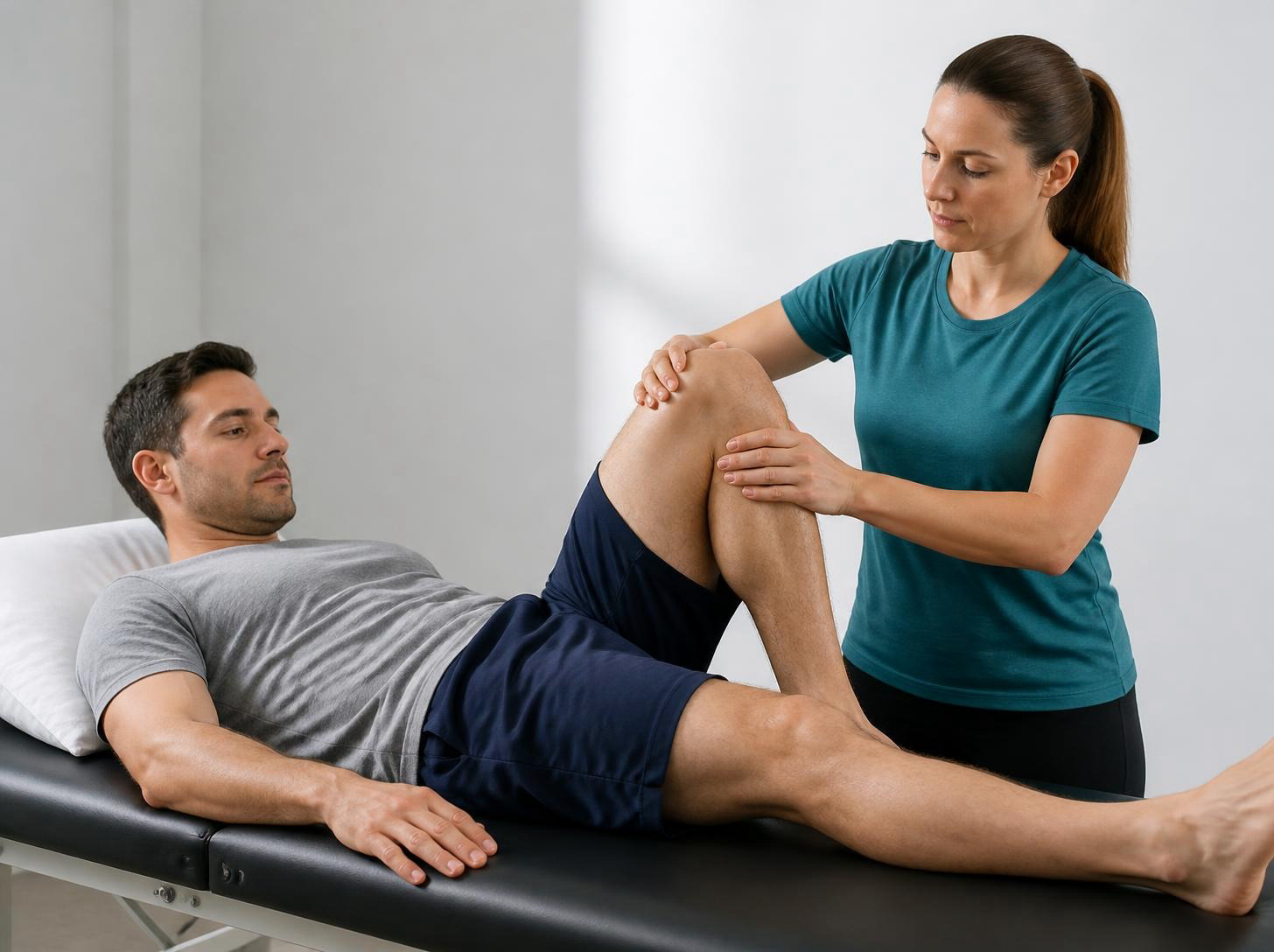
Table Neuro Training, the flagship Physiokinetix workshop for practitioners, was developed to complement the mobility and stability levels of the PKT Self-Care program. It treats the table as a place where hands-on input is combined with active neurological and movement input. The Physiokinetix cue “hold it and mold it” describes the therapist’s hands guiding the region while the client produces the force. In motor learning terms, that is guided practice early in learning: the guidance narrows the ways a movement can drift, and the client’s effort makes it practice rather than something done to the client. As control improves, we reduce our guidance in the same way we fade feedback.
General and specific physical preparedness add another lens. General preparation builds broad capacity such as strength, balance, coordination, and work capacity, and often suits blocked work. Specific preparation applies that capacity to the demands of a particular activity, occupation, or sport, which is where interleaving earns its place because transfer to the real task is the aim. The same principles carry into the PKT Self-Care program, so practice continues between sessions and builds toward greater independence rather than reliance on the session itself.
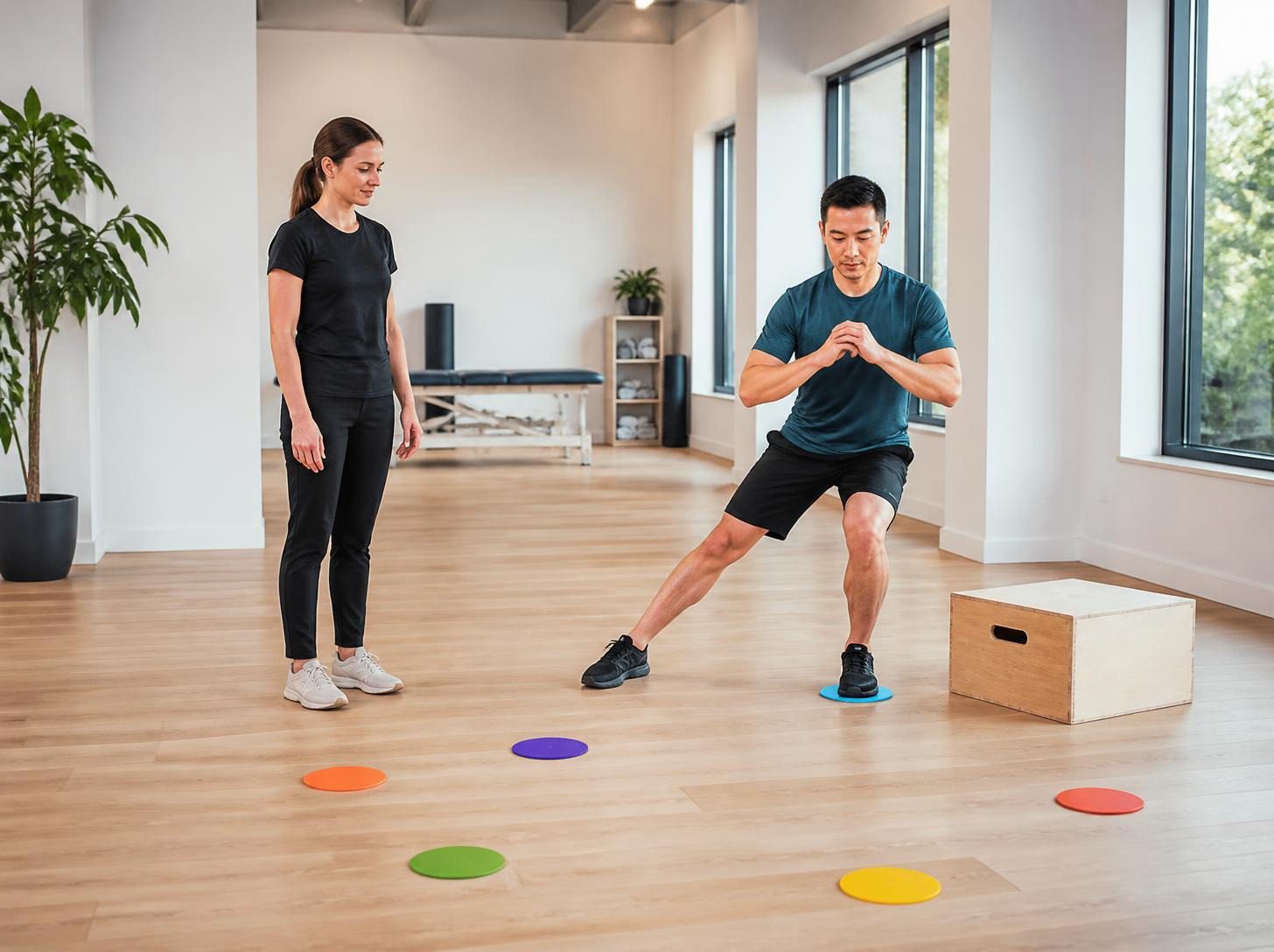
Motor learning research draws a clear line between how practice looks and what it leaves behind. Interleaved practice improves retention and transfer in many studies, with the strongest evidence in laboratory tasks and in adult and older learners. The advantage of an external focus is contested: an earlier meta-analysis reported consistent benefits, while a bias-corrected reanalysis found average effects close to zero with substantial unexplained variation. Feedback research favors moderate frequency and learner control over a rule that less is always better.
Within our approach, these findings shape the whole session. Table work, movement, and loading form one sequence. Guidance and feedback start higher and taper as control grows. Variation enters once the basic movement is in place, cues are chosen to suit the task and the person, and progress is judged by what the client can still do at the next visit.
1. Czyż SH, Wójcik AM, Solarská P, Kiper P. High contextual interference improves retention in motor learning: systematic review and meta-analysis. Scientific Reports. 2024;14:15974. https://doi.org/10.1038/s41598-024-65753-3
2. Czyż SH, Wójcik AM, Solarská P. The effect of contextual interference on transfer in motor learning: a systematic review and meta-analysis. Frontiers in Psychology. 2024;15:1377122. https://doi.org/10.3389/fpsyg.2024.1377122
3. Chua LK, Jimenez-Diaz J, Lewthwaite R, Kim T, Wulf G. Superiority of external attentional focus for motor performance and learning: systematic reviews and meta-analyses. Psychological Bulletin. 2021;147(6):618 to 645. https://doi.org/10.1037/bul0000335
4. McKay B, Corson AE, Seedu J, De Faveri CS, Hasan H, Arnold K, Adams FC, Carter MJ. Reporting bias, not external focus: a robust Bayesian meta-analysis and systematic review of the external focus of attention literature. Psychological Bulletin. 2024;150(11):1347 to 1362. https://doi.org/10.1037/bul0000451
5. Hebert EP, Coker C. Optimizing feedback frequency in motor learning: self-controlled and moderate frequency KR enhance skill acquisition. Perceptual and Motor Skills. 2021;128(5):2381 to 2397. https://doi.org/10.1177/00315125211036413
6. Jimenez-Diaz J, Chaves-Castro K, Morera-Castro M. Effect of self-controlled and regulated feedback on motor skill performance and learning: a meta-analytic study. Journal of Motor Behavior. 2021;53(3):385 to 398. https://doi.org/10.1080/00222895.2020.1782825
7. van der Veer IPA, Verbecque E, Rameckers EAA, Bastiaenen CHG, Klingels K. How can instructions and feedback with external focus be shaped to enhance motor learning in children? A systematic review. PLoS One. 2022;17(8):e0264873. https://doi.org/10.1371/journal.pone.0264873
8. Shishov N, Melzer I, Bar-Haim S. Frontiers in Human Neuroscience. 2017;11:82. https://doi.org/10.3389/fnhum.2017.00082
9. Gokeler A, Neuhaus D, Benjaminse A, Grooms DR, Baumeister J. Principles of motor learning to support neuroplasticity after ACL injury: implications for optimizing performance and reducing risk of second ACL injury. Sports Medicine. 2019;49(6):853 to 865. https://doi.org/10.1007/s40279-019-01058-0