

A resistance band is one of the simplest tools in a Physiokinetix session and one of the most useful. It costs little, weighs almost nothing, and fits in a kitchen drawer. In skilled hands it can load a muscle, steady a hold, support a limb through a new range, and follow a client home. In Physiokinetix the band has a clear job: it lets the client do more of the mechanical work, so hands-on input on the table becomes active, loaded movement.
Can a band really load a muscle?
For years bands had a reputation as the “light” option, fine for warming up but not for real strength work. The research has moved well past that.
What is established. A 2016 meta-analysis by Aboodarda, Page, and Behm pooled studies that measured muscle activity (EMG) during similar exercises done with elastic resistance or with free weights and machines. They found no significant difference in activation of the prime movers, the opposing muscles, the helping muscles, or the stabilizers. The authors reasoned that when the external load is matched, similar strength adaptations can be expected.
Training studies point the same way. In a 12-week trial of 29 healthy middle-aged and older adults, Lima and colleagues found that elastic tubing and weight machines produced similar gains in muscle force and functional exercise capacity. A 2021 review by Iversen and colleagues summarized that bands produce similar activation to traditional equipment for single-joint exercises, and similar strength gains in people with prior training experience.
The widest view comes from a 2025 network meta-analysis by Wiedenmann and colleagues: 102 trials and 4,754 community-dwelling older adults. Every training style beat doing nothing, with moderate to large strength gains. Machines ranked highest, then free weights, then bands, then bodyweight. The authors concluded that when intensity, volume, and duration are adequate, the choice of tool can come down to preference, enjoyment, and practicality. A 2024 review by Li and colleagues (28 studies, 1,697 older participants) also reported improvements in flexibility, endurance, upper-body strength, balance, and cardiopulmonary fitness with band training.
Where bands are not the first choice. Iversen and colleagues also noted lower leg-muscle activation during squats done with bands alone compared with free weights, and they recommend conventional equipment for very heavy lower-body lifts when it is available. That fits Physiokinetix well. The band’s strength is accessible, adjustable load for most people, in most settings, most of the time.
The rising-tension profile, in plain terms
A band pulls back harder the further it stretches. At the start of a movement, when the band is slack, resistance is light. Near the end, when the band is most stretched, resistance is at its highest. Nuzzo, Pinto, and Nosaka describe band resistance as mostly linear in this way, and point out that it does not match many human strength curves and does not adjust for the fact that muscles are stronger lowering a load than lifting it.
This profile changes where the effort lands, but it does not automatically make a muscle work harder. Saeterbakken and colleagues added bands to heavy barbell squats. Total resistance went up in the harder and upper parts of the lift (105% and 113% of the plain barbell load), yet measured muscle activity did not increase.
Practical inference. Rising tension is a way to shape an exercise, not a better form of load. It suits movements where people are strongest near the finish, like standing up out of a squat or pressing a band out in front of the chest. Where the end of the range is the weakest or least familiar spot for a client, a lighter band, a shorter stretch, or a different anchor point keeps the load manageable.
Bands on the table
In Physiokinetix, the table often serves as a controlled place to add active, client-generated input to manual work. That kind of active table work shows up in several Physiokinetix courses and is central to Table Neuro Training (TNT), the flagship professional workshop, built to complement the Mobility and Stability levels of the PKT Self-Care program. Bands make it practical in several ways:
- Isometric holds. The client presses into a band and holds while the therapist adds manual input around the region or cues position.
- Controlled concentric and eccentric work. With the band anchored to the table or held by the therapist, the client moves out against the band and returns slowly, the same “hold it and mold it” sequence taught throughout Physiokinetix.
- Active-assisted movement. A band can carry part of a limb’s weight so the client can move through a range they cannot yet control under full load, then take more of the load as control improves.
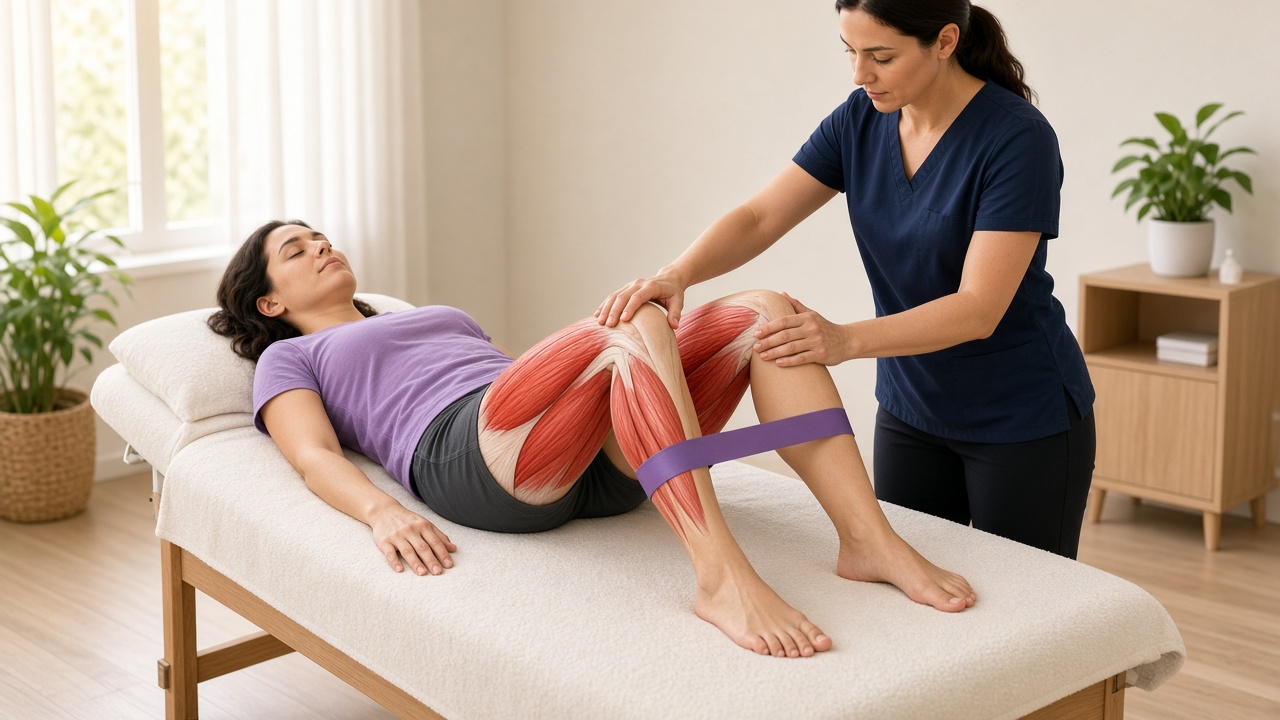
Practical observation. When a therapist supplies all the resistance by hand, the therapist’s own body does much of the work, and the dose can drift as the therapist tires. Anchoring a band shifts that work to the client and frees the therapist’s hands to guide, cue, and feel how the movement is organized. This is an ergonomic and teaching observation from practice, not a measured outcome in trials.
Evidence status. The research on band training as a whole is strong. Trials that isolate band-resisted isometrics or band-assisted movement specifically are fewer, so these table applications rest on well-established loading principles and the mechanics of the band rather than on dedicated studies.
Progressing load, from table to standing
Bands progress through simple levers: a thicker band, a longer stretch or farther anchor, a different grip, more sets or repetitions, a slower lowering phase, or a longer hold. Because a band has no number stamped on the load, Iversen and colleagues suggest guiding intensity by effort, using a rating-of-perceived-exertion scale or “reps in reserve” (how many more clean repetitions you could have done).
A 2018 randomized trial by Iversen and colleagues, run in a multidisciplinary rehabilitation setting, showed that a band program can be progressed systematically over 12 weeks and continued at home. It was not better than general exercise in that trial. The lesson for Physiokinetix students is useful: the band is a delivery system for progressive load, and the progression and consistency matter more than the tool.
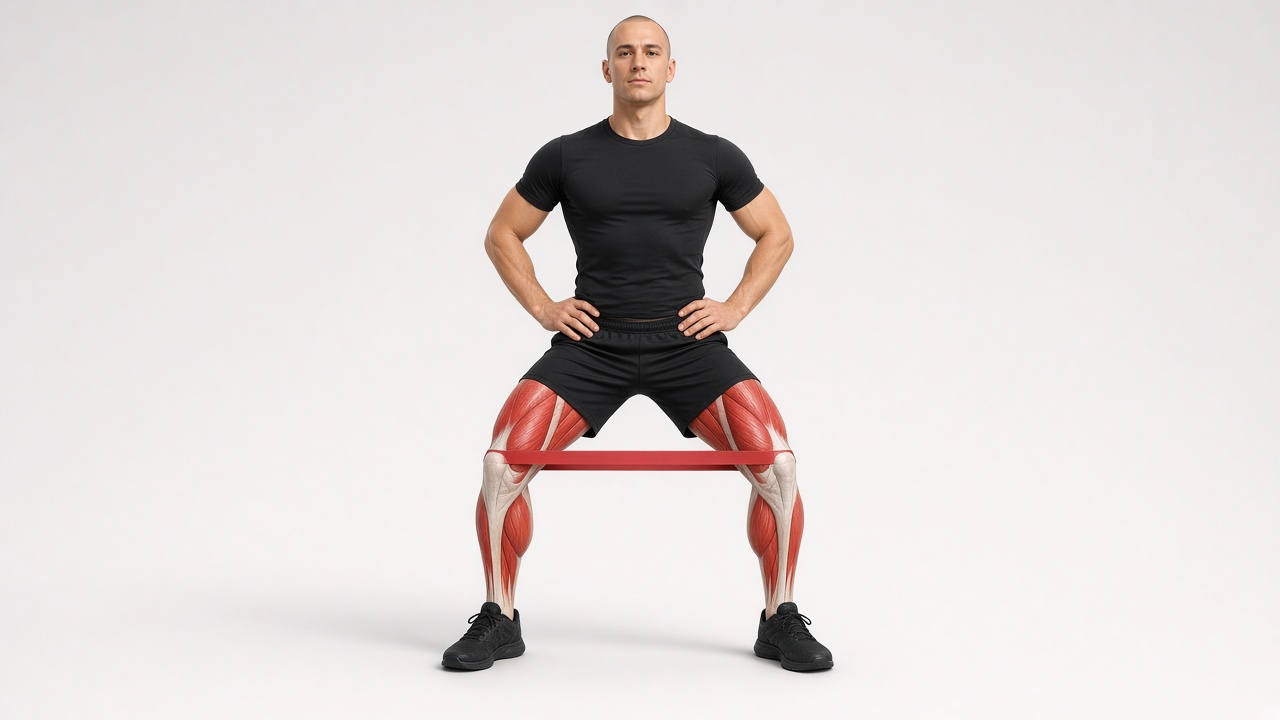
In Physiokinetix this progression follows Mobility, Stability, Power, Performance as a practical guide rather than a rigid ladder. A client might start with a band-resisted hold on the table, move to a standing band row or a lateral band walk, then build toward faster, more complex, activity-specific patterns. That is table-to-movement transfer, one of the core ideas of the method.
Home work that actually happens
Bands travel well: a gym bag, a carry-on, a desk drawer. Portability helps, but a band left in a drawer does not train anyone.
In the Li review, one feasibility study of unsupervised band training found that few participants reached the target training dose. Nuzzo and colleagues note that the modest strength effects sometimes seen with band and bodyweight programs in older adults have been attributed to low loads, low effort, and little supervision. A meta-analysis of band programs for frail older adults by Daryanti Saragih and colleagues found no significant change in grip or leg strength at any time point, a reminder that dose and duration matter.
Practical inference. The home program works best when it is short, specific, taught in session, checked for form, set at a clear effort level, and reviewed at the next visit. At Temple Human Performance, clients leave with a few band exercises they have already practiced on the table and on their feet. In the Physiokinetix program, students learn to write, dose, and progress those routines.
What is established, what is inference, what is still open
- Established: with matched load, bands produce muscle activation comparable to free weights and machines; band training builds meaningful strength across many populations; resistance rises as the band stretches.
- Practical inference: bands let the client own more of the work on the table; rising tension can be matched to movements that are strongest near the finish; supervised, well-dosed home routines are more likely to reach a useful training dose.
- Observation: anchoring a band reduces the therapist’s physical load and frees the hands for guidance.
- Still open: dedicated trials of band isometrics and band-assisted movement; how best to measure and progress band load precisely between sessions.
Scope
Temple Human Performance sessions are massage and manual therapy combined with movement and load. They are not physical therapy, chiropractic, or medical care, and they do not diagnose or treat disease. Anyone managing a medical condition should work with their healthcare provider alongside their sessions. Physiokinetix reaches individuals through the PKT Self-Care program and offers professional and continuing education for massage therapists, bodyworkers, trainers, and a wide range of healthcare and movement practitioners, who apply it within their own scope.
Closing
A band will never replace skilled hands or a well-built barbell program, and it does not need to. It lets the client take over more of the work, turns a table position into a loaded pattern, and carries that pattern home. In Physiokinetix, that is exactly the job: manual input, active participation, progressive load, and movement that belongs to the client.
Images in this post are educational illustrations.
References
- Aboodarda SJ, Page PA, Behm DG. Muscle activation comparisons between elastic and isoinertial resistance: a meta-analysis. Clinical Biomechanics. 2016;39:52-61. doi:10.1016/j.clinbiomech.2016.09.008 (PMID 27681867)
- Lima FF, Camillo CA, Gobbo LA, et al. Resistance training using low cost elastic tubing is equally effective to conventional weight machines in middle-aged to older healthy adults: a quasi-randomized controlled clinical trial. Journal of Sports Science & Medicine. 2018;17(1):153-160. No DOI; PMID 29535589, PMCID PMC5844202
- Iversen VM, Norum M, Schoenfeld BJ, Fimland MS. No time to lift? Designing time-efficient training programs for strength and hypertrophy: a narrative review. Sports Medicine. 2021;51(10):2079-2095. doi:10.1007/s40279-021-01490-1 (PMID 34125411)
- Wiedenmann T, Held S, Morat T, et al. The effects of different resistance training modalities on muscle strength in community-dwelling older adults: a network meta-analysis. Gerontology. 2025;71(7):576-588. doi:10.1159/000546346 (PMID 40452461)
- Li A, Sun Y, Li M, Wang D, Ma X. Effects of elastic band resistance training on the physical and mental health of elderly individuals: a mixed methods systematic review. PLoS One. 2024;19(5):e0303372. doi:10.1371/journal.pone.0303372 (PMID 38739588)
- Nuzzo JL, Pinto MD, Nosaka K. Connective adaptive resistance exercise (CARE) machines for accentuated eccentric and eccentric-only exercise: introduction to an emerging concept. Sports Medicine. 2023;53(7):1287-1300. doi:10.1007/s40279-023-01842-z (PMID 37097413)
- Saeterbakken AH, Andersen V, van den Tillaar R. Comparison of kinematics and muscle activation in free-weight back squat with and without elastic bands. Journal of Strength and Conditioning Research. 2016;30(4):945-952. doi:10.1519/JSC.0000000000001178 (PMID 26349045)
- Iversen VM, Vasseljen O, Mork PJ, et al. Resistance band training or general exercise in multidisciplinary rehabilitation of low back pain? A randomized trial. Scandinavian Journal of Medicine & Science in Sports. 2018;28(9):2074-2083. doi:10.1111/sms.13091 (PMID 29603805)
- Daryanti Saragih I, Yang YP, Saragih IS, Batubara SO, Lin CJ. Effects of resistance bands exercise for frail older adults: a systematic review and meta-analysis of randomised controlled studies. Journal of Clinical Nursing. 2022;31(1-2):43-61. doi:10.1111/jocn.15950 (PMID 34289511)