

A person can get genuinely stronger and still feel unsteady on the one movement they care about. The stairs. The reach to a shelf. The path down to the floor and back up. That gap is not a sign that the strength work failed. It is how adaptation works. The largest gain shows up in the task that was practiced. A smaller gain, still a real one, carries over to a related task that was not. Physiokinetix is built on both halves of that fact. We build broad capacity first, on the table and off it. Then we practice the actual movement the client needs. Two supporting ideas describe that order: general physical preparation, which builds broad capacity, and specific physical preparation, which applies it to a particular activity, job, or sport.
The practiced task keeps most of the gain
What is established. Two large reviews, asking slightly different questions, land in the same place.
Spitz and colleagues pooled 12 studies of healthy adults who lifted in the ordinary way and were tested twice: on the lift itself, and on a different device that still used the trained muscles, either an isometric hold or an isokinetic machine. Strength rose on both. The gain on the practiced lift was about twice the gain on the test they had not practiced. The carryover was smaller, and it was still clearly greater than doing no training.
Saeterbakken and colleagues looked wider: 43 studies, 1,660 healthy people from 16 to 60 years old, and 72 programs. Dynamic lifting improved dynamic strength. The same programs improved an isometric test the participants had not trained, and that transfer was real, but the practiced gain was about twice as large. People new to resistance training gained the most on both tests. People with more than six months of lifting experience gained the least on both. Whatever the training background, the practiced gain stayed more than twice as large as the carryover. Muscle growth and changes in recorded muscle activity did not predict either result.
Practical inference. A general strength base is worth building because some of it travels. It does not stand in for the movement you want to improve. If the goal is a particular task, that task has to show up in the practice.
What has to match
Specificity is not one switch. The closer the practice is to the test, the more of the gain you keep.
What is established. Blazevich and colleagues looked at how fast force rises on an isometric test. Training that resembled the test improved that peak rate. Training that did not resemble the test did not show a clear effect. Faster movements helped, and so did a slower lift done with a clear intent to produce force quickly.
Speed is not a bonus on every scoreboard. Davies and colleagues compared fast lifting with moderate-to-slow lifting, intensity and volume matched, and measured ordinary dynamic strength. Gains were similar in novices and experienced lifters, and in younger and older adults. Fast work matters when the quality you want is speed, not as an automatic upgrade to every strength score.
Range is simpler. Pallares and colleagues found that full-range training produced greater strength gains than partial-range training, and greater muscle growth in the lower limbs. A 2026 American College of Sports Medicine position stand, reviewing prescription research in healthy adults, draws a line from the other direction. Compared head to head, contraction type did not change the size of the overall strength gain. Stressing one phase of a lift does not replace practicing the task.
Young’s 2006 review used sprinting as the example. Two-legged vertical work, such as squats and jump squats, transferred little. Plyometrics that were one-legged and moved the body horizontally transferred much more to sprint acceleration. Young still keeps general strength work in the plan: potentially useful for adding body mass, lowering soft-tissue injury risk, and building core stability. The best transfer still needs practice aimed at the performance itself.
Swinton and colleagues modeled hundreds of resistance-training studies in healthy adults. The largest improvements were in maximum strength, especially when the test resembled the trained lift. Jumping and power improved less. Sprinting improved least. Much of that training is two-legged and vertical. Sprinting is one-legged, brief, and more horizontal. That gap is a reason to practice the sprint, or the stairs, or the reach. It is not a reason to skip the base.
A shared gain, and a larger specific one
What is established. The carryover is not only a sport finding. Pagan and colleagues assigned thirty older adults, average age 71, to six weeks of supervised training, twice a week. One group used free weights and machines. The other practiced everyday patterns, standing from a chair, a short walk, and a timed up-and-go, in a weighted vest. The gym-style group gained about two to three times as much on the trap-bar deadlift, leg press, and leg extension. The vest group improved comfortable walking speed and the timed up-and-go more, which were among the patterns they practiced. Both groups improved an isometric knee extension they had not trained as an exercise, and both increased muscle size. Some of the adaptation was shared. The biggest piece followed the task.
General preparation, then the movement itself
Practical inference. General and specific work cooperate rather than compete. In Physiokinetix both serve the larger progression of mobility, stability, power, and performance, which moves forward in stages but adjusts to what each person needs.
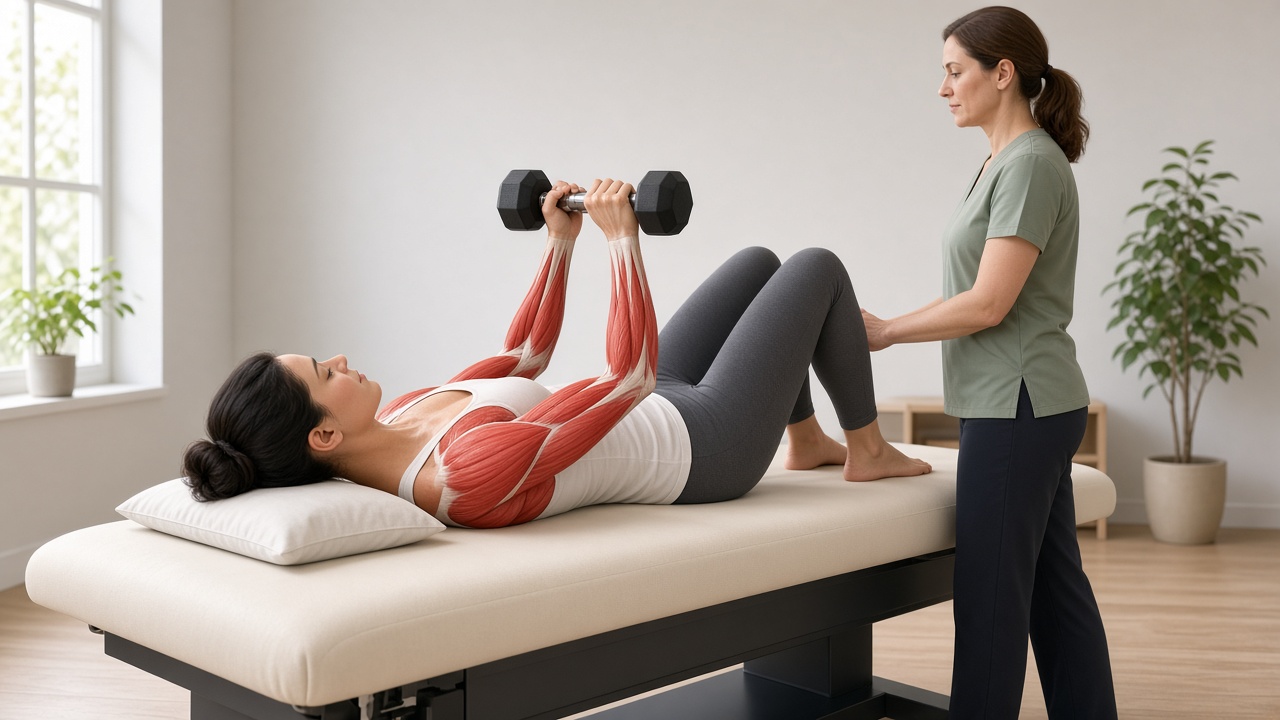
General physical preparation is the broad work: strength, endurance, balance, coordination, mobility, and overall work capacity. On the table, a client can be supported and loaded in a simple pattern. The therapist’s hands guide the region. The client produces the force. Off the table, the same idea is a basic squat, hinge, carry, or step-up: enough to build muscle and strength without copying every detail of the day. That work transfers some, the shared piece the reviews keep finding.
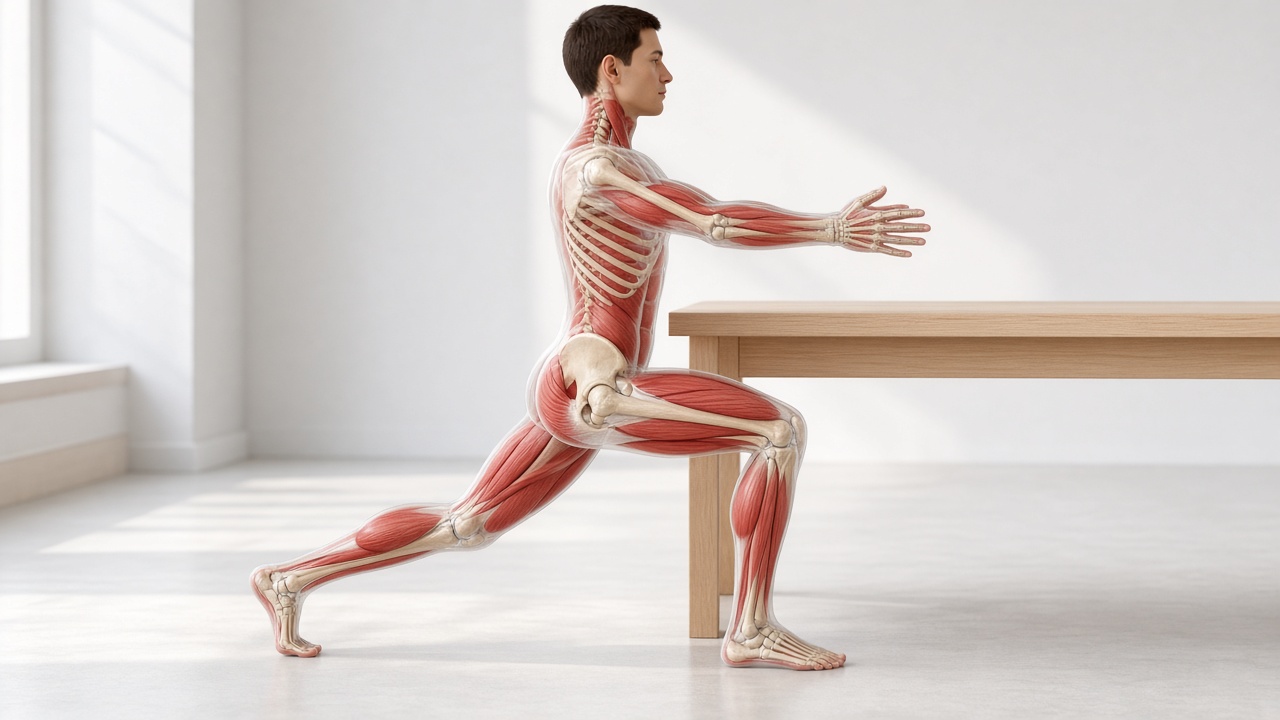
Specific physical preparation is how the rest of the gain is earned. It is practice of the movement the person came in to do, in a direction, speed, and range that resemble the real thing. A step-up, if stairs are the hard part. A lunge and a reach, if a shelf is the hard part. Keep two or three general patterns for the muscles the task needs, then spend real repetitions on a standing copy of it. Progress the general work by load. Progress the specific work by making it look more like the real task.
Observation. In a Temple Human Performance session, that handoff is the visit. General work often starts on or beside the massage table: manual input plus a simple loaded pattern. The session does not stop there. The client stands and practices the movement that belongs to their day. The strength studies were not massage sessions. They describe the reasoning we work from: a base that partly transfers, then the client’s own movement for the rest. Physiokinetix carries that reasoning into its professional and continuing education for massage therapists, bodyworkers, trainers, and other healthcare and movement practitioners, and into the PKT Self-Care program for individuals.
What is established, what is inference, what is still open
- Established: Practiced strength gains are about twice the gain on an unpracticed strength test, and that smaller gain is real. Matching the movement, training a full range, and practicing the task itself all push the result toward what was trained. A general program can still grow muscle and improve a test that was not the exercise.
- Practical inference: General physical preparation and specific physical preparation belong together. Broad capacity on and off the table, then the actual movement. Do not drop the base. Do not expect the base alone to finish the task.
- Observation: Temple Human Performance follows guided loading on or beside the table with the client’s standing task. In Physiokinetix, that general-to-specific reasoning supports the broader progression of mobility, stability, power, and performance rather than replacing it. The studies support the principle. They were not massage-table trials.
- Still open: The exact size of transfer differs between the two main reviews because the tests and the programs differ. Muscle growth and muscle activity did not explain the transfer. How much general work to do before shifting time to the specific movement has not been measured, and most of the evidence is in healthy adults. This is a teaching principle, not a medical protocol and not a promise about one person.
Scope
Temple Human Performance sessions are massage and manual therapy combined with movement and load. They are not physical therapy, chiropractic, or medical care, and they do not diagnose or treat disease. Anyone managing a medical condition should work with their healthcare provider alongside their sessions. Physiokinetix reaches individuals through the PKT Self-Care program and offers professional and continuing education for massage therapists, bodyworkers, trainers, and a wide range of healthcare and movement practitioners, who apply it within their own scope.
Closing
General training is not wasted work, and specific practice is not a replacement for a strength base. The base transfers some. The movement you want has to be practiced to get the rest. General physical preparation builds capacity on and off the table, and specific physical preparation turns that capacity toward the task itself, owned by the client.
Images in this post are educational illustrations.
References
- Spitz RW, Kataoka R, Dankel SJ, et al. Quantifying the generality of strength adaptation: a meta-analysis. Sports Medicine. 2023;53(3):637 to 648. doi:10.1007/s40279-022-01790-0 (PMID 36396899)
- Saeterbakken AH, Stien N, Paulsen G, et al. Task specificity of dynamic resistance training and its transferability to non-trained isometric muscle strength: a systematic review with meta-analysis. Sports Medicine. 2025;55(7):1651 to 1676. doi:10.1007/s40279-025-02225-2 (PMID 40314751)
- Blazevich AJ, Wilson CJ, Alcaraz PE, Rubio-Arias JA. Effects of resistance training movement pattern and velocity on isometric muscular rate of force development: a systematic review with meta-analysis and meta-regression. Sports Medicine. 2020;50(5):943 to 963. doi:10.1007/s40279-019-01239-x (PMID 32034703)
- Davies TB, Kuang K, Orr R, Halaki M, Hackett D. Effect of movement velocity during resistance training on dynamic muscular strength: a systematic review and meta-analysis. Sports Medicine. 2017;47(8):1603 to 1617. doi:10.1007/s40279-017-0676-4 (PMID 28105573)
- Pallarés JG, Hernández-Belmonte A, Martínez-Cava A, Vetrovsky T, Steffl M, Courel-Ibáñez J. Effects of range of motion on resistance training adaptations: a systematic review and meta-analysis. Scandinavian Journal of Medicine & Science in Sports. 2021;31(10):1866 to 1881. doi:10.1111/sms.14006 (PMID 34170576)
- Currier BS, D’Souza AC, Singh MAF, et al. American College of Sports Medicine position stand. Resistance training prescription for muscle function, hypertrophy, and physical performance in healthy adults: an overview of reviews. Medicine & Science in Sports & Exercise. 2026;58(4):851 to 872. doi:10.1249/MSS.0000000000003897 (PMID 41843416)
- Young WB. Transfer of strength and power training to sports performance. International Journal of Sports Physiology and Performance. 2006;1(2):74 to 83. doi:10.1123/ijspp.1.2.74 (PMID 19114741)
- Swinton PA, Schoenfeld BJ, Murphy A. Dose-response modelling of resistance exercise across outcome domains in strength and conditioning: a meta-analysis. Sports Medicine. 2024;54(6):1579 to 1594. doi:10.1007/s40279-024-02006-3 (PMID 38652410)
- Pagan JI, Bradshaw BA, Bejte B, et al. Task-specific resistance training adaptations in older adults: comparing traditional and functional exercise interventions. Frontiers in Aging. 2024;5:1335534. doi:10.3389/fragi.2024.1335534 (PMID 38746477)