

Clinical context
Hard training leaves a footprint. In the hours after a demanding strength or endurance session, force output drops, jumps get lower, and muscles start to ache, and how quickly those changes settle shapes how well a person can train, work, and move the next day. Recovery is part of the training process itself, not a pause between sessions, which is why sport science has spent years testing what helps the body come back from a hard effort.
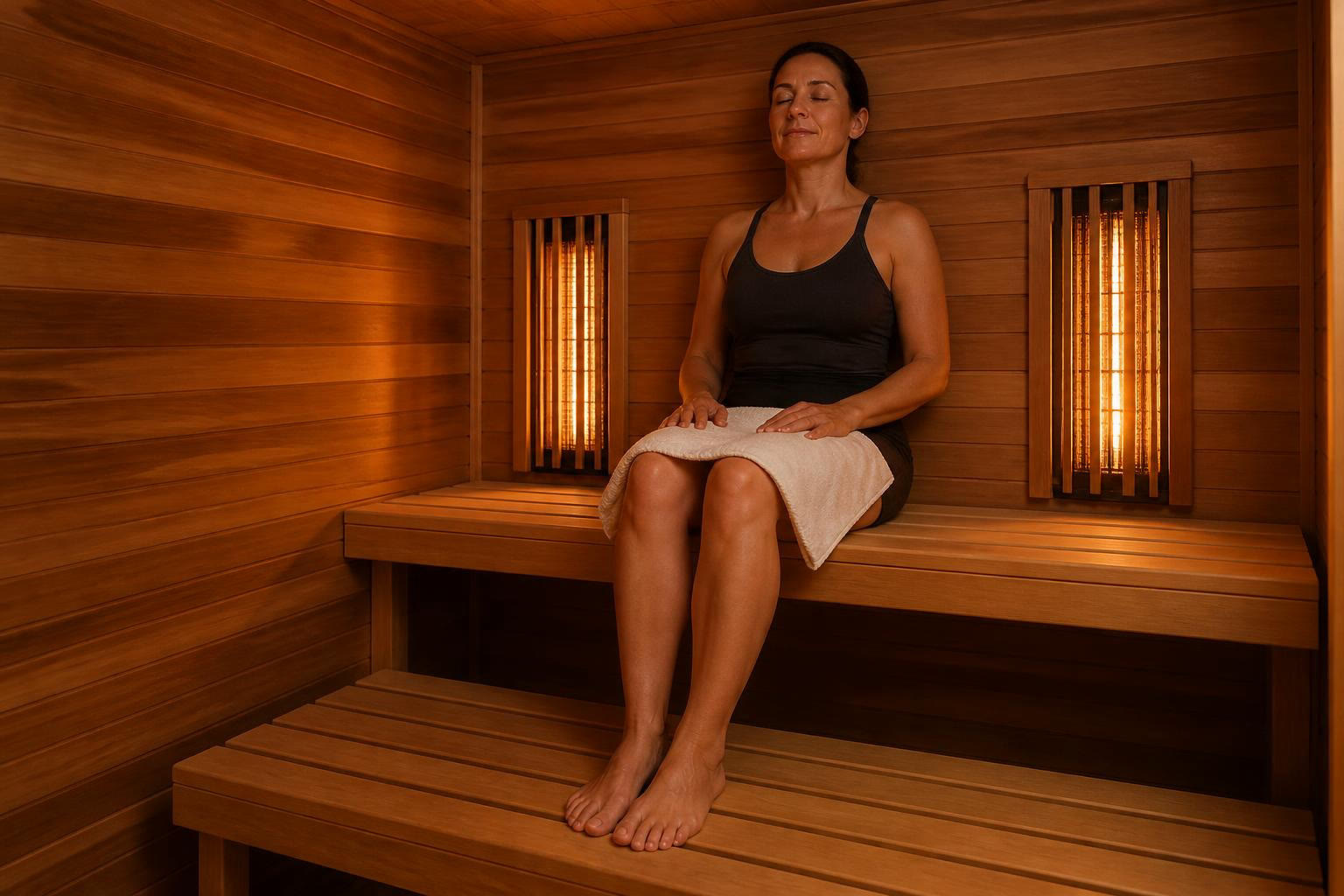
Heat is one of the oldest tools in that search. At Temple Human Performance, massage and osteopathic-based manual therapy, movement training, and physical preparation work together as one treatment-and-training approach, and our recovery technology, including the far infrared sauna, is used alongside that work rather than in place of it. This article looks at what far infrared sauna is, what controlled studies report about using it after strength and endurance training, what the research shows about comfort and tolerance, and how we fit it into the same plan as the table work and the training.
Scientific background
Infrared radiation sits just beyond the red end of visible light, and far infrared refers to its longer wavelengths. It is felt as radiant warmth, the same kind of heat that comes off sunlit stone. A far infrared sauna uses heater panels that emit this radiation, so much of the warming reaches the body directly rather than coming only from very hot air. A traditional Finnish sauna works the other way, heating the air in the room and relying on that air, and often added steam, to warm the bather.
That difference changes the experience. In the studies below, the infrared cabins ran at air temperatures of about 35 to 50°C, and the radiant heat still reached muscle. Reed and colleagues (2025) placed temperature probes at three depths in the thigh muscles of 10 adults during a 45-minute far infrared sauna session. Muscle temperature rose by 3.0°C at 1.4 cm below the skin, 1.9°C at 2.4 cm, and 1.1°C at 3.4 cm, with the warming greatest closest to the surface. Core temperature did not change, while mean skin temperature rose by 6.2°C. In other words, the session warmed the skin and the muscle beneath it without raising the body’s internal temperature.
Muscle temperature matters for movement. As Reed and colleagues note, increases in muscle temperature during exercise and during passive heating are associated with beneficial outcomes, which is part of why a thorough warm-up comes before the first heavy set. The research question for recovery is whether bringing that warmth to the body after training helps it bounce back.
What the research shows
Mero and colleagues (2015) studied far infrared sauna directly after training. Ten healthy, physically active men completed either a 60-minute strength session aimed at muscle growth or a 34 to 40 minute maximal endurance session, followed by 30 minutes in a far infrared sauna at 35 to 50°C and 25 to 35 percent humidity, or 30 minutes of sitting with no sauna. Both sessions produced the expected acute changes, including lower force and jump height after the strength session. After the strength session, recovery measures did not differ between sauna and no sauna. After the maximal endurance session, countermovement jump height 30 minutes into recovery was higher after the far infrared sauna (0.34 m) than after sitting without it (0.32 m). The researchers also compared a traditional sauna in the same temperature range with 60 to 70 percent humidity: heart rate after the session was 92 beats per minute after the traditional sauna and 71 after the far infrared sauna. The authors concluded that far infrared sauna bathing appeared favorable for neuromuscular recovery from maximal endurance performance, describing it as a very light loading for the body and a comfortable and relaxing experience.

Ahokas and colleagues (2023) tested the question after a demanding resistance session. Sixteen male basketball players completed a session of maximal strength work combined with plyometrics on two occasions one week apart, followed by either 20 minutes of passive recovery or 20 minutes in an infrared sauna at about 43°C. Performance was tested 14 hours later with a 20 m sprint, a countermovement jump, and an isometric leg press. After the sauna, the drop in countermovement jump performance from before to after exercise was smaller, muscle soreness was less severe, and perceived recovery was higher. Heart rate rose during the sauna session itself, as expected with heat, but overnight heart rate and heart rate variability did not differ between the two conditions. The authors concluded that post-exercise infrared sauna attenuated the drop in explosive performance and decreased muscle soreness, with no detrimental effects on recovery of the autonomic nervous system.
The same research group then looked at regular use over a training block (Ahokas et al., 2025). Forty female team sport athletes were pair-matched into two groups of 20 and completed six weeks of strength and power training, two to three sessions per week. One group used an infrared sauna for 10 minutes at 50°C after training three times per week. Both groups improved in performance and muscle size. For jump height and peak power in a countermovement jump with 15 percent added load, the analysis showed an interaction effect, with the sauna group reaching higher values after the six weeks than before, while the measures of muscle size showed no difference in how the two groups changed. The authors concluded that adding post-exercise infrared sauna does not significantly change hypertrophy gains but might boost long-term power production.
Comfort and tolerance have also been studied in people living with persistent joint pain and stiffness. In a pilot study by Oosterveld and colleagues (2009), 17 adults with rheumatoid arthritis and 17 with ankylosing spondylitis completed eight infrared sauna sessions over four weeks. The sessions were well tolerated, no adverse effects were reported, and disease activity scores showed no relevant change. Pain and stiffness decreased significantly during the sessions, fatigue also decreased, and participants felt comfortable on average during and especially after the sessions.
At a wider scale, Hussain and Cohen (2018) systematically reviewed research since 2000 on regular dry sauna bathing and found 40 clinical studies with a total of 3,855 participants. Outcome measures varied widely, and most studies reported beneficial health effects. The authors concluded that regular dry sauna bathing has potential health benefits.
Functional significance
Taken together, these studies describe a tool that is gentle on the body and useful at the edges of training. The clearest signal is in explosive performance: jump height held up better after far infrared sauna following maximal endurance work, the drop in jump performance after a hard resistance session was smaller with the sauna, and regular use over six weeks was linked with gains in loaded jump height and power. Soreness and the sense of being recovered also moved in a favorable direction. These are the qualities that decide whether the next session can be productive.
The comfort findings matter just as much. A recovery method only helps if a body can tolerate it and a person is willing to use it. Far infrared heat produced a lower heart rate afterward than a traditional sauna at the same temperature range with higher humidity in the Mero comparison, warmed muscle without raising core temperature in the Reed measurements, and was described as comfortable and relaxing by researchers and participants alike. People living with stiff, sore joints tolerated it well in the Oosterveld pilot, and reported less pain and stiffness during the sessions.
None of this replaces the work itself. Strength, power, and tissue tolerance are built through training and progressive loading, supported by skilled hands-on work. Recovery strategies earn their place by helping the body absorb that work and come back ready for more.
How we apply it at Temple Human Performance
Recovery is part of Repair, one of the four parts of our model alongside Educate, Perform, and Nourish. Our far infrared sauna, the full-spectrum light table, and the BEMER bed are recovery technologies, and we use them with hands-on work, not instead of it. Not every visit includes them. They come in when they fit the session and the person.
Every client starts with a history intake and a movement assessment, and health history guides whether heat belongs in the plan. When it does, we use the sauna for what it does well: radiant warmth that eases sore, stiff areas and leaves a client more comfortable after a hard day of training or a demanding session on the table. For clients in a strength or power block, a session in the sauna after training fits the pattern the research describes. For a client who arrives guarded and stiff, warmth can help the body settle so that the table work and the movement that follows go more smoothly.
That sequence reflects the way Physiokinetix, the education program I developed, thinks about change. Hands-on input can shift how a region feels and moves, but the lasting value comes when a person actively uses that change, practices it, and gradually loads it. Warmth and comfort are part of creating the conditions for that active work. A client who feels less sore and more recovered is more ready to move well, and moving well is where capacity is built. Two clients with similar soreness may use the sauna very differently, or not at all, because the plan follows the individual rather than a fixed recipe. Anything that calls for medical evaluation is referred to the appropriate provider, and we keep that line clear.
Conclusion
Controlled studies of far infrared and infrared sauna after training point in a favorable direction. A single session after maximal endurance work went with higher jump height 30 minutes later, a session after hard resistance training reduced the drop in jump performance along with muscle soreness, and regular use across a six-week strength and power block was linked with gains in loaded jump height and peak power, with muscle growth unchanged by the sauna. Far infrared heat warmed muscle without raising core temperature, produced a lower heart rate than a more humid traditional sauna in the same temperature range, and was well tolerated and comfortable in people with persistent joint pain and stiffness. A broad review of regular dry sauna bathing found that most studies reported beneficial effects. In our clinic, the sauna is one recovery tool in a single plan that joins hands-on work, training, and the habits that let the body keep its gains.
References
1. Mero A, Tornberg J, Mäntykoski M, Puurtinen R. Effects of far-infrared sauna bathing on recovery from strength and endurance training sessions in men. SpringerPlus. 2015;4:321. https://doi.org/10.1186/s40064-015-1093-5
2. Ahokas EK, Ihalainen JK, Hanstock HG, Savolainen E, Kyröläinen H. A post-exercise infrared sauna session improves recovery of neuromuscular performance and muscle soreness after resistance exercise training. Biology of Sport. 2023;40(3):681 to 689. https://doi.org/10.5114/biolsport.2023.119289
3. Ahokas EK, Hanstock HG, Kyröläinen H, Ihalainen JK. Effects of repeated use of post-exercise infrared sauna on neuromuscular performance and muscle hypertrophy. Frontiers in Sports and Active Living. 2025;7:1462901. https://doi.org/10.3389/fspor.2025.1462901
4. Reed EL, Uzoekwe CC, Atencio JK, Minson CT, Halliwill JR. Muscle temperature increases during a single far infrared sauna session without changes in intestinal temperature. Journal of Applied Physiology. 2025;138(6):1628 to 1637. https://doi.org/10.1152/japplphysiol.00067.2025
5. Oosterveld FGJ, Rasker JJ, Floors M, Landkroon R, van Rennes B, Zwijnenberg J, van de Laar MAFJ, Koel GJ. Infrared sauna in patients with rheumatoid arthritis and ankylosing spondylitis: a pilot study showing good tolerance, short-term improvement of pain and stiffness, and a trend towards long-term beneficial effects. Clinical Rheumatology. 2009;28(1):29 to 34. https://doi.org/10.1007/s10067-008-0977-y
6. Hussain J, Cohen M. Clinical effects of regular dry sauna bathing: a systematic review. Evidence-Based Complementary and Alternative Medicine. 2018;2018:1857413. https://doi.org/10.1155/2018/1857413