

Clinical context
No two steps, throws, or reaches are ever exactly the same. Even a highly practiced movement, repeated a hundred times, varies slightly in joint angles, muscle timing, and force from one repetition to the next. For a long time, this variation was treated mainly as error, something a well-trained person would gradually remove. Current motor learning research describes it differently. Variability is part of how a healthy nervous system explores options, adapts to changing conditions, and keeps the important parts of a task consistent while the details change.
At Temple Human Performance, we combine massage and osteopathic-based manual therapy with movement training and physical preparation in one integrated approach. Movement variability matters at every step of that process. The hands-on work changes the sensory and mechanical conditions a client moves with, and the training that follows gives the nervous system a chance to explore and organize movement under those new conditions. How we structure that practice, with sameness or with variation, shapes what the client learns.
Scientific background
Movement variability is the natural change in how a movement is performed across repetitions. It can be measured in the amount of variation, such as how much a joint angle differs from one trial to the next, and in its structure, meaning how the pattern of variation unfolds over time. These are different properties. A movement can be highly variable in amount yet organized in structure, or low in amount yet rigid.
The idea that skilled movement involves flexibility rather than exact copying is captured in the phrase “repetition without repetition,” associated with the movement scientist Nikolai Bernstein and used as the title of a 2020 perspective discussed below. A skilled performer reaches the same goal repeatedly, but solves the movement problem slightly differently each time. Some of the variation affects the outcome, such as where a ball lands. Much of it does not, such as the small adjustments among joints that still deliver the hand to the same place. A long-standing idea in motor control theory holds that skilled movement limits the variation that matters for the goal while allowing the variation that does not.
Variability also has a role in learning. Dhawale, Smith, and Ölveczky (2017) reviewed human and animal research and described motor variability not only as the unwanted result of a noisy nervous system but as a feature of how sensorimotor systems learn. In this view, rooted in reinforcement learning, variability is a form of exploration. Trying slightly different solutions and keeping those that work is one way the nervous system finds better movement strategies. The authors also described neural mechanisms that generate and regulate variability, which suggests the system can adjust how much it explores.
What the research shows
Expertise shapes variability, though not in a simple way. Marineau and colleagues (2024) gathered 59 studies comparing athletes of different skill levels in sports tasks. In 48 of those studies, higher-skilled athletes showed less motor variability than lower-skilled athletes, both within individuals and between them, regardless of how expertise or variability was measured. This fits the idea that skill involves narrowing the variation that affects performance. It does not mean less variability is always better, since most of these measures captured the amount of variation rather than whether the remaining variation was flexible and useful.
Ranganathan, Lee, and Newell (2020) addressed that distinction directly. They described behavioral flexibility as a hallmark of skilled performance: experts can produce a movement pattern that reliably achieves a goal and can also change that pattern to fit a new context. They argued that practice should be designed to build this flexibility, not only consistency, and that understanding the link between variability, stability, and learning is central to developing skill.
The relationship between variability and musculoskeletal injury is real but not simple. Baida and colleagues (2018) systematically reviewed studies comparing lower limb movement variability in injured and uninjured people during repetitive tasks such as running, jumping, and kicking. A significant difference between groups appeared in 73 percent of studies. Of those, 64 percent found greater variability in the injured group, which means a substantial minority found less. The trend was not consistent across injury types, and the authors called for more uniform methods and prospective research. The practical reading is that variability differing from typical levels, in either direction, can accompany injury, and that neither more nor less variability is automatically the goal. These are associations, not evidence that changing variability prevents injury.
Simply forcing more variability into practice does not guarantee better learning. Friedman, Amiaz, and Korman (2022) trained people on a finger sequence task and used audio cues to make the timing of movements either random, fixed, or self-paced. The random-timing group did show more variability during training, but they did not learn more than the self-paced group, and the fixed-timing group performed worse after training. Imposed sameness hurt learning, while imposed randomness did not help. Variability that arises from the learner’s own exploration appears to differ from variability imposed from outside.
How practice is organized changes what the nervous system does during it. Lelis-Torres and colleagues (2017) measured brain activity with electroencephalography while 21 men practiced a timed key-pressing task in either a constant schedule or a random schedule that mixed three timing goals. Random practice produced greater task engagement, reflecting sensory processing and attention, and engagement and workload declined less over practice than in the constant condition. Varied practice appears to keep the learner more involved in organizing the movement.
Attention shapes the structure of movement as well. Bauer and colleagues (2025) had 14 participants perform knee extension tasks while focusing internally, on their own muscles, or externally, on the effect of the movement. An external focus increased the complexity of torque output, meaning a less regular and more adaptable pattern of force, without changing the amount of variation or peak torque. It also reduced co-contraction of the hamstrings. The authors interpreted this as more flexible and efficient motor control. The study was small and measured immediate effects in one task, so it shows a mechanism rather than a long-term training outcome.
Functional significance
Several points from this research shape how we think about movement quality.
Variability is information, not only error. A client who moves slightly differently each time is not necessarily moving poorly. What matters is whether the goal of the movement is reached reliably and whether the person can adjust when conditions change.
Both too little and too much can be a concern. Movement that is very rigid may leave few options when the task changes, while movement that is highly erratic may not reach the goal consistently. Healthy, skilled movement sits between these.
Practice design matters. Constant, identical repetition can build consistency in one context, while varied practice and an external focus appear to keep the learner engaged and support more flexible control. Imposing randomness for its own sake is less useful than giving the learner a goal and room to find solutions.
Application at Temple Human Performance
When we assess movement, we look at both consistency and adaptability. We watch whether a client can repeat a squat, a step, or a reach to the same goal, and then we change the conditions slightly: a different height, direction, speed, or surface. A person who reaches the goal reliably but can also adjust to small changes shows the kind of flexibility the research describes. A person who can do only one version of the movement, or who cannot reach the goal consistently, shows us where practice can help.
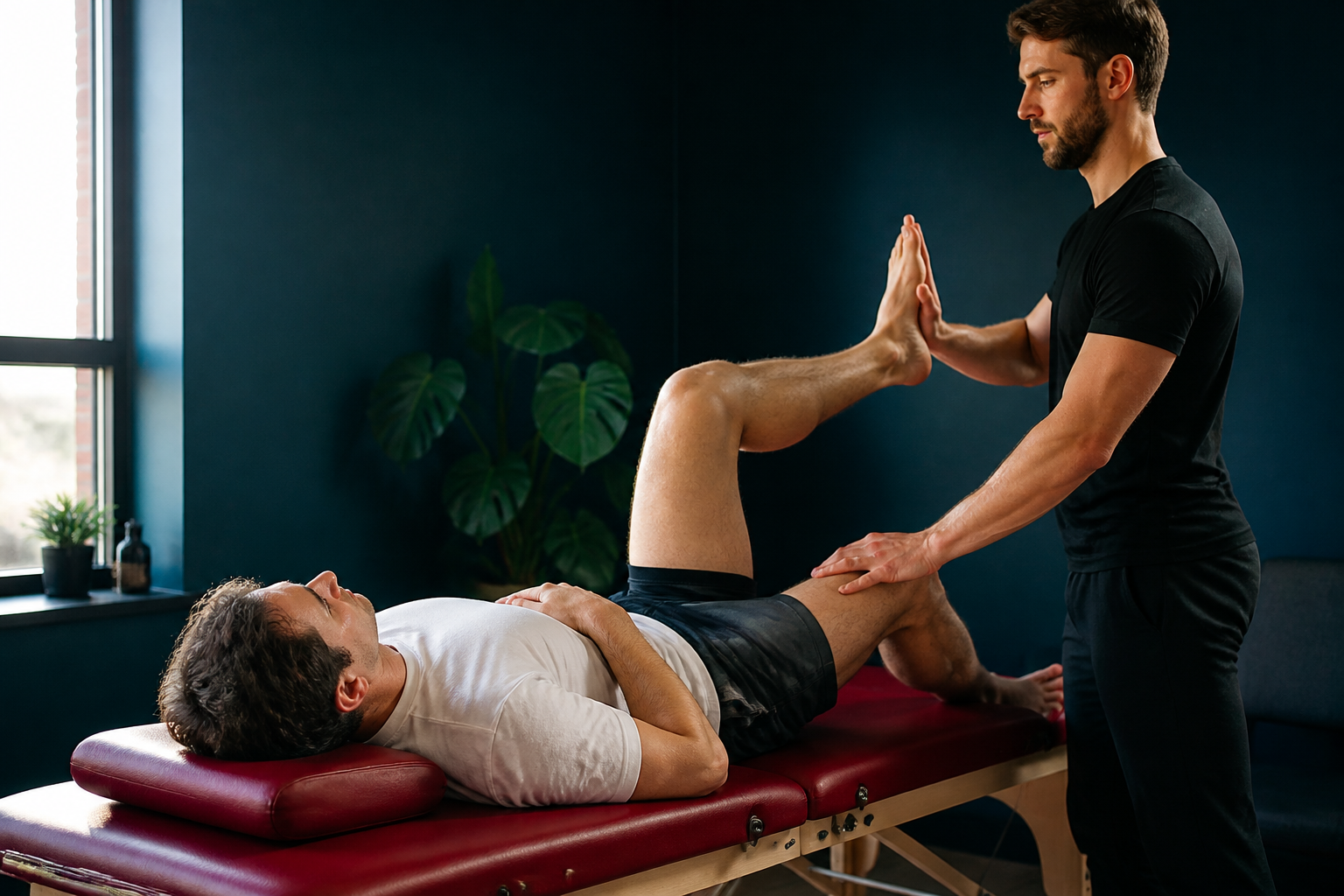
On the table, we pair hands-on work with active movement and varied input. After the tissue and joint work, a client may push against a therapist’s hand in slightly different directions, move a limb through several arcs rather than one, or respond to changes in resistance and position. This gives the nervous system new sensory information and a chance to explore movement options while the change from the hands-on work is fresh. Within PKT education, using the table as a place where hands-on input is combined with active neurological and movement input is the focus of Table Neuro Training, the flagship PKT professional workshop developed to complement the Mobility and Stability levels of PKT Self-Care.
Off the table, we build variety into practice deliberately. Rather than repeating one exercise in exactly the same way, we vary stance, direction, load, tempo, and target. Stepping to different floor targets, reaching to changing points, catching and tossing while balancing, and changing grips or surfaces all give the movement a consistent goal with varied conditions. We cue the result of the movement, such as reaching the target or moving the ball, more often than the position of individual muscles, consistent with the research on external focus.
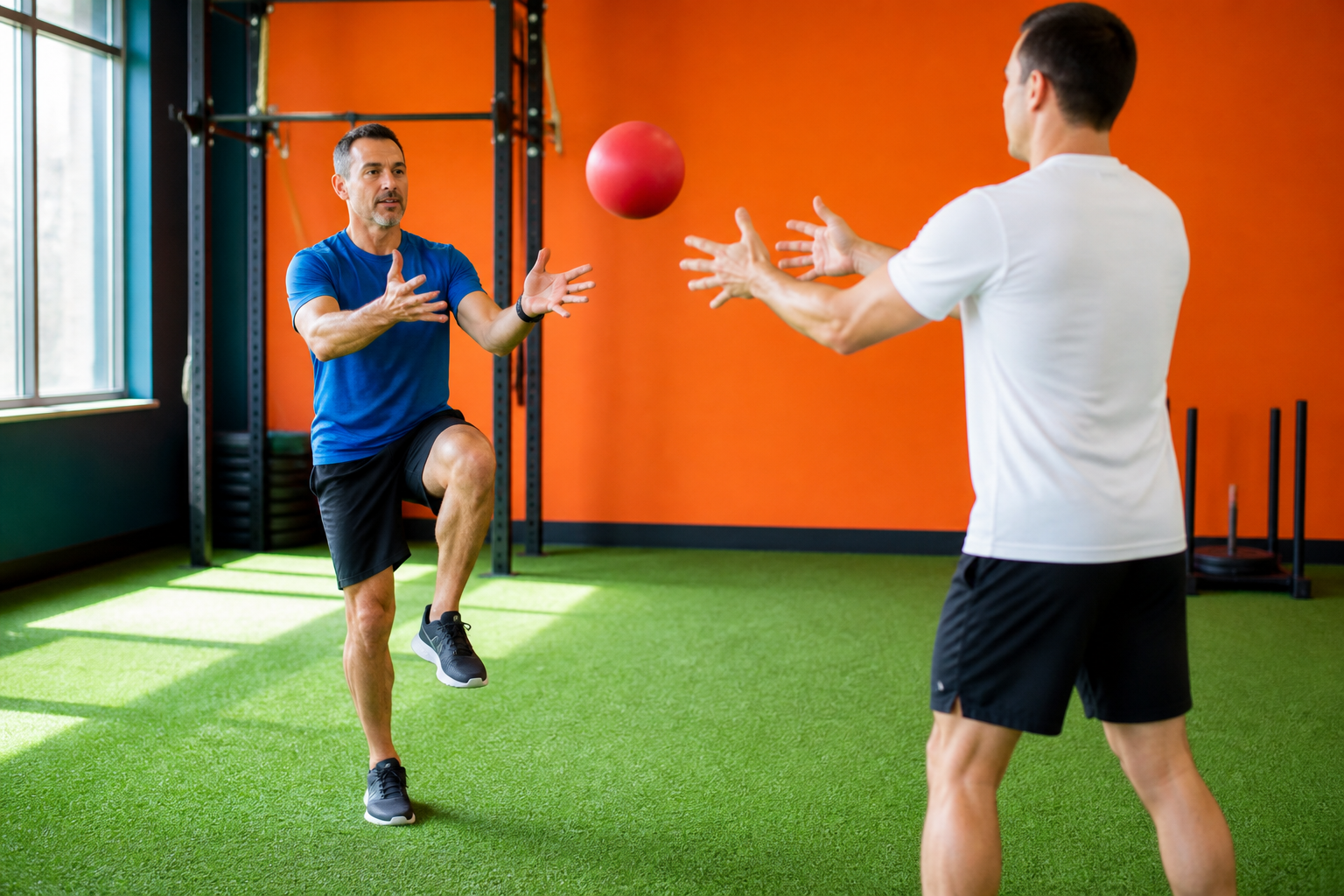
We still use repetition. When a client is learning a new movement or building strength, a more consistent setup helps establish the pattern and allows load to be progressed safely. Variation increases as the movement becomes more reliable, so that the client can carry it into tasks that never repeat exactly.
The Physiokinetix perspective
Physiokinetix organizes movement development through four progressive levels: Mobility, Stability, Power, and Performance. Mobility gives the body movement options, which is the raw material for variability. Stability is the ability to control movement, including holding the goal of a task steady while the details change. Power adds force and load, and variability here can mean producing force in different directions, speeds, and positions. Performance applies all of this to sport, work, and daily life, where conditions rarely repeat. The levels are progressive, not a rigid protocol, and variation can be introduced at any of them in a form that suits the person.
Within the PKT education on pain, posture, and performance, movement variability is one of the factors considered alongside load tolerance, capacity, adaptation, and resilience. The emphasis is on the ability to respond when movement is disrupted rather than on a single correct pattern. This research supports that view: healthy movement has options, and training can build them.
The PKT Self-Care program carries this into daily practice. Using simple tools and body positions, clients can vary resistance, leverage, position, and sensory input between sessions, so that practice remains a process of exploring and organizing movement rather than copying one fixed routine.
Conclusion
Movement variability is a normal and useful feature of healthy, skilled movement. Research describes it as a form of exploration that supports learning, shows that skilled athletes generally limit the variation that affects performance, and associates injury with variability that differs from uninjured levels, more often higher than lower. Varied practice and an external focus appear to keep learners engaged and support flexible control, while imposed randomness alone does not guarantee better learning. Within our approach, we use hands-on work to change the conditions a client moves with, add active and varied movement on the table and in training, build consistency before adding variation, and progress toward the flexibility needed for real tasks that never repeat exactly the same way.
References
- Dhawale AK, Smith MA, Ölveczky BP. The role of variability in motor learning. Annu Rev Neurosci. 2017;40:479-498. https://doi.org/10.1146/annurev-neuro-072116-031548
- Ranganathan R, Lee MH, Newell KM. Repetition without repetition: challenges in understanding behavioral flexibility in motor skill. Front Psychol. 2020;11:2018. https://doi.org/10.3389/fpsyg.2020.02018
- Marineau E, Ducas J, Mathieu J, Rodriguez AP, Descarreaux M, Abboud J. From novice to expert: how expertise shapes motor variability in sports biomechanics. A scoping review. Scand J Med Sci Sports. 2024;34(8):e14706. https://doi.org/10.1111/sms.14706
- Baida SR, Gore SJ, Franklyn-Miller AD, Moran KA. Does the amount of lower extremity movement variability differ between injured and uninjured populations? A systematic review. Scand J Med Sci Sports. 2018;28(4):1320-1338. https://doi.org/10.1111/sms.13036
- Friedman J, Amiaz A, Korman M. The online and offline effects of changing movement timing variability during training on a finger-opposition task. Sci Rep. 2022;12(1):13319. https://doi.org/10.1038/s41598-022-16335-8
- Lelis-Torres N, Ugrinowitsch H, Apolinário-Souza T, Benda RN, Lage GM. Task engagement and mental workload involved in variation and repetition of a motor skill. Sci Rep. 2017;7(1):14764. https://doi.org/10.1038/s41598-017-15343-3
- Bauer P, Gomes JS, Oliveira JH, Santos P, Pezarat-Correia P, Vaz JR. Effects of attentional focus on the regulation of torque complexity. PLoS One. 2025;20(6):e0325302. https://doi.org/10.1371/journal.pone.0325302