

Clinical context
A body is not a set of separate departments. Tissue that feels tight on Monday, a training session on Wednesday, the meals in between, and the quality of recovery each night all act on the same nervous system and the same muscles. Yet most people meet these pieces in different places, from different people, with no one connecting them. The massage happens in one building, the training in another, and nutrition advice comes from a website.
At Temple Human Performance, massage and osteopathic-based manual therapy, movement training and physical preparation, nutrition coaching, and our recovery technology are organized as one treatment-and-training approach. This article looks at what research shows about how these pieces interact, where the evidence is strong, where it is modest, and how we fit them together so each one supports the others rather than standing alone.
Scientific background
Adaptation is the common thread. Muscle, tendon, and the nervous system change in response to the demands placed on them, and they need raw material and recovery time to complete that change. Training supplies the signal. Nutrition supplies much of the material. Recovery is the window in which the change is consolidated. Hands-on work can influence how a region feels and moves in the short term, which shapes how well a person can take part in the training that drives longer-term change.
Seen this way, the question is less about which single service works best and more about how each one changes the effect of the next. A research literature that tests each tool in isolation is useful, but it tends to understate what happens when tools are combined with a clear purpose.
What the research shows
The clearest example of two pieces amplifying each other comes from nutrition and resistance training. Morton and colleagues (2018) pooled 49 randomized trials with 1,863 participants in which healthy adults did at least six weeks of resistance training with or without added dietary protein. Protein supplementation produced greater gains in one-repetition maximum strength (about 2.5 kg on average), fat-free mass (about 0.3 kg), and muscle size. The added benefit plateaued at a total intake of around 1.6 g of protein per kilogram of body weight per day, and the effect on fat-free mass was smaller with increasing age. The key point for integration is that protein worked on top of training. The trials paired the two; protein alone was not the question.
Age changes the picture. The PROT-AGE Study Group (Bauer and colleagues, 2013), an international expert group reviewing protein needs with aging, recommended that adults over 65 aim for at least 1.0 to 1.2 g of protein per kilogram per day, with higher intake for those who are exercising, and recommended endurance and resistance exercise at individualized, tolerated levels alongside it. This is a consensus position rather than a single trial, and the authors noted that evidence on protein quality and timing was not yet sufficient for specific recommendations. Read together with Morton, it describes a simple principle: the older the body, the more the diet and the training need to be planned together.
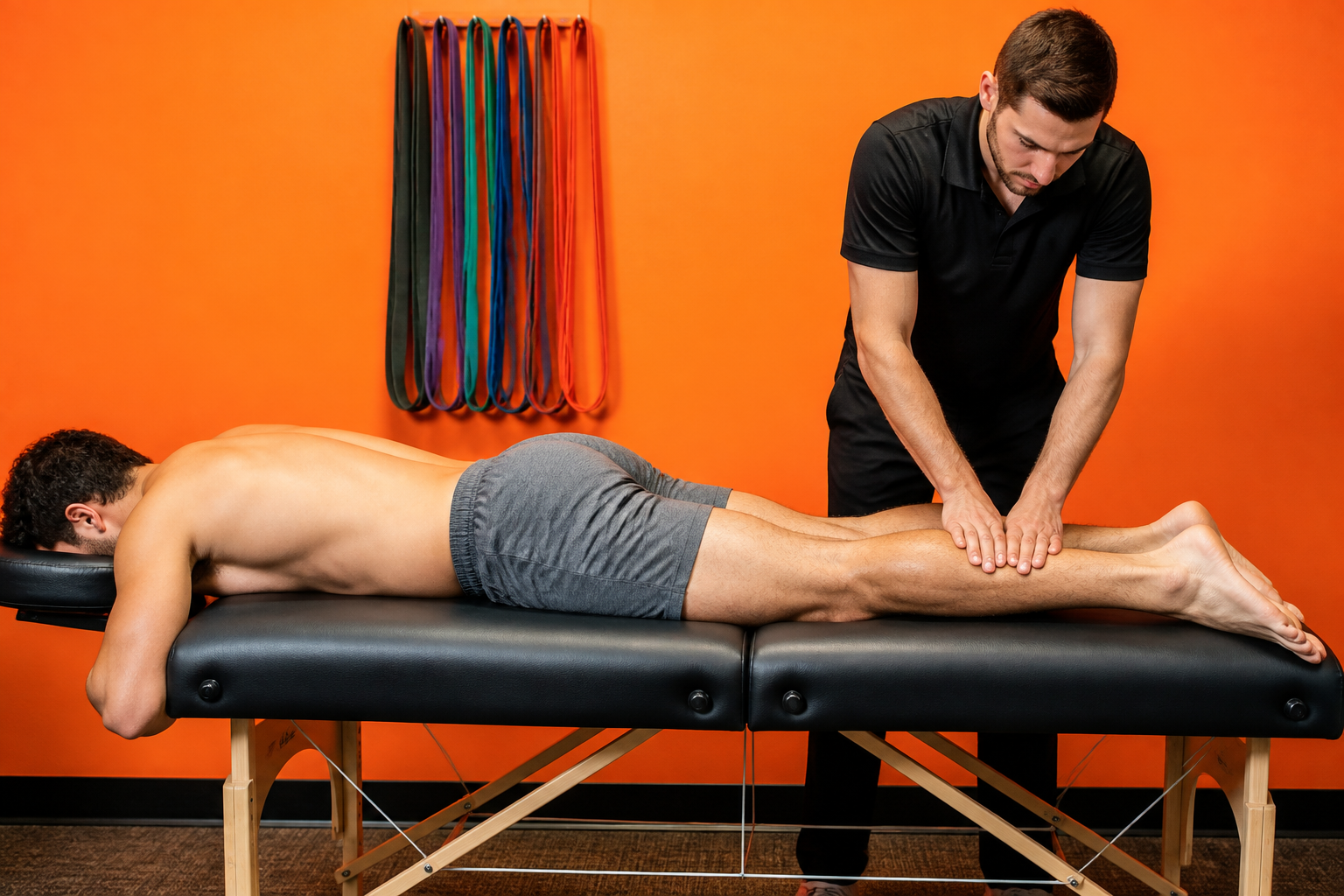
Massage has a more specific role, and the research is honest about its size. Davis and colleagues (2020) reviewed 29 randomized studies with 1,012 participants and found no evidence that massage directly improved strength, jump, sprint, endurance, or fatigue, while massage was associated with small but statistically significant improvements in flexibility and delayed onset muscle soreness. Poppendieck and colleagues (2016) analyzed 22 randomized trials on massage for performance recovery and reported effects that were small overall, larger for short recovery periods of up to 10 minutes and after high-intensity mixed exercise, and smaller after pure strength or endurance work.
These findings matter for how the pieces fit. Massage is not a performance enhancer on its own, and we do not present it as one. What it does well, according to this literature, is ease soreness and improve how freely a region moves. Those are exactly the conditions that make the next training session easier to perform with good quality.

Functional significance
Put side by side, the research describes different jobs. Training produces the adaptation signal. Nutrition, especially adequate protein, enlarges what the body can build from that signal, and matters more with age. Hands-on work changes comfort and range in the short term, which supports the quality and consistency of training. Recovery tools sit at the edges, helping a person feel ready to go again. Our inference from this literature, rather than a tested finding, is that the combination is more useful than any single piece because each piece removes a different limit on adaptation.
There are also real limits. Most trials test one tool against nothing, not a planned combination against a single tool. Effects of massage on performance are small. Protein benefits are measurable but modest in absolute terms. None of this is a claim about curing or managing disease. It is a description of how healthy adaptation is supported.
How we apply it at Temple Human Performance
Temple’s model is Educate, Repair, Perform, and Nourish, and the four parts are meant to work as one system. Every client starts with a history intake and a movement assessment so the plan follows the person rather than a menu. Repair covers the hands-on work and our recovery technology: the infrared sauna, the full-spectrum light table, and the BEMER bed. Perform covers personal training, with individual, couple, and small-group sessions. Nourish covers nutrition coaching. Educate runs through all of it, because a client who understands why each piece is there is more likely to keep doing the parts that happen at home.
In practice the order matters more than the menu. Table work often comes first in a visit, when a region is guarded or sore, so that the movement that follows is more comfortable and better organized. Training then asks the body to use that change under load. Nutrition coaching supports the adaptation between sessions, and for clients in a strength block or older clients building capacity, protein intake is one of the first things we look at. Recovery technology comes in when it fits the day and the person; not every visit includes it.
The Physiokinetix perspective
This sequence reflects the thinking behind Physiokinetix, the professional education and movement system I developed. Physiokinetix holds that hands-on input can change how a region moves or feels, but the lasting value comes when the person actively uses that change, practices it, and gradually loads it. Its general logic runs from assessment, to influencing the system, to activating and loading it, to integrating the change into meaningful tasks.
Physiokinetix is the education side; the clinic is where we apply it. Its progressive framework of Mobility, Stability, Power, and Performance gives the clinic a shared language for where a client is working, without turning the plan into a fixed protocol. Hands-on work and movement on the table often serve Mobility and Stability, while Power and Performance move toward greater resistance, capacity, and real activities. Nutrition and recovery do not belong to one level. They support every level, because adaptation at any stage needs material and rest.
Conclusion
Research that tests one tool at a time still points to a coherent picture. Protein added to resistance training increased gains in strength and muscle across 49 trials, with a plateau near 1.6 g per kilogram per day and a smaller effect with age. Older adults are advised to eat more protein and to exercise alongside it. Massage produced small improvements in soreness and flexibility rather than direct performance gains, with the largest recovery effects over short windows. Each tool removes a different limit on adaptation. At Temple Human Performance, we bring them into one plan, with training as the driver of change, hands-on work preparing the body to train well, nutrition supplying what adaptation needs, and recovery technology supporting readiness for the next session.
References
- Morton RW, Murphy KT, McKellar SR, Schoenfeld BJ, Henselmans M, Helms E, Aragon AA, Devries MC, Banfield L, Krieger JW, Phillips SM. A systematic review, meta-analysis and meta-regression of the effect of protein supplementation on resistance training-induced gains in muscle mass and strength in healthy adults. Br J Sports Med. 2018;52(6):376-384. https://doi.org/10.1136/bjsports-2017-097608
- Bauer J, Biolo G, Cederholm T, Cesari M, Cruz-Jentoft AJ, Morley JE, Phillips S, Sieber C, Stehle P, Teta D, Visvanathan R, Volpi E, Boirie Y. Evidence-based recommendations for optimal dietary protein intake in older people: a position paper from the PROT-AGE Study Group. J Am Med Dir Assoc. 2013;14(8):542-559. https://doi.org/10.1016/j.jamda.2013.05.021
- Davis HL, Alabed S, Chico TJA. Effect of sports massage on performance and recovery: a systematic review and meta-analysis. BMJ Open Sport Exerc Med. 2020;6(1):e000614. https://doi.org/10.1136/bmjsem-2019-000614
- Poppendieck W, Wegmann M, Ferrauti A, Kellmann M, Pfeiffer M, Meyer T. Massage and performance recovery: a meta-analytical review. Sports Med. 2016;46(2):183-204. https://doi.org/10.1007/s40279-015-0420-x