Bending to tie a shoe, sitting into a chair, climbing a step, or absorbing a landing all ask the hip to move while the lumbar spine, pelvis, and knee share the load. The hip is a deep ball-and-socket joint with a large range of motion, and when that range is limited, neighboring regions often finish the movement. The practical question is whether gaining more hip range on a table or in a stretch automatically changes how those regions move when the person stands, walks, runs, or lifts.
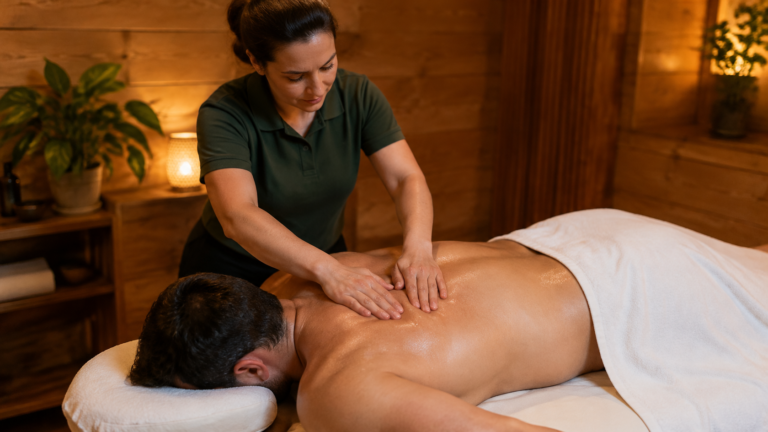
At Temple Human Performance, massage and osteopathic-based manual therapy work together with movement training and physical preparation in one treatment-and-training plan. Hands-on work can change how freely the hip moves. Training decides whether that new range shows up when the person actually uses the hip. This article looks at what research shows about hip mobility gains, what does and does not transfer to dynamic lumbar, pelvic, and knee motion, and how we carry table work into loaded movement within Physiokinetix.
Passive hip range is what a joint can do when someone else moves it, or when a person stretches without having to control the end of the range. Active or dynamic range is what the person can organize and use under their own control, often while standing or moving. Those two measures often diverge. A hip that extends farther in a Thomas test may not extend farther in a stride. A stretch that changes standing posture by a degree or two may leave lumbar curvature unchanged.
The hip also shares work with the lumbar spine and pelvis during forward bending. When hip flexion is limited, a larger share of the bend can come from the lumbar region and from shifting the pelvis backward. When hip flexion is available, more of the total bend can come from the hip itself. That relationship is about coordination under load, not about a single stretch creating a new posture on its own.
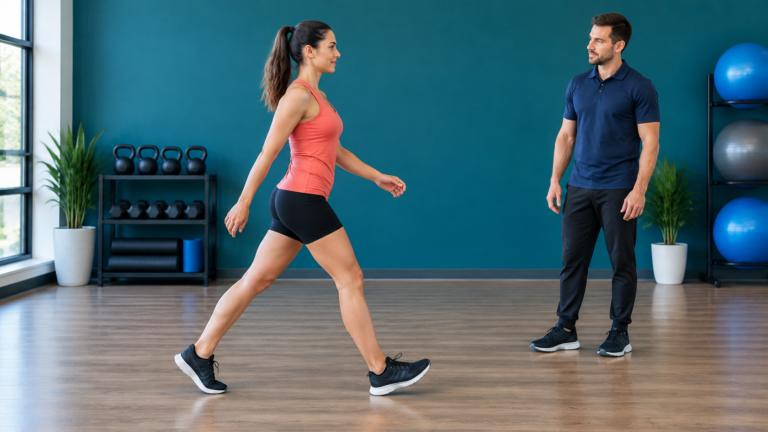
Stretching can change passive hip range without changing how the hip, pelvis, and lumbar spine move during activity. Mettler and colleagues (2019) studied 20 healthy adults with limited passive hip extension. After a three-week home hip-flexor stretching program, passive hip extension increased, but running kinematics did not: active hip extension, anterior pelvic tilt, and lumbar spine extension during running were unchanged, and the change in passive range did not correlate with changes in those running measures. The authors concluded that passive hip flexibility may be of limited importance for lumbo-pelvic-hip kinematics during submaximal running, while noting that greater hip range might matter closer to maximal speeds.
A single stretch session shows a similar pattern. Preece and colleagues (2021) measured 23 healthy men before and after passive hip-flexor stretching. Passive hip extension rose by 2.6 degrees on average, and anterior pelvic tilt in relaxed standing fell by 1.2 degrees. Lumbar lordosis did not change, and there were no meaningful correlations between the change in passive hip extension and the change in pelvic tilt or lordosis. Immediate postural shift was small and incomplete.
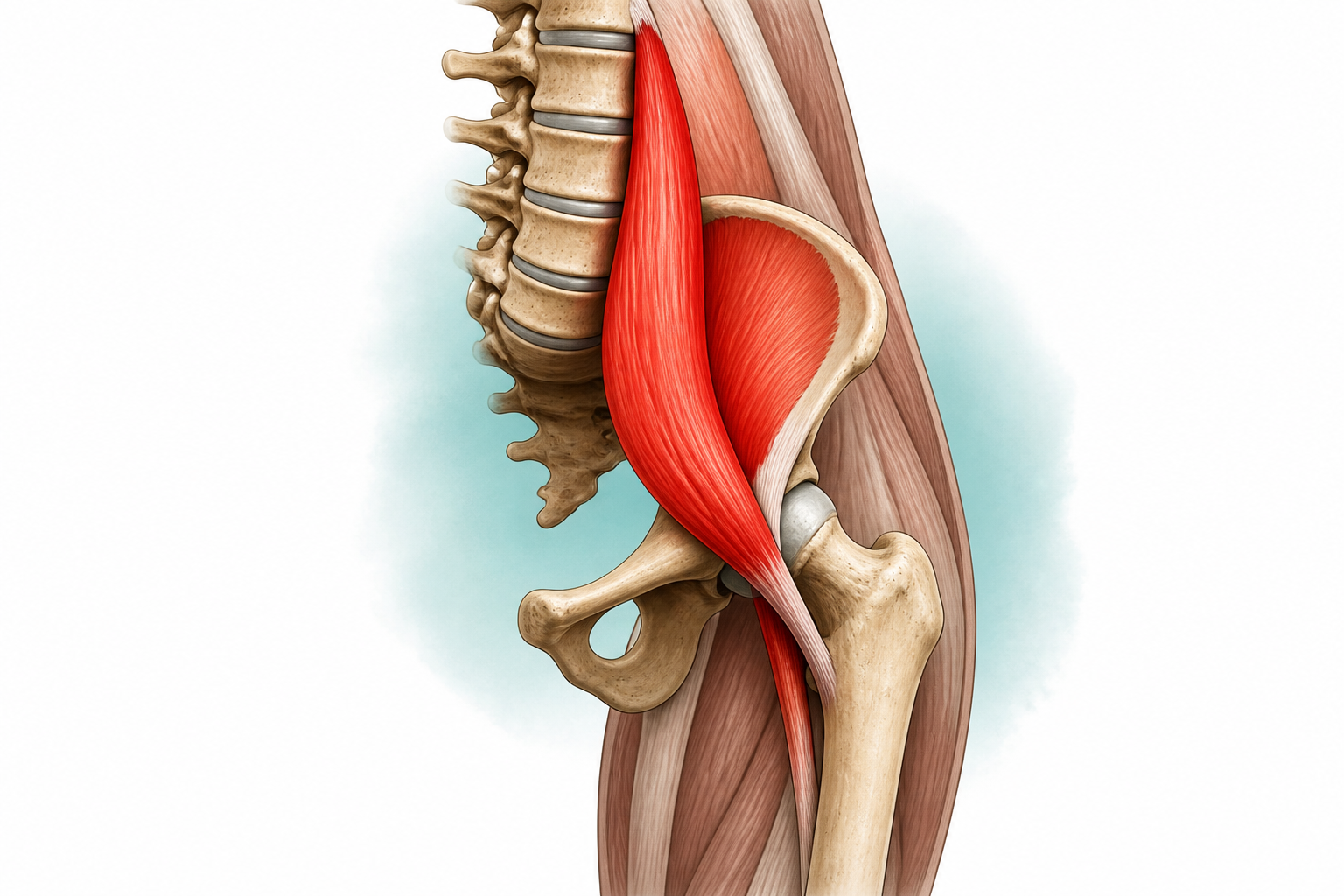
Coordination during forward bending depends on how much hip flexion is available. Shin and Yoo (2020) divided 44 asymptomatic younger women into three groups by hip flexion angle during trunk forward bending: less than 30 degrees, 30 to 50 degrees, and 50 degrees or more. As hip angle increased across groups, pelvic and total angles rose, while lumbar-to-hip and pelvic-to-hip angle ratios fell. People with less hip flexion showed a greater relative contribution from pelvic motion and a higher pelvic-posterior-shift-to-hip ratio, a pattern consistent with using neighboring motion when the hip does not contribute enough.
Older biomechanical work connects that mobility picture to bending load. Dolan and Adams (1993) measured lumbar flexion with a skin-surface system in 49 people during forward bending and lifting, then estimated bending moment at the lumbosacral junction from cadaver spine properties. Subjects flattened or reversed their lumbar lordosis when lifting, and many came close to or exceeded their static in vivo flexion limit. Estimated bending moments were lower in people with good sagittal lumbar mobility. Good hip mobility was also associated with lower bending moment, reaching statistical significance in the subgroup that reported a history of lumbar discomfort. This is an association from a lifting study, not a claim that stretching treats lumbar discomfort, and the estimates rely on cadaver calibration.
For the knee, the better-supported links run through ankle mobility and hip muscle strength or control more than through hip mobility alone. Cronstrom and colleagues (2016) systematically reviewed 33 studies on modifiable factors linked to knee abduction during weight-bearing tasks. In healthy people, reduced trunk strength, reduced gluteus maximus amplitude, decreased ankle range of motion, and increased hip external-rotation range were moderately associated with greater knee abduction. Decreased strength of the hip abductors, external rotators, and extensors was at most weakly associated. The review points investigators toward trunk strength, gluteus maximus activation, and ankle range rather than toward hip stretching as the primary lever for knee alignment.
Taylor and colleagues (2021) reinforced the ankle side of that picture in 19 active women during a drop vertical jump. Lesser weight-bearing ankle dorsiflexion predicted less hip flexion excursion, lower peak knee flexion, and less hip and knee extensor work. Using a smaller share of available dorsiflexion predicted greater peak knee abduction. In other words, ankle dorsiflexion, and whether that available motion is used, tracked with hip and knee landing mechanics more clearly than hip mobility studies have tracked with running or standing posture.
A modeling study makes a similar point about hip strength rather than hip stretch. Jolas and colleagues (2023) built musculoskeletal models from gait trials of 24 healthy adults and tested simulated 30 percent increases in peak isometric strength of gluteus medius and maximus. The first peak of knee compression force fell by roughly 1.6 to 6 percent depending on walking strategy, with larger reductions in people who already used higher hip moments early in stance. This is a simulation, not a training trial, but it aligns with the idea that hip muscle capacity can change knee load even when mobility alone does not.
Taken together, the research describes a gap between having range and using range. Passive hip gains after stretching are real and often measurable within a session or a few weeks. Transfer to running kinematics and to lumbar lordosis is weak or absent in the samples studied. Standing pelvic tilt can shift slightly after a stretch, without a matching change in the lumbar curve. During forward bending, limited hip flexion is linked with a different coordination pattern that leans more on the pelvis. Estimated bending moments during lifting are associated with lumbar and hip mobility, and knee landing and walking loads track more clearly with ankle dorsiflexion and hip muscle strength or activation than with hip mobility alone.
Our inference, not a finding from a single trial that tested this sequence, is that mobility work creates options, and that those options change dynamic movement only when the nervous system organizes and loads them. Stretching alone is not enough when the goal is a different step, bend, or landing.
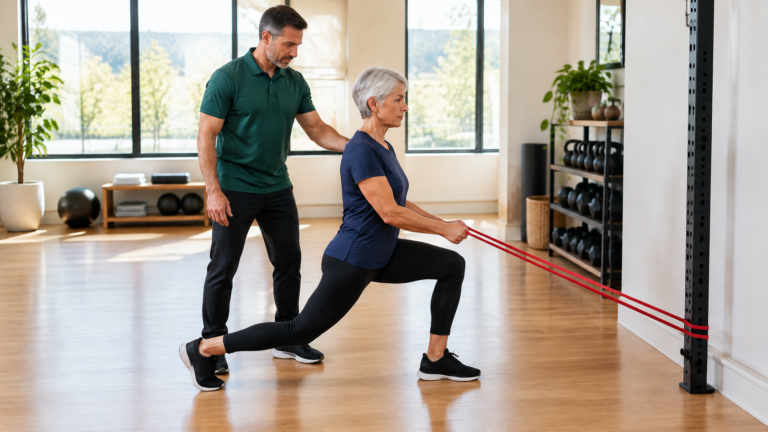
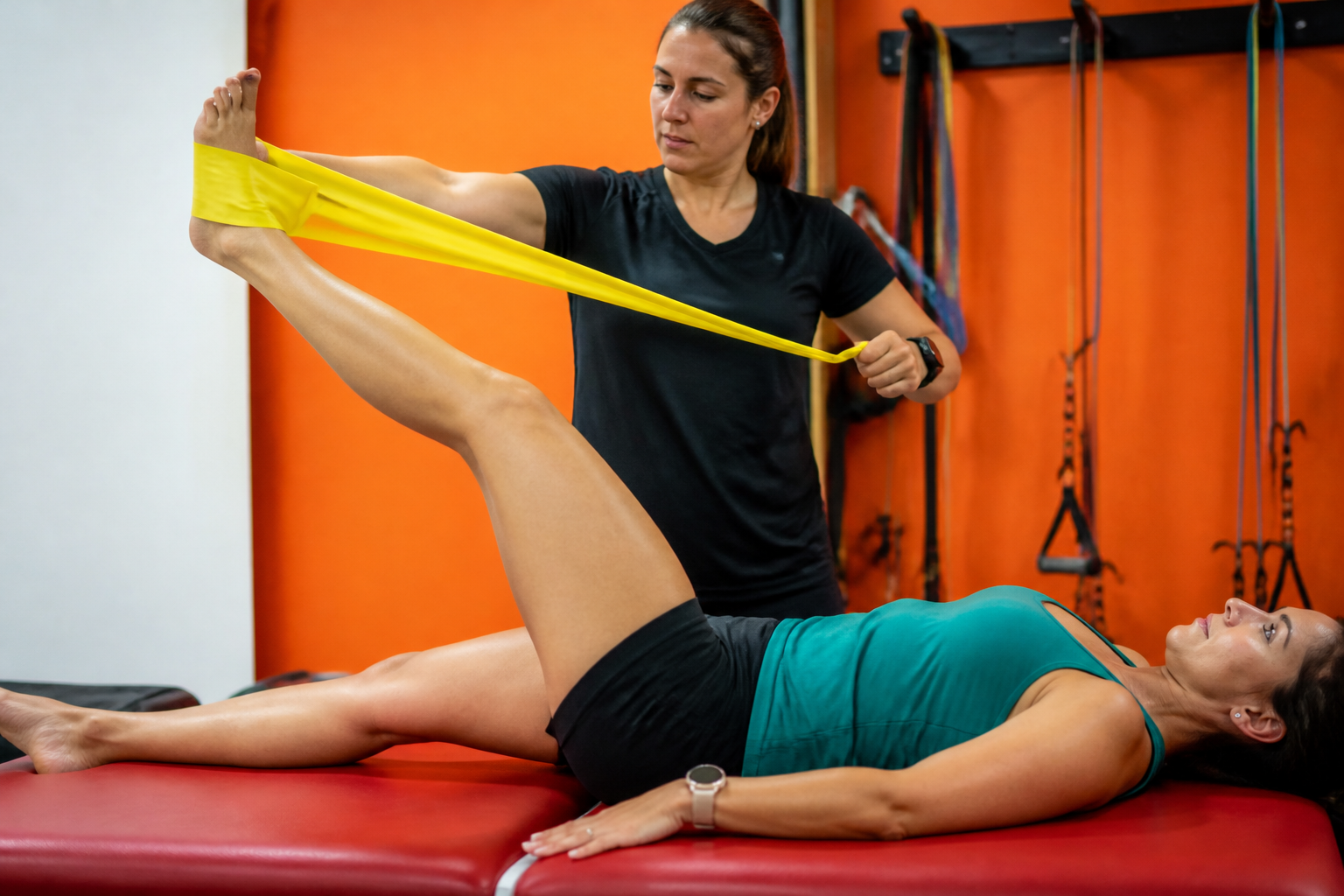
We treat passive range as a door, not the destination. A session may begin with hands-on work to the hip flexors, the posterior hip, or related regions when assessment shows limited or poorly organized hip motion. Once the hip moves more freely, the client practices that motion actively on the table and then standing, with attention to how the pelvis and lumbar spine share the bend. Light resistance bands often come next, so the new range is used under low load before heavier patterns.
That sequence matches the Physiokinetix progression from Mobility into Stability, then into Power and Performance when the person is ready. The levels are progressive, not a rigid protocol. A client who already owns the range may spend little time stretching and more time organizing and loading. A client with a true restriction may need more time opening the hip before the same loading makes sense. Table Neuro Training, our flagship professional workshop that complements Mobility and Stability of the PKT Self-Care program, teaches practitioners to combine hands-on input with active movement on the table so the change is practiced, not only received.
We do not promise that a stretch will resolve lumbar discomfort or protect a knee. The research above does not support that promise. What it does support is being honest about transfer: measure the hip, then watch the bend, the step, and the landing, and train the parts that still do not use the new range.
Physiokinetix, the education and movement system I developed, treats movement as an interaction among joints, load, sensory input, and motor control rather than as the product of a single stretch. Mobility provides options. Stability is the ability to control those options. Power and Performance apply them under greater demand and in real tasks. The general logic runs from assessment to influence, activation, loading, integration, and performance, without requiring every client to walk through every stage the same way.
The hip article sits beside our earlier work on thoracic mobility for the shoulder and neck. The principle is the same and the region is different. Opening a joint creates a chance. Active practice and progressive loading decide whether the lumbar spine, pelvis, and knee actually move differently afterward.
Hip mobility training reliably increases passive range. In the studies reviewed here, those gains did not reliably change running kinematics or lumbar lordosis, produced only a small immediate shift in standing pelvic tilt, and left the knee picture better explained by ankle dorsiflexion and hip muscle strength or activation than by hip mobility alone. Coordination during forward bending and estimated bending moments during lifting still show why hip contribution matters when the body bends under load. At Temple Human Performance, we open the hip when it needs opening, then ask the nervous system to use and load the new range, so Mobility becomes Stability and, when appropriate, Power and Performance.