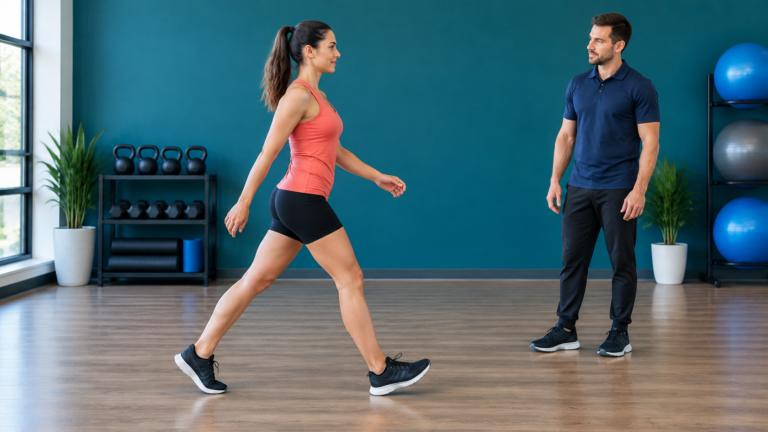
Every landing begins at the ankle. The foot meets the floor, the shin travels forward over it, and the knee and hip then take their share of the work of absorbing the load. When the ankle gives that forward travel freely, the rest of the leg has more options. When it does not, the other joints organize around what is available. That is a distal-to-proximal relationship, one of the kinetic-chain ideas Physiokinetix (PKT) teaches practitioners to keep in view, and it is why we pay attention to the ankle even when the question a client brings is about the knee.
At Temple Human Performance, our work brings massage and osteopathic-based manual therapy together with movement training and physical preparation, so a finding at the ankle is never an end point. The useful question is what the range means once the person is moving and loading it. This article looks at what research shows about ankle dorsiflexion and landing, how the range is best measured, and how we connect hands-on work at the ankle to a better landing.
Ankle dorsiflexion (DF) is the movement of the shin and the top of the foot toward each other, the motion that lets the knee travel forward over a planted foot in a squat, a step-down, or a landing. Research measures it in two main ways. In the non-weight-bearing method, the foot is moved passively, often with the knee straight. In the weight-bearing lunge test (WBLT), the person lunges forward with the foot flat and the knee drives over the toes, and the angle or distance is recorded.
The WBLT has a solid measurement record. Powden and colleagues (2015) systematically reviewed 12 reliability studies and found strong evidence of good reliability, with intraclass correlations of 0.80 to 0.99 between clinicians and 0.65 to 0.99 within a clinician. The minimal detectable change was about 4.6 degrees (1.6 cm) between clinicians and 4.7 degrees (1.9 cm) within a clinician, which tells a practitioner how large a change has to be before it exceeds measurement error.
The method matters for what the number says about movement. Dill and colleagues (2014) tested 40 physically active adults and classified them two ways. Grouped by non-weight-bearing passive DF, the limited and normal groups showed no differences in knee and ankle kinematics during squatting and landing tasks. Grouped by the WBLT, the picture changed: people with greater DF in the lunge showed more knee flexion and more ankle DF displacement in both the overhead squat and the single-leg squat, and more knee varus displacement in the single-leg squat. The authors concluded that the weight-bearing measure gave insight into compensatory squat patterns that the passive measure did not.
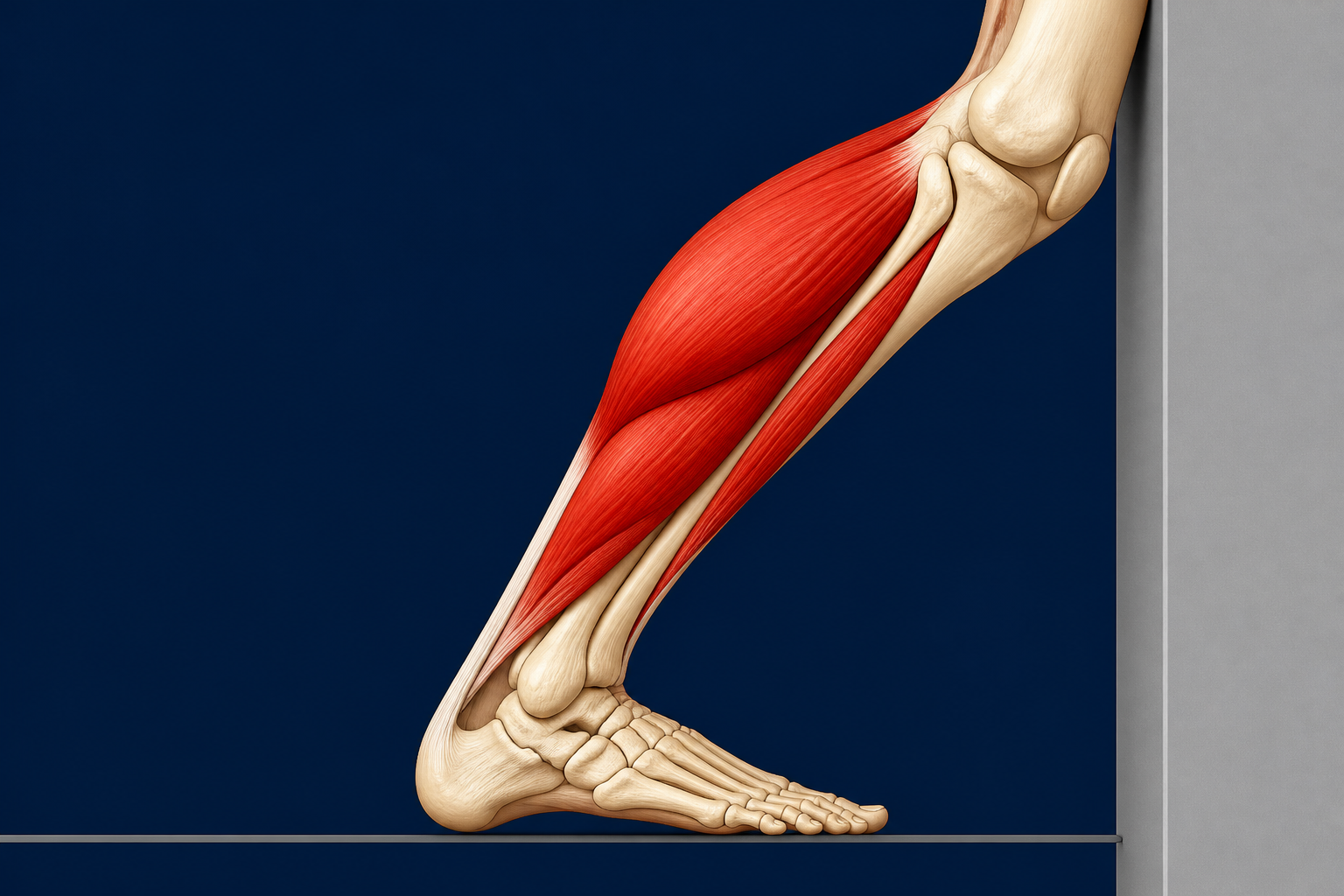
Landing studies, mostly laboratory-based, point in a consistent direction. Mason-Mackay and colleagues (2017) systematically reviewed six studies on restricted DF and landing mechanics and concluded that landing mechanics are altered with restricted DF range, while noting that the studies disagreed on which mechanical variables are affected. That disagreement is partly a product of different landing tasks and different ways of measuring range, which is why individual studies are worth reading closely.
Fong and colleagues (2011) studied 35 healthy, physically active volunteers who landed on a force plate under motion capture. DF measured with the knee extended correlated with knee flexion displacement during landing (r = 0.464) and, negatively, with vertical (r = -0.411) and posterior (r = -0.412) ground reaction forces. The authors read this as greater DF going with a landing posture that gives the leg more room to absorb force. DF measured with the knee flexed was not significantly related to knee valgus displacement in that sample.
Howe and colleagues (2019) added drop height. In 39 participants dropping from 50, 100, and 150 percent of countermovement jump height, DF range from the WBLT was not related to peak vertical ground reaction force, time to peak force, or loading rate. It was related to how the leg was organized. At the two higher drops, DF range correlated moderately to strongly with knee and ankle angles at first contact (r = -0.34 to -0.40) and at peak (r = -0.42 to -0.52), and across all heights it correlated positively with knee joint displacement (r = 0.39 to 0.47) and frontal-plane projection angle (r = 0.37 to 0.40). The authors concluded that ankle DF range influences the coordination strategies that manage ground reaction force during landing.
Akbari and colleagues (2023) moved the question out of the controlled drop and into a soccer-specific task. Thirty male soccer players had DF measured by the WBLT, and their landings were scored with a landing error scoring system. Lower DF range went with more landing errors (r = -0.450, p = 0.006), which led the authors to suggest that DF range is a useful clinical measure for identifying poor landing posture in a real-world sport task.
Ota and colleagues (2014) tested cause and effect in a different way. Thirty healthy volunteers walked in a custom brace that restricted DF in graded steps, from a free condition with peak DF near 13.7 degrees to a severe restriction near 4.2 degrees. Peak knee extension angle shifted from about -6.7 to 0.6 degrees across those conditions, and knee varus moment rose significantly at about 8 degrees of restriction. The task was gait, not landing, but the design shows that taking range away from the ankle changes what the knee does within the same session.
Feigel and colleagues (2023) add a useful distinction in 672 military personnel, 122 of them women. They measured maximum DF with the WBLT and then used markerless motion capture during a drop jump to measure the DF that was actually used and the percentage of available range it represented. All of the DF measures went with movement patterns that countered a stiff-legged landing strategy, and the dynamic measures, the range used during the landing itself, had higher predictive value than the clinical measure. Neither kind of measure predicted ankle injury, so the finding belongs to movement patterns, which is where we keep it.
Together, these studies describe correlations of moderate size, which is the right scale for the claim. Range available at the ankle is one contributor to how a person lands, and how much of it the person uses in the task is another.
Delahunt and colleagues (2013) studied the acute effect of ankle mobilization on landing. Fifteen participants with self-reported chronic ankle instability performed single-leg drop landings before and immediately after three mobilizations: a Mulligan talocrural dorsiflexion mobilization with movement, a Mulligan inferior tibiofibular mobilization, and a Maitland anteroposterior talocrural mobilization. Ankle plantarflexion at initial contact decreased from 34.89 degrees to 31.90 degrees, a mean decrease of 2.98 degrees (95% CI 0.54 to 5.43), a large effect size. The authors concluded that the mobilization had a mechanical effect that facilitated a more favorable ankle position when landing from a jump. The measurement was immediate and within one group, so the finding is about what changes right after the input, which is the window PKT sets out to use.
A landing has to be organized within a fraction of a second. The ankle sets the starting position of the shin, the knee decides how much it can bend to share the work, and the hip and trunk follow. When the ankle offers less range, or when a person does not use the range on offer, the pattern tends to shift in the ways the studies describe: less knee and ankle excursion, a different knee alignment at contact, and, in some tasks, a stiffer posture.
The same logic applies off the court. Stepping down from a curb, sitting into a low chair, and squatting to lift all ask the shin to travel over the foot under load. A client who has the range but not the control, or the control but not the range, will often show it first at one of these tasks.
We measure the weight-bearing lunge first, because the research shows it tells more about squat and landing patterns than a passive measure alone, and we repeat it against the minimal detectable change before we call a difference real. We then watch the person do the task: a squat, a step-down, a stick landing from a low height. We compare what the lunge shows with what the movement shows, side to side and joint to joint, because the PKT view of the kinetic chain asks for the relationships, not a single number.
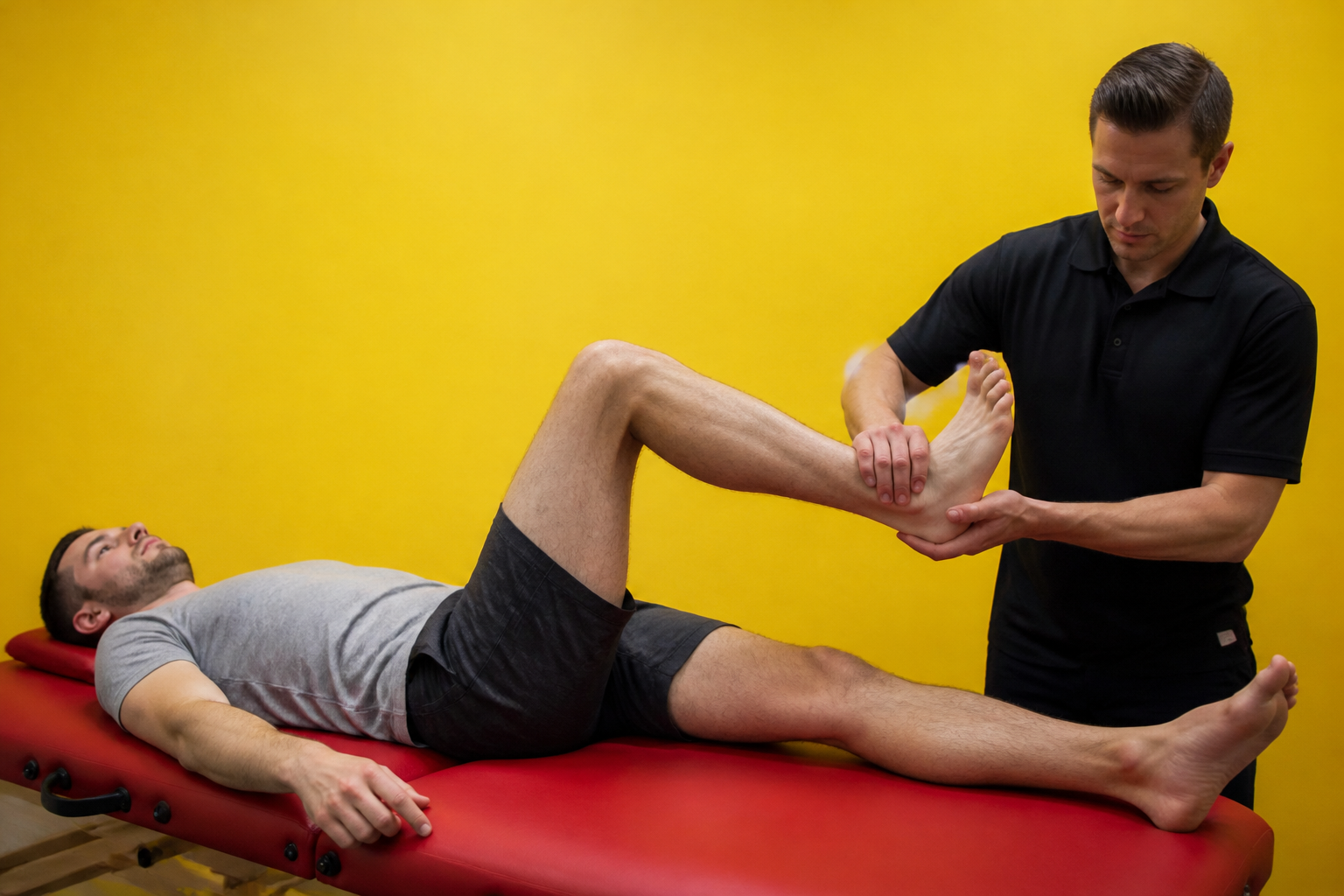
When the ankle is a limiting link, hands-on work on the table gives the joint more options. We then move to the next stage immediately, with the client actively using the new range in a squat, a lunge, or a low landing. This is the bridge PKT describes between hands-on input, active movement, and progressive loading, and it is the use of the table that Table Neuro Training (TNT), the flagship PKT workshop, teaches. TNT was developed to complement the Mobility and Stability levels of the PKT Self-Care program, which puts the table work and the active use of the new range in the same session.
Mobility and Stability give way to Power and Performance in the same progression. The landing task gets harder in stages: lower to higher drop, double-leg to single-leg, predictable to varied. Our inference, which none of the studies above tested as a sequence, is that range is most useful when it is followed by practice and then by load.
Within the PKT framework, Mobility offers movement options, Stability is the ability to control them, Power adds force, and Performance applies all of it to something that matters to the person. The ankle sits at the base of that progression in any standing task. A dorsiflexion measure tells us where the kinetic chain begins. The landing tells us what the person does with it.
Research on ankle dorsiflexion and landing points in a similar direction, with associations of moderate size. In one direct comparison, a weight-bearing measure described squat patterns that a passive measure did not, lower range went with less knee and ankle excursion and different knee alignment in several landing tasks, experimentally restricting range changes knee mechanics, and the range actually used in a landing carries predictive value beyond the number measured on the table. One study found that a set of ankle mobilizations changed landing position immediately afterward. Read together, the work supports measuring the ankle in the way that reflects the task, using the range through active practice, and loading it progressively.