

Hands-on work can change how a body feels and moves in the moment. Lasting capacity usually comes from what happens next: asking tissues and the nervous system to share real load, with control.
That sequence sits at the heart of Physiokinetix. Manual input helps organize the system. Progressive loading builds the strength, tendon tolerance, and movement confidence that carry into daily life, training, and sport. The question is not “Which contraction mode is magic?” It is “Which tool fits this person, today, on the way toward meaningful load?”
Three tools, one goal
When you load a muscle–tendon unit, you generally use one of three strategies:
- Isometric: produce force without changing joint angle (a controlled hold).
- Concentric: produce force while the muscle shortens (lifting phase).
- Eccentric: produce force while the muscle lengthens under control (lowering phase).
Physiokinetix treats these as tools—not a hierarchy. The destination is the same: organized movement under progressive load, transferred from the table into active participation.
What the evidence actually supports
Across Achilles and patellar loading research, a clear pattern repeats: how hard and how consistently you load often matters more than which contraction label you pick.
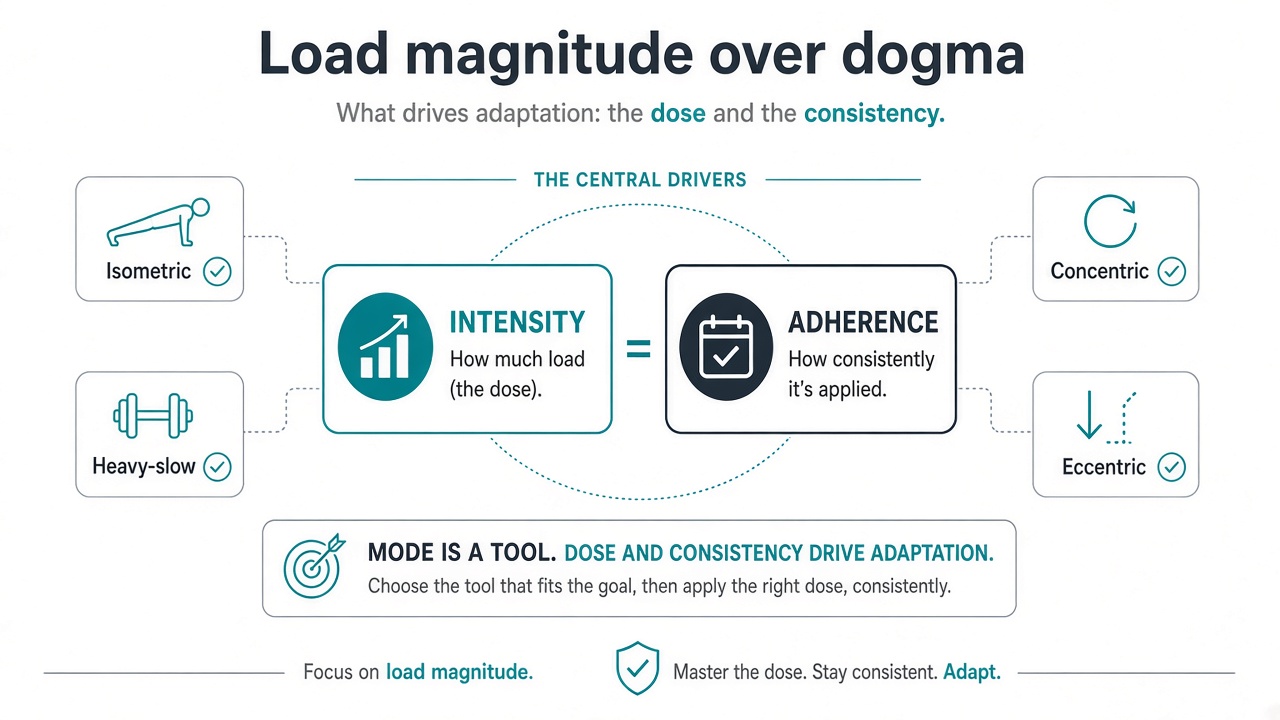
Systematic comparisons show eccentric programs can help, especially compared with passive modalities, but they are not a universal gold standard over other well-designed exercise approaches. In Achilles tendinopathy, eccentric work has performed similarly to heavy-slow resistance and to combined loading strategies for many clinical outcomes. In patellar tendinopathy, heavy-slow resistance has often looked at least as strong as—and sometimes preferable to—isolated eccentric work for longer-term function and adherence.
Isometrics can be a smart early bridge. They are often well tolerated, and for some people they may ease symptoms in the short term. That effect is inconsistent across studies, and it is not a reason to stay in holds forever. Think of isometrics as an on-ramp, not a parking space.
Programs that build meaningful intensity and stick with loading for roughly twelve weeks or longer tend to show stronger adaptations in tendon stiffness and clinical markers. Structure on imaging can change with training, but feeling and function do not always move in lockstep with those pictures. Neuromuscular performance—torque, work, endurance—tracks clinical progress more reliably than “the ultrasound got prettier.”
Why the table still matters
If loading is the long game, why start with hands-on care?
Because a skilled session can reduce guarding, improve joint play, and make the next movement feel available. Mobilization and related articular input can outperform doing nothing or placebo in some contexts, and they often pair well with supervised exercise. They are generally not superior to other active approaches on their own.
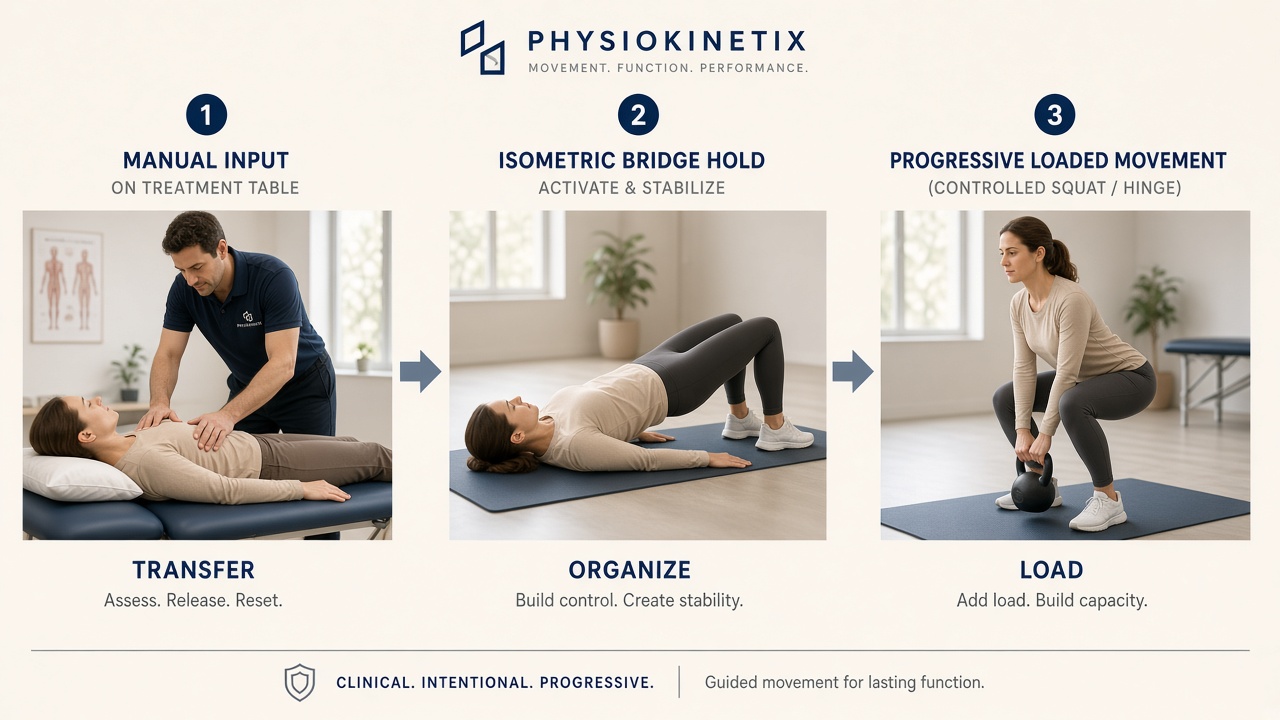
In Physiokinetix terms, that is the transfer: use manual input to open a window, then step into active loading while the system is organized. Passive work is not the finish line. It is preparation for participation.
How Physiokinetix puts the tools to work
Without turning education into a one-size protocol, the practical flow looks like this:
- Organize on the table. Manual input prepares tissues and sensory-motor access for the work ahead.
- Bridge with the gentlest effective tool. If dynamic loading is poorly tolerated, an isometric hold can introduce force without a full movement demand.
- Progress into concentric and eccentric work as tolerance allows. Match the tool to the task—lifting, lowering, sport-specific demands—not to a slogan.
- Raise magnitude over time. Enough load to stimulate adaptation, enough recovery to absorb it, enough weeks to matter.
- Watch the next-day response. Quality of movement, swelling or irritability that settles, and confidence returning to baseline guide the next dose more wisely than a single pain number.
Clients at Temple Human Performance experience this as a conversation between hands-on care and progressive training. Students of Physiokinetix learn to see the same conversation as methodology: input, organization, load, and transfer.
What we are still learning
Honest gaps keep the work sharp:
- Who gets meaningful short-term relief from isometrics, and who does not?
- Does manual therapy immediately before loading improve long-term outcomes compared with loading alone, or mainly improve the session experience?
- What combinations of frequency, volume, joint angle, and tempo fit different tissues and goals?
- Can we better predict who will respond to a given loading style?
Those questions refine programming. They do not weaken the core Physiokinetix idea: build capacity through intelligent loading after the system is prepared to accept it.
Closing
Isometric, concentric, and eccentric actions are three ways to ask the body for force. Physiokinetix chooses among them the way a skilled practitioner chooses any tool—by fit, by tolerance, and by the destination. The destination is clear: organized movement under progressive load, carried from the table into a stronger, more capable body.
References
1. Yuan F, Ren K, Zhao Z, Wang P, Song L. The efficacy of eccentric exercise in the treatment of Achilles tendinopathy: a systematic review and meta-analysis. BMC Musculoskeletal Disorders. 2026. doi:10.1186/s12891-026-09861-3
2. Logerstedt DS, Ebert JR, MacLeod TD, et al. Effects of and Response to Mechanical Loading on the Knee. Sports Medicine. 2022;52:201-235. doi:10.1007/s40279-021-01579-7
3. Gabbett TJ, Oetter E. From Tissue to System: What Constitutes an Appropriate Response to Loading? Sports Medicine. 2025;55:17-35. doi:10.1007/s40279-024-02126-w
4. Millar NL, Silbernagel KG, Thorborg K, et al. Tendinopathy. Nature Reviews Disease Primers. 2021;7:1. doi:10.1038/s41572-020-00234-1
5. Soliman EFF, Nagra D, Goh SL, et al. Isometric Exercises for Tendinopathies: A Systematic Literature Review. Clinical Therapeutics. 2026. doi:10.1016/j.clinthera.2026.04.027
6. Malliaras P, Barton CJ, Reeves ND, Langberg H. Achilles and Patellar Tendinopathy Loading Programmes: A Systematic Review Comparing Clinical Outcomes and Identifying Potential Mechanisms for Effectiveness. Sports Medicine. 2013;43:267-286. doi:10.1007/s40279-013-0019-z
7. Beyer R, Kongsgaard M, Hougs Kjær B, et al. Heavy Slow Resistance Versus Eccentric Training as Treatment for Achilles Tendinopathy: A Randomized Controlled Trial. The American Journal of Sports Medicine. 2015. doi:10.1177/0363546515584760
8. Li Y, Sun D, Fang Y, et al. Mixed comparison of intervention with eccentric, isometric, and heavy slow resistance for Victorian Institute of Sport Assessment Patella Questionnaire in adults with patellar tendinopathy: A systematic review and network meta-analysis. Heliyon. 2024;10:e39171. doi:10.1016/j.heliyon.2024.e39171
9. Kongsgaard M, Kovanen V, Aagaard P, et al. Corticosteroid injections, eccentric decline squat training and heavy slow resistance training in patellar tendinopathy. Scandinavian Journal of Medicine & Science in Sports. 2009. doi:10.1111/j.1600-0838.2009.00949.x
10. Lee G, Woo H, Han Y, et al. Clinical efficacy of joint mobilization for shoulder impingement syndrome: a systematic review and meta-analysis. PLoS One. 2026. doi:10.1371/journal.pone.0352260
11. Westad K, Tjoestolvsen F, Hebron C. The Effectiveness of Mulligan’s Mobilisation With Movement (MWM) on Peripheral Joints in Musculoskeletal (MSK) Conditions: A Systematic Review. Musculoskeletal Science & Practice. 2019;39:157-163. doi:10.1016/j.msksp.2018.12.001