

The Shoulder Blade’s Job: A Stable Base for a Strong Arm in Physiokinetix
A strong arm does not start in the hand. It starts with a base that can move with the ribcage, accept force from the trunk and hips, and give the rotator cuff something stable to work from.
That base is the scapula—the shoulder blade. In Physiokinetix, we treat it as a living link in the kinetic chain: part of how movement is organized from the center of the body out to the arm. When the scapula does its job well, reaching, lifting, and overhead work feel more available. When it does not, the arm often tries to do too much on its own.
### What the shoulder blade is actually doing
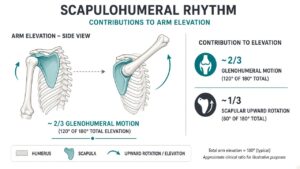
Illustrative scapulohumeral rhythm schematic for arm elevation. Generated educational graphic; not clinical evidence.
Modern imaging work makes that partnership even clearer. In a biplane-fluoroscopy study of healthy adults, scapular motion contributed a large share of the arm’s axial rotation during elevation—on the order of about three-quarters or more of that rotation component in the positions studied. The takeaway for training and sessions is practical: if you only chase the arm, you miss a major piece of how the arm actually moves.
Periscapular muscles—including the trapezius, serratus anterior, rhomboids, and related neighbors—help rotate, tilt, and slide the scapula so the socket stays well positioned as the arm travels. That is not a trivia fact. It is why Physiokinetix looks at the shoulder girdle as an organizing surface, not an isolated “shoulder muscle” problem.
### The scapula as a kinetic-chain link
In overhead and reaching sports, coaches and clinicians have long described the shoulder blade as a relay between the legs/trunk and the arm. Reviews of the kinetic chain in throwing and serving athletes emphasize the same idea Physiokinetix teaches in the clinic and classroom: distal power depends on proximal organization. Hips and trunk set the stage. The scapula helps deliver that force into a usable arm path.
That does not mean every shoulder complaint is “caused by the core.” Much of the core–shoulder literature is associative. What we can say with confidence is that the body is built to share load across links—and that training and manual work land better when they respect those relationships.
There is also mechanical continuity through the posterior trunk. Classic anatomical work on the thoracolumbar fascia describes load transfer between spine and legs. More recent in vivo and biomechanical studies show measurable coupling between latissimus activity and contralateral hip mechanics. Pelvic position can even change available shoulder range in healthy adults. These findings support a Physiokinetix habit: organize the trunk and hips when you care about the arm—without claiming that one distant “restriction” explains every symptom.
### What movement practice can change
A 2026 systematic review of scapular-focused, movement-based exercise in athletes found moderate-certainty evidence that this kind of work likely improves shoulder function, disability scores, and glenohumeral range over roughly six to twelve weeks. Evidence for pain, strength, and detailed scapular kinematics was lower certainty. Sport-specific performance outcomes, such as throwing velocity, remain highly uncertain.
That is exactly the kind of honesty Physiokinetix can stand on. We train because function and available motion respond. We do not overpromise a perfect kinematic reset or a guaranteed performance jump.
### How Physiokinetix uses this in a session
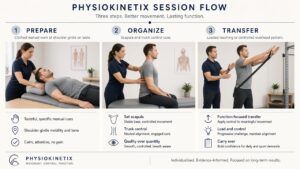
Illustrative Prepare → Organize → Transfer session flow for shoulder-girdle organization. Generated educational graphic; not clinical evidence.
1. **Prepare.** Hands-on work around the shoulder girdle, ribs, and related tissues can reduce guarding and make the next movement feel more available. Think preparation—not a permanent “realignment.”
2. **Organize the base.** Cue and load scapular positioning with the trunk involved: upward rotation and control that serve reaching, not isolated “squeeze your shoulder blades” as a lifestyle.
3. **Connect the chain.** Bring in hip and trunk contributions so the arm is not working alone.
4. **Transfer into task.** Closed-chain support, open-chain reaching, then loaded or sport-like patterns while the organization is fresh.
Clients at Temple Human Performance feel this as sessions that clear the arm’s path and then ask the whole body to use it. Students of Physiokinetix learn it as methodology: input, organization, load, and transfer—applied to one of the body’s most important kinetic links.
### What we are still learning
Useful open questions keep the work sharp:
– When scapular motion improves, how often does distal power or accuracy follow?
– Which core–scapula relationships are causal in daily life, and which are simply correlated?
– How lasting are the benefits of manual preparation beyond the session?
– How much pelvic-position change translates into meaningful scapular change for a given person?
Those questions refine programming. They do not change the central Physiokinetix idea: a strong arm needs a well-organized shoulder blade that can share force with the trunk and hips.
### Closing
The shoulder blade is not a decorative bone on the back. It is a mobile base and a kinetic-chain link. Physiokinetix trains it that way—prepare it, organize it with the trunk, and transfer that organization into real arm work—so strength has somewhere honest to live.
—
References
1. Aliaj K, Lawrence RL, Bo Foreman K, Chalmers PN, Henninger HB. Kinematic Coupling of the Glenohumeral and Scapulothoracic Joints Generates Humeral Axial Rotation. *Journal of Biomechanics.* 2022;136:111059. doi:10.1016/j.jbiomech.2022.111059 PMID:35367838
2. Solana-Tramunt M, Fakoor Rashid H, Norouzi N, et al. Effects of scapular-focused movement-based exercises on sports performance of athletes with scapular dyskinesis: A systematic review. *PLoS One.* 2026. doi:10.1371/journal.pone.0344540
3. Ellenbecker TS, Aoki R. Step by Step Guide to Understanding the Kinetic Chain Concept in the Overhead Athlete. *Current Reviews in Musculoskeletal Medicine.* 2020;13:155-163. doi:10.1007/s12178-020-09615-1
4. Kibler WB, Sciascia A. Current Concepts: Scapular Dyskinesis. *British Journal of Sports Medicine.* 2010;44:300-305. doi:10.1136/bjsm.2009.058834
5. Jildeh TR, Ference DA, Abbas MJ, Jiang EX, Okoroha KR. Scapulothoracic Dyskinesis: A Concept Review. *Current Reviews in Musculoskeletal Medicine.* 2021;14:246-254. doi:10.1007/s12178-021-09705-8
6. Saini SS, Shah SS, Curtis AS. Scapular Dyskinesis and the Kinetic Chain: Recognizing Dysfunction and Treating Injury in the Tennis Athlete. *Current Reviews in Musculoskeletal Medicine.* 2020. doi:10.1007/s12178-020-09672-6
7. Vleeming A, Pool-Goudzwaard AL, Stoeckart R, van Wingerden JP, Snijders CJ. The Posterior Layer of the Thoracolumbar Fascia. Its Function in Load Transfer From Spine to Legs. *Spine.* 1995;20:753-758. doi:10.1097/00007632-199504000-00001
8. Caldeira PF, Resende RA, Murta BJ, et al. Myofascial Force Transmission Between Latissimus Dorsi and Contralateral Gluteus Maximus in Runners: A Cross-Sectional Study. *Journal of Biomechanics.* 2024;177:112431. doi:10.1016/j.jbiomech.2024.112431
9. Lobbos BS, Essa MMM, Khaireldin A, et al. Influence of pelvic position on shoulder range of motion. *BMC Musculoskeletal Disorders.* 2025. doi:10.1186/s12891-025-08280-0