

Clinical context
Many everyday tasks call for a modest, steady amount of force rather than a maximal one. Holding a cup of coffee at arm’s length, lowering into a chair, keeping the head still while reading a screen, or easing the knee through the middle of a stair step all depend on producing a small force and holding it there without wobble. Strength tests rarely capture this. A person can test strong on a maximal effort and still struggle to hold a light, constant effort smoothly. Researchers call this quality force steadiness, and a consistent body of research shows that it tends to be reduced in people living with musculoskeletal pain.
At Temple Human Performance, we combine massage and osteopathic-based manual therapy with movement training and physical preparation in one plan. Force steadiness gives us a precise way to think about what happens between the hands-on work and heavier loading: the stage where a client learns to produce force with control, not just to produce more of it.
Scientific background
No muscle produces a perfectly constant force. When a person tries to hold a fixed target, the force output rises and falls slightly from moment to moment. Force steadiness describes how small those fluctuations are. In the laboratory it is usually tested during a submaximal isometric contraction, in which the person pushes against a force sensor at a set percentage of maximal effort, often between 5 and 25 percent, while watching a target line on a screen.
Two measures are common. The standard deviation of force describes the absolute size of the fluctuations. The coefficient of variation divides that standard deviation by the average force, which allows comparison across people and target levels. A higher coefficient of variation means a less steady contraction.
Steadiness is related to, but different from, accuracy. Accuracy asks whether the person reaches the target on average. Steadiness asks how much the force wanders around it. A contraction can be centered on the target and still be unsteady, which is why some of the studies below measure the two separately.
Test conditions matter. In 22 healthy volunteers, Krishnan and colleagues (2011) found that quadriceps force fluctuations, along with agonist and antagonist muscle activity, were significantly larger with the knee bent to 90 degrees than at 30 degrees. Joint position, target level, and the specific muscle all change the result, so a steadiness task has to be set up the same way each time if it is going to track change.
The nervous system’s contribution is central. Pethick and colleagues (2022), reviewing force control in aging, describe force fluctuations as reflecting the behavior of whole populations of motor units and conclude that age-related loss of force control is likely related to increased common fluctuations in the timing of motor unit discharges. Steadiness is therefore less about how big a muscle is and more about how smoothly its drive is organized.
What the research shows
The strongest synthesis is the meta-analysis by Arvanitidis and colleagues (2025), which pooled 32 studies, 19 in people with clinical pain and 13 using experimental pain in healthy volunteers. In clinical pain, force steadiness was reduced whether measured by the coefficient of variation (standardized mean difference 0.80, moderate strength of evidence) or by the standard deviation of force (0.61, low strength of evidence). With experimental pain, the coefficient of variation also showed reduced steadiness (0.50), but the standard deviation result (0.44) did not reach significance, and both experimental estimates rested on very low strength of evidence. The authors concluded that pain, particularly clinical pain, impairs force steadiness and that these impairments could become targets for treatment, while noting that the benefits of steadiness training still need to be studied.
Pethick, Clark, and Liew (2022) narrowed the question to peripheral joints. Across 14 studies and 694 participants with musculoskeletal disease, injury, surgery, or joint replacement in the arms or legs, the coefficient of variation of force was greater than in controls, though the overall effect was small (0.19). The difference appeared only when symptomatic people were compared with people without symptoms, not when an affected limb was compared with the person’s other limb. It was larger for knee conditions (0.29) and largest after surgery for anterior cruciate ligament injury (0.56). The pattern suggests that the effect depends on the joint, the condition, and how the comparison is made.
Individual studies show the effect in specific regions. Rice and colleagues (2015) injected hypertonic saline into the fat pad below the kneecap of 15 healthy volunteers to produce brief knee pain. During pain, quadriceps steadiness at 10 percent of maximal effort dropped in isometric, lowering, and lifting contractions alike. Matching error showed only a nonsignificant trend upward. Because the volunteers had healthy knees, the study isolates pain itself as a cause of reduced steadiness.
In the neck, Muceli and colleagues (2011) found that women with chronic neck pain had a higher coefficient of variation during light isometric neck flexion than controls (3.9 compared with 2.7 percent in one experiment, 3.4 compared with 1.7 percent in another), even though motor unit behavior and surface muscle activity were similar between groups. Brief vibration applied to the neck, which acts on sensory receptors in muscle, reduced the coefficient of variation in the women with neck pain but not in controls. The authors proposed that altered sensory input from the muscles, rather than a change in muscle activation, explained the unsteadiness. The samples were small, 9 and 10 per group.
English and colleagues (2025) tested 14 people with chronic neck pain and 15 without across six neck directions at 10 and 25 percent of maximal effort. Steadiness was significantly worse in the neck pain group at both levels, with the larger difference at 10 percent. The neck pain group also showed more variable error when matching a force. Test and retest reliability for steadiness was moderate to good for most contractions, which matters if steadiness is to be used to track change.
Attention and cognitive load also influence steadiness, at least in people without pain. Parr and colleagues (2023) had 27 participants perform an isometric hand force task with an internal focus on body sensations or an external focus on the outcome. The internal focus produced poorer accuracy and steadiness. Pereira and colleagues (2024) found that a difficult mental task during a very light elbow contraction reduced steadiness, especially in women and older adults, while larger, high-gain visual feedback improved steadiness in all groups.
Whether steadiness training changes pain or function is still an open question. Pethick and colleagues (2022) note evidence that physical activity interventions can reverse the loss of force control in older adults, but whether that improves daily function has not been established, and trials testing steadiness training in people with musculoskeletal pain remain limited.
Functional significance
Several points from this research shape how we view force control.
Steadiness is a separate quality from strength. In the neck pain study, steadiness was reduced even though motor unit behavior and surface muscle activity looked similar to controls. A client who has regained strength on a test may still produce force unevenly at the low and moderate levels that daily tasks actually use.
The deficit shows most at low force. In the neck studies and the knee pain model, differences were clearest at 10 to 25 percent of maximal effort. That is the range of holding, carrying, positioning, and controlled lowering, and it is easy to skip in a program that moves quickly toward heavy loading.
Sensory input appears to play a role. The neck vibration finding, though small and early, points toward the sensory side of control and fits the broader view that force output depends on what the nervous system is receiving as well as what it is sending.
The evidence has limits. Most studies are cross-sectional, so they show that pain and unsteadiness occur together rather than which comes first. The experimental pain evidence is of very low certainty, the peripheral joint effect overall is small, and training studies in pain populations are few. Steadiness is best treated as a meaningful, measurable aspect of control, not as the explanation for every symptom.
Application at Temple Human Performance
In our sessions, steadiness work sits where the hands-on work meets active loading.
Assessment includes the quality of a light, sustained effort, not only its size. We ask a client to hold a gentle press of the head into a hand, a light knee extension against resistance, or a shallow squat at a fixed depth, and we watch for tremor, drifting, breath holding, or bracing elsewhere in the body. We keep joint position and effort the same from one session to the next so a change means something.
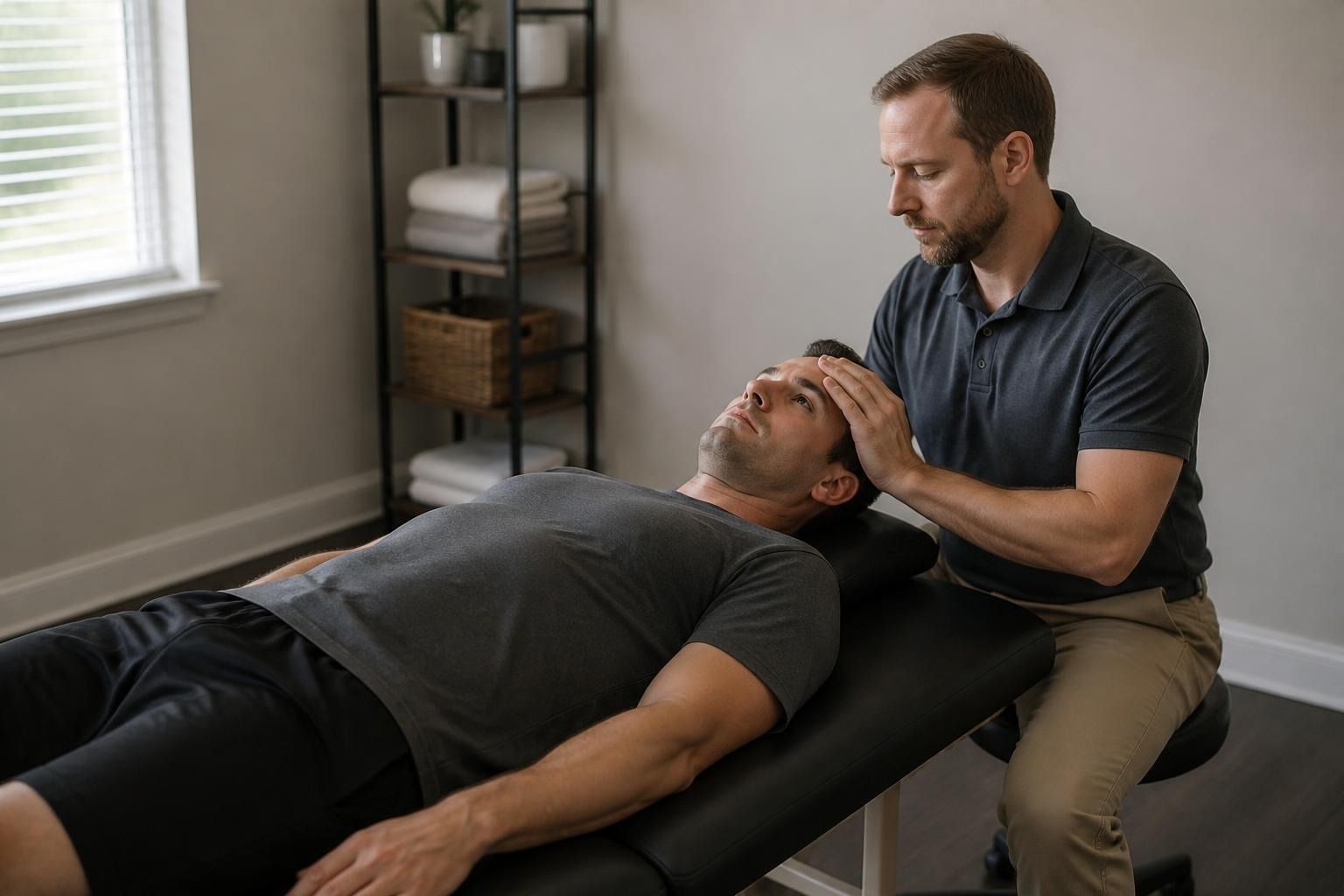
On the table, the hands-on work often opens the session by changing how a region moves or feels. We then use the change right away with low-force isometric holds, often around the same region. A light press of the head into a hand, a gentle push of the knee into resistance, or a slow hold of the shoulder blade against a fixed point asks the nervous system to grade a small force while sensory input from the session is fresh. We keep efforts light, often well below half of maximal effort, because that is where the research shows the largest differences.
From there, we vary the conditions that research shows affect steadiness. We change joint angle, hold time, and direction. We move from holds into slow lowering and lifting at controlled speed. We use simple, concrete targets, such as holding a mark or keeping a band at the same length, which keep attention on the outcome rather than on muscle sensations. Light bands work well for this, because they give a visible, graded resistance; the lightest level in our range, the PKT Neuro resistance band, suits the very low forces where steadiness is most challenged. We keep conversation and distraction to a minimum during precise holds early on, then add them back deliberately later when we want to test control under a divided focus.
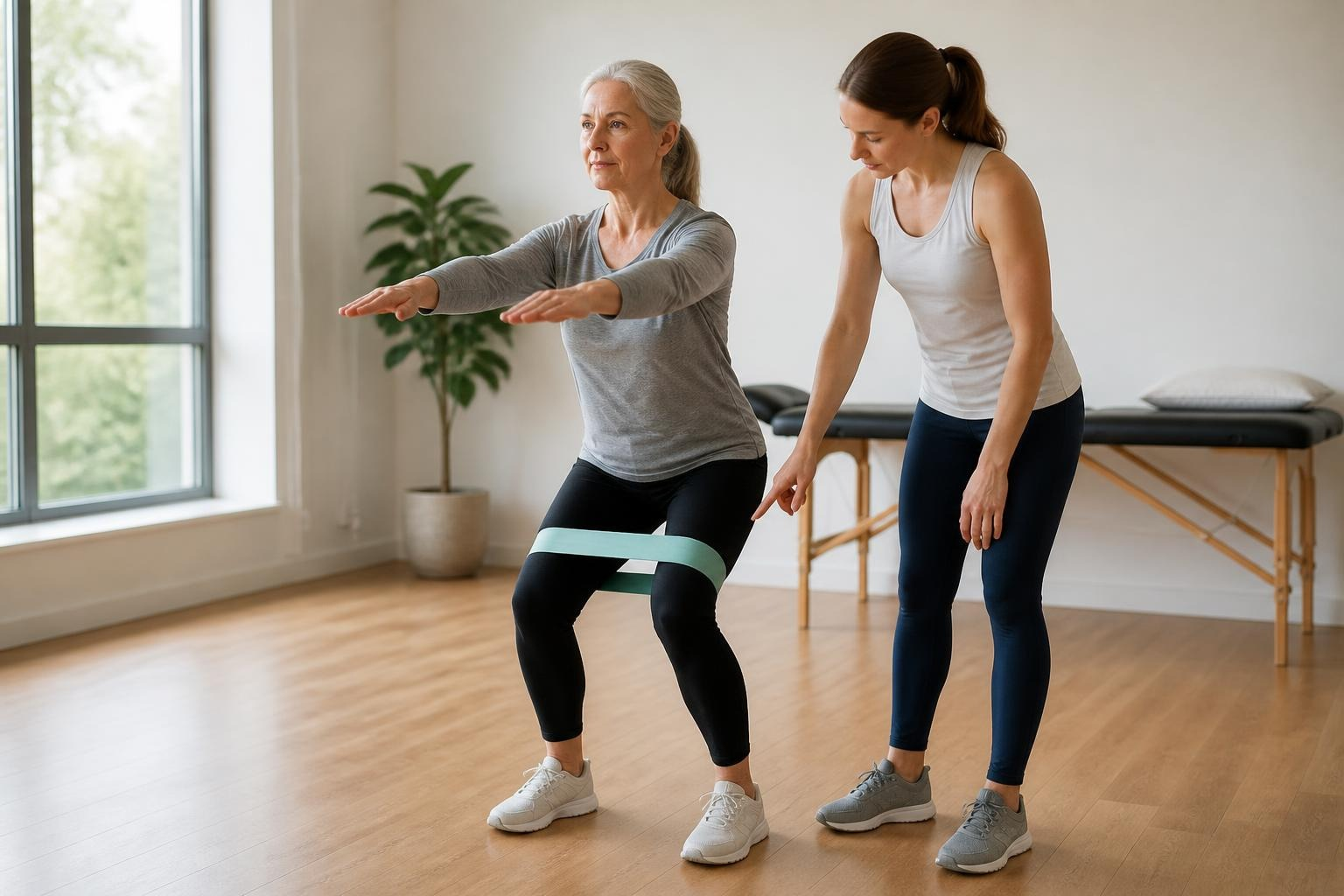
Steadiness does not replace strength or speed. Once a client can hold and move a light load smoothly, we add resistance, range, and eventually faster efforts, and we check that the control holds as the demand rises.
The Physiokinetix perspective
Physiokinetix organizes training through four levels: Mobility, Stability, Power, and Performance. Mobility gives the body options for movement. Stability is the ability to control movement, including holding and managing a position while moving. Power develops greater force, load tolerance, and rate of force. Performance applies those capacities to meaningful activity. The levels are progressive but not a fixed protocol, and a client’s needs determine where the work begins.
Force steadiness belongs mainly to Stability. It is the ability to produce a chosen amount of force and keep it there, which is a precise form of control. It also prepares the ground for Power, because loading a movement that is already unsteady at low force tends to build on an uneven foundation.
Table Neuro Training, the flagship PKT professional workshop, was developed to complement the Mobility and Stability levels of PKT Self-Care. It teaches practitioners to use the table as an environment where hands-on input is combined with active movement, resistance, and sensory input, which is close to how we use low-force holds right after table work. PKT Self-Care then gives clients simple tools and positions to keep practicing that control between sessions, so the change does not stay in the treatment room.
Conclusion
Force steadiness describes how evenly a person can hold a submaximal force. Meta-analyses show it is reduced in people with clinical musculoskeletal pain, with the strongest evidence for the coefficient of variation and smaller, less certain effects in peripheral joint conditions and experimental pain. Studies in the knee and neck show that pain can reduce steadiness directly, particularly at low forces, and that sensory input, attention, and cognitive load all influence it. Training effects in pain populations are not yet well established. Within our approach, we assess steadiness under consistent conditions, follow hands-on work with light, precise holds, vary position and task, and build toward heavier and faster loading once control is in place.
References
- Krishnan C, Allen EJ, Williams GN. Effect of knee position on quadriceps muscle force steadiness and activation strategies. Muscle and Nerve. 2011;43(4):563 to 573. https://doi.org/10.1002/mus.21981
- Pethick J, Taylor MJD, Harridge SDR. Aging and skeletal muscle force control: current perspectives and future directions. Scandinavian Journal of Medicine and Science in Sports. 2022;32(10):1430 to 1443. https://doi.org/10.1111/sms.14207
- Arvanitidis M, Falla D, Sanderson A, Martinez-Valdes E. Does pain influence control of muscle force? A systematic review and meta-analysis. European Journal of Pain. 2025;29(2):e4716. https://doi.org/10.1002/ejp.4716
- Pethick J, Clark NC, Liew B. Alterations in peripheral joint muscle force control in adults with musculoskeletal disease, injury, surgery, or arthroplasty: a systematic review and meta-analysis. Journal of Electromyography and Kinesiology. 2022;66:102696. https://doi.org/10.1016/j.jelekin.2022.102696
- Rice DA, McNair PJ, Lewis GN, Mannion J. Experimental knee pain impairs submaximal force steadiness in isometric, eccentric, and concentric muscle actions. Arthritis Research and Therapy. 2015;17:259. https://doi.org/10.1186/s13075-015-0768-1
- Muceli S, Farina D, Kirkesola G, Katch F, Falla D. Reduced force steadiness in women with neck pain and the effect of short term vibration. Journal of Electromyography and Kinesiology. 2011;21(2):283 to 290. https://doi.org/10.1016/j.jelekin.2010.11.011
- English DJ, Weerakkody N, Zacharias A, Green RA, French T, Hocking C, et al. Cervicocephalic force steadiness and force sense in people with and without neck pain. Musculoskeletal Science and Practice. 2025;76:103284. https://doi.org/10.1016/j.msksp.2025.103284
- Parr JVV, Gallicchio G, Canales-Johnson A, Uiga L, Wood G. Cortical, muscular, and kinetic activity underpinning attentional focus strategies during visuomotor control. Psychophysiology. 2023;60(6):e14249. https://doi.org/10.1111/psyp.14249
- Pereira HM, Keenan KG, Hunter SK. Influence of visual feedback and cognitive challenge on the age-related changes in force steadiness. Experimental Brain Research. 2024;242(6):1411 to 1419. https://doi.org/10.1007/s00221-024-06831-w