

Clinical context
Every step begins and ends at the foot. It is the only part of the body that touches the ground in standing, walking, and running, and it has to do two jobs that seem to pull in opposite directions. Early in stance it needs to soften and adapt to the surface. Moments later it needs to stiffen into a lever that can push the body forward. Much of that shift is managed by the arch, and much of the arch’s control comes from a group of small muscles that sit entirely within the foot. Training those muscles directly, an approach often described as training the foot core, has become a well-studied part of lower-limb conditioning.
At Temple Human Performance, we combine massage and osteopathic-based manual therapy with movement training and physical preparation in one plan. The foot is a natural place to see how that works. Hands-on work can change how the foot moves and what it feels, and specific training teaches the foot to use that change under body weight, in balance, and eventually in fast, loaded movement.
Scientific background
The muscles that control the foot fall into two groups. The extrinsic muscles, such as the calf muscles, tibialis posterior, and the peroneals, begin in the lower leg and cross the ankle with long tendons. They are large and powerful and move the foot and ankle as a whole. The intrinsic muscles begin and end within the foot itself. They are arranged in layers on the sole and include muscles such as abductor hallucis, which runs along the inner border of the foot, and flexor digitorum brevis, which lies beneath the plantar fascia. They are small, but they sit right under the arch and can fine-tune its shape and stiffness from moment to moment.
McKeon and colleagues (2015) proposed the foot core as a way to describe this system. Drawing a parallel with the deep muscles of the trunk that support the spine, they described the intrinsic foot muscles as local stabilizers of the arch, working alongside the larger extrinsic muscles, the passive structures of bones, ligaments, and plantar fascia, and the nervous system, which receives a dense stream of information from the sole. They also observed that the intrinsic muscles had largely been overlooked, with care for the foot more often directed at external support than at training the muscles to do their job.
The intrinsic muscles do work harder as demand rises. Ridge and colleagues (2022) recorded muscle activity with fine-wire electrodes in 20 healthy young adults across six standing postures, from standing on two feet to single-leg stance, squats, and heel raises. Intrinsic foot muscle activity increased as load and balance demand increased, while the extrinsic muscles each responded in their own way. The findings support a role for the intrinsic muscles in standing balance and suggest that the intrinsic and extrinsic muscles work together rather than in isolation.
The best-known training exercise is the short-foot exercise. The person draws the ball of the big toe toward the heel to lift and shorten the arch while keeping the toes long and relaxed rather than curling them. Other common exercises include toe spreading, lifting the big toe while keeping the smaller toes down and the reverse (sometimes called toe yoga), and resisted toe flexion. Loaded exercises such as heel raises then train the intrinsic and extrinsic muscles together.
What the research shows
Jaffri and colleagues (2023) carried out the most direct meta-analysis, pooling 13 randomized trials of intrinsic foot muscle training that met a minimum quality threshold. Compared with control groups, training reduced navicular drop, a measure of how far the inner arch lowers when weight is taken, and improved the Foot Posture Index. It also improved balance, foot strength, and self-reported disability. The pooled effects ranged from small to large across outcomes, with standardized mean differences reported as ranges, for example 0.37 to 1.83 for navicular drop and 0.18 to 1.86 for balance. Training was not superior to control for reducing pain.
Wei and colleagues (2022) reviewed 16 studies, 10 of high and 6 of moderate quality, and reached a similar conclusion: intrinsic foot muscle training had positive effects on the shape and behavior of the medial longitudinal arch and improved dynamic balance. The authors called for more standardized training methods matched to the demands of different sports.
Older adults are a group in whom foot strength and balance carry particular weight. Futrell and colleagues (2022) reviewed nine studies of intrinsic foot muscle strengthening in adults aged 65 and older. The interventions contributed to improvements in strength, balance, and mobility, with little effect on gait. The quality of evidence was fair, and the studies were too varied to pool statistically. Participants’ own reports suggested that better sensation and awareness of the feet might be part of the benefit.
Recent trials add detail. In 24 young adults with chronic ankle instability, Katsuya and colleagues (2026) found that four weeks of short-foot exercise, three times a week, improved single-leg static balance and the participants’ own sense of ankle stability compared with controls, though dynamic reach balance did not change. In 28 healthy, recreationally active adults, Gabriel and colleagues (2024) assigned one leg to foot exercises twice a day for four weeks. The Foot Posture Index improved by 26 percent in the trained leg and by 11 percent in the untrained leg, and the trained leg’s improvement was still present after a four-week break. Ankle range of motion and balance in the trained leg improved, becoming significant at the follow-up. Flexibility and performance further up the back of the leg did not change, so the effects in these healthy young adults were local to the foot.
Foot training also appears to work best as part of a larger plan. In a network meta-analysis of 11 randomized trials in adults with flexible flat feet, Jia and colleagues (2024) found that the short-foot exercise improved navicular drop compared with control, but the highest-ranked programs combined foot work with training further up the chain, such as tibialis posterior strengthening with hip flexor stretching, hip-focused neuromuscular exercise, or intrinsic foot training combined with gluteal strengthening. These rankings rest on a small number of trials, and some of the estimates had wide confidence intervals that crossed zero, but the authors concluded that hip and whole-limb training were particularly effective.
Performance findings are mixed. Day and Hahn (2019) randomized 20 runners and found that ten weeks of intrinsic foot strengthening increased toe flexor strength but did not change joint mechanics at the toes and ankle or running economy. In contrast, Sulowska-Daszyk and colleagues (2024) randomized 55 recreational runners to eight weeks of short-foot exercises or training in minimalist shoes. Running velocity at lactate threshold rose in both groups, but only the short-foot group’s change was significant. The two trials measured different outcomes, and both were small, so the performance question remains open.
Functional significance
Three points stand out from this research.
The clearest benefits are in foot posture, arch control, strength, and balance. Pain, gait, and running performance show weaker or less consistent effects. Training the foot core builds a better-controlled foot. It is not a guaranteed route to relieving symptoms on its own.
The intrinsic muscles matter most under load and balance demand. Their activity rises as stance narrows and load increases, and single-leg control is where many of the training effects show. That points training toward standing and single-leg work rather than leaving it seated.
The foot works within a chain. The best-ranked programs for arch measures combined foot training with hip and whole-limb work, and the foot’s role in balance links it to everything above. In healthy young adults, four weeks of foot exercise did not change the posterior chain on its own, which suggests that the connections up the chain have to be trained rather than assumed.
Application at Temple Human Performance
In our sessions, foot work starts with how the foot moves and what it can sense. We look at the mobility of the toes and the joints of the midfoot, how the arch behaves as weight moves onto one leg, how well a client can lift the big toe or the smaller toes independently, and what happens to the foot and the rest of the leg in single-leg stance.
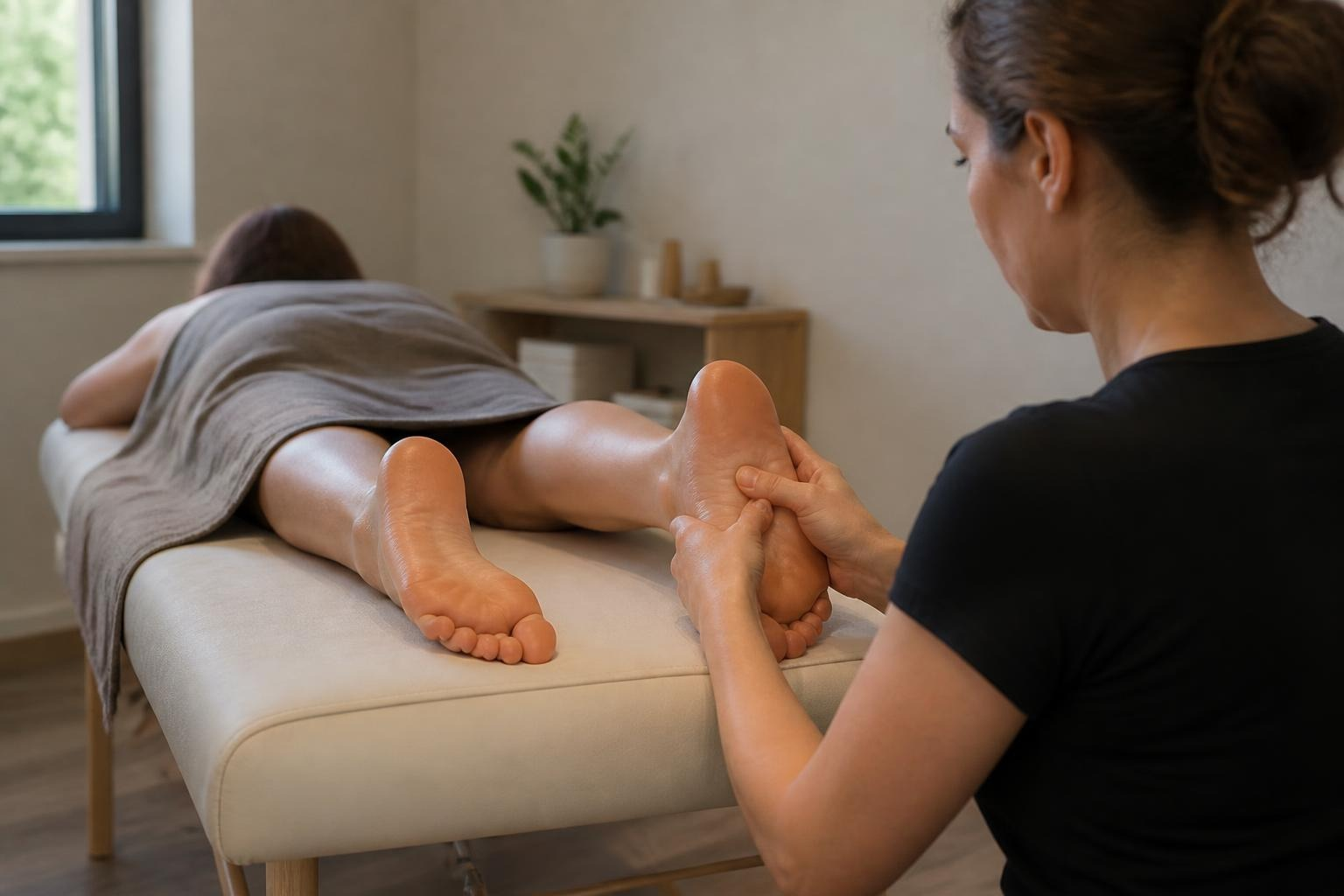
On the table, we work the sole of the foot, the toes, and the calf, and mobilize the joints of the foot and ankle where movement is limited. The aim is not only comfort. A foot that moves more freely and sends clearer information through the sole is ready to be used. We then ask for activity right away, often with the client still on the table or seated: doming the arch, spreading the toes, or separating the big toe from the others. Doing this while the effects of the hands-on work are fresh gives the nervous system a chance to use new range and sensation instead of letting it fade.
From there, we progress the work into standing. The short-foot exercise moves from seated to standing to single-leg stance, then into reaching, half squats, and step-downs while the arch stays controlled. Resisted toe and ankle work, such as pressing the toes into a light band or pulling the foot inward against it, adds load to the small muscles. A light band such as the PKT Neuro resistance band gives the gentle, graded resistance these small muscles need. Heel raises on two legs and then one leg bring the intrinsic and extrinsic muscles together under body weight.
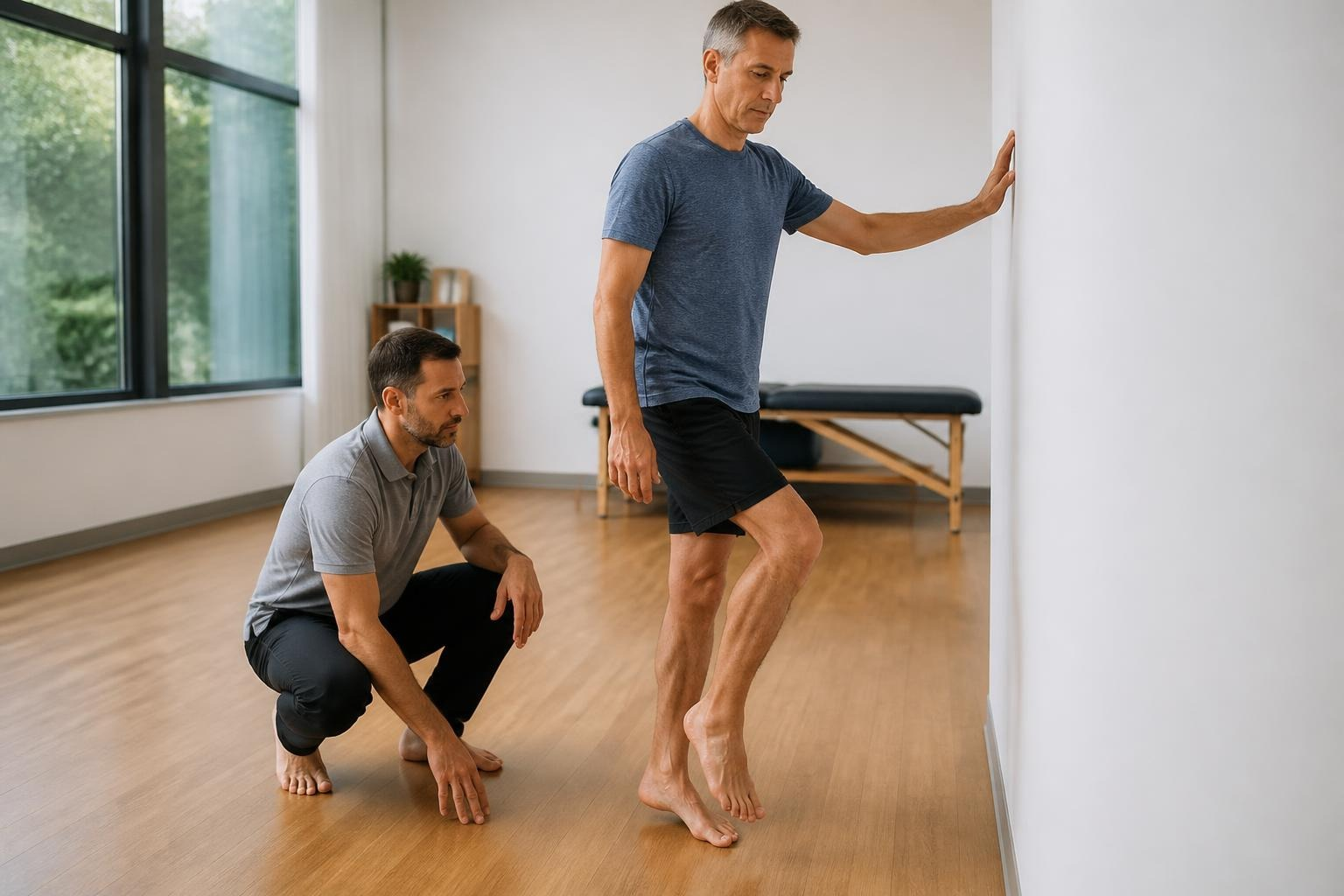
We train the foot alongside the hip and the rest of the leg rather than on its own. The research ranking combined programs highest, and in practice the control we build at the foot is only useful when the knee and hip organize around it. Over time, the work moves toward faster and more dynamic tasks such as hopping, quick direction changes, and walking or running drills, where the foot has to shift between soft and stiff in a fraction of a second.
The Physiokinetix perspective
Physiokinetix organizes training through four progressive levels: Mobility, Stability, Power, and Performance. The foot shows clearly how they connect. Mobility at the toes, midfoot, and ankle gives the foot the options it needs to adapt to the ground. Stability, which includes balance and control of position, is where the foot core does much of its work, holding the arch under body weight and in single-leg stance. Power brings in load and rate through heel raises, resisted work, and hops. Performance applies that capacity to walking, running, sport, and daily life. The levels build on one another, but they are not a rigid sequence, and the person’s needs determine where the work starts.
Physiokinetix also looks beyond the place where a person feels a problem. The 5 Key Links in PKT education address relationships through the kinetic chain, including how a region near the ground can influence, and be influenced by, regions above it. The foot is a clear example. The research suggests that foot training does the most when it is paired with work at the hip and the rest of the limb, and that the chain has to be trained as a chain.
Table Neuro Training, the flagship PKT professional workshop, was developed to complement the Mobility and Stability levels of PKT Self-Care. It teaches practitioners to use the table as a place where hands-on input is combined with active movement and sensory input, which is close to how we pair plantar work with immediate arch and toe activation. PKT Self-Care then gives clients simple tools and positions to keep training the foot between sessions, which matters because the foot core improves with regular practice.
Conclusion
The intrinsic foot muscles are small, but they sit at the base of every standing movement and help control the arch as the foot shifts between adapting to the ground and pushing off it. Systematic reviews show that training them improves arch measures, foot strength, and balance, with weaker and less consistent effects on pain, gait, and running performance, and the strongest programs combine foot training with work further up the leg. Within our approach, we use hands-on work to restore movement and sensation in the foot, activate the foot core immediately, progress it into standing, single-leg, and loaded tasks, and connect it to the hip and the rest of the chain so the foot can do its job in real movement.
References
- McKeon PO, Hertel J, Bramble D, Davis I. The foot core system: a new paradigm for understanding intrinsic foot muscle function. British Journal of Sports Medicine. 2015;49(5):290. https://doi.org/10.1136/bjsports-2013-092690
- Ridge ST, Rowley KM, Kurihara T, McClung M, Tang J, Reischl S, et al. Contributions of intrinsic and extrinsic foot muscles during functional standing postures. BioMed Research International. 2022;2022:7708077. https://doi.org/10.1155/2022/7708077
- Jaffri AH, Koldenhoven R, Saliba S, Hertel J. Evidence for intrinsic foot muscle training in improving foot function: a systematic review and meta-analysis. Journal of Athletic Training. 2023;58(11-12):941 to 951. https://doi.org/10.4085/1062-6050-0162.22
- Wei Z, Zeng Z, Liu M, Wang L. Effect of intrinsic foot muscles training on foot function and dynamic postural balance: a systematic review and meta-analysis. PLoS One. 2022;17(4):e0266525. https://doi.org/10.1371/journal.pone.0266525
- Futrell EE, Roberts D, Toole E. The effects of intrinsic foot muscle strengthening on functional mobility in older adults: a systematic review. Journal of the American Geriatrics Society. 2022;70(2):531 to 540. https://doi.org/10.1111/jgs.17541
- Katsuya M, Yoshida K, Takano S, Hayashi K, Nakamura S, Yunosawa T, et al. Short-foot exercises improve postural control and ankle instability in chronic ankle instability: a randomized controlled trial. Journal of Athletic Training. 2026;61(4):272 to 278. https://doi.org/10.4085/1062-6050-0433.25
- Gabriel A, Ridge ST, Birth M, Horstmann T, Pohl T, Konrad A. Local and non-local effects (on the posterior chain) of four weeks of foot exercises: a randomized controlled trial. Scientific Reports. 2024;14(1):22000. https://doi.org/10.1038/s41598-024-71585-y
- Jia Y, Sai X, Zhang E. Comparing the efficacy of exercise therapy on adult flexible flatfoot individuals through a network meta-analysis of randomized controlled trials. Scientific Reports. 2024;14(1):21186. https://doi.org/10.1038/s41598-024-72149-w
- Day EM, Hahn ME. Increased toe-flexor muscle strength does not alter metatarsophalangeal and ankle joint mechanics or running economy. Journal of Sports Sciences. 2019;37(23):2702 to 2710. https://doi.org/10.1080/02640414.2019.1661562
- Sulowska-Daszyk I, Zając B, Mika A. The influence of foot muscles exercises and minimalist shoes on lactate threshold velocity in long-distance amateur runners: a randomized controlled trial. Scientific Reports. 2024;14(1):16496. https://doi.org/10.1038/s41598-024-67525-5