A very light contact can change how a person stands. The contact need not bear weight. In laboratory studies of healthy adults, a fingertip or a partner’s touch, often under 1 N, is enough to reduce postural sway during quiet standing. The contact appears to give the nervous system information about where the body is, rather than holding the body up.
That finding matters to how we think about sensory input in a session. Hands-on work is not only a mechanical event. A light cue can also be a source of information. The studies reviewed here tested fingertip or shoulder contact during quiet standing. They did not test table work, and they do not show that a hands-on session improves balance or that the effect carries into walking, reaching, or other dynamic tasks.
For nearly 30 years, Temple Human Performance has combined massage and osteopathic-based manual therapy with movement training and physical preparation in one plan. Light-touch research helps us treat contact as information, and it helps us distinguish a sensory cue from a brace.
Lara and colleagues (2022) asked healthy adults to stand as quietly as possible on a force plate, either touching a rigid surface with a fingertip at less than 1 N or not touching at all. Eight people stood on both feet and 14 stood on one leg. In both stances, light touch reduced the area, magnitude, and velocity of center-of-pressure motion compared with no touch.
Brachman, Michalska, and Bacik (2025) tested 25 healthy students with and without light touch, with the eyes open or closed, and with or without a simple reaction-time task. Light touch reduced anteroposterior sway velocity and the standard deviation of sway in both the visual and the reaction-time conditions, with large effects. Reaction time itself did not differ across postural conditions. Sway also became less regular with light touch. The authors suggested that the contact may redirect attention outward. That reading is an inference from the change in regularity, not a direct measure of attention.
These are short-term, laboratory effects in quiet standing. They describe how sway changes while the contact is present. They do not describe what happens after the contact is removed, and they do not describe performance in a moving task.
If the effect were only mechanical, a heavier contact might be expected to work better simply by holding the person up. Prado-Rico and colleagues (2018) had 10 young adults stand quietly while touching a rigid bar at target forces of 1, 2, 4, 6, or 8 N, with the eyes open or closed. Touch reduced the sway trajectories, especially a slower component the authors associated with more supraspinal control, and especially with the eyes closed. The amplitudes and velocities reached a minimum at 4 N. In other words, a contact well below the force needed to lean on a surface was already enough to change sway, and adding more force did not keep reducing it in this study. The idea that the slower component reflects a particular level of the nervous system is the authors’ framing of that measure.
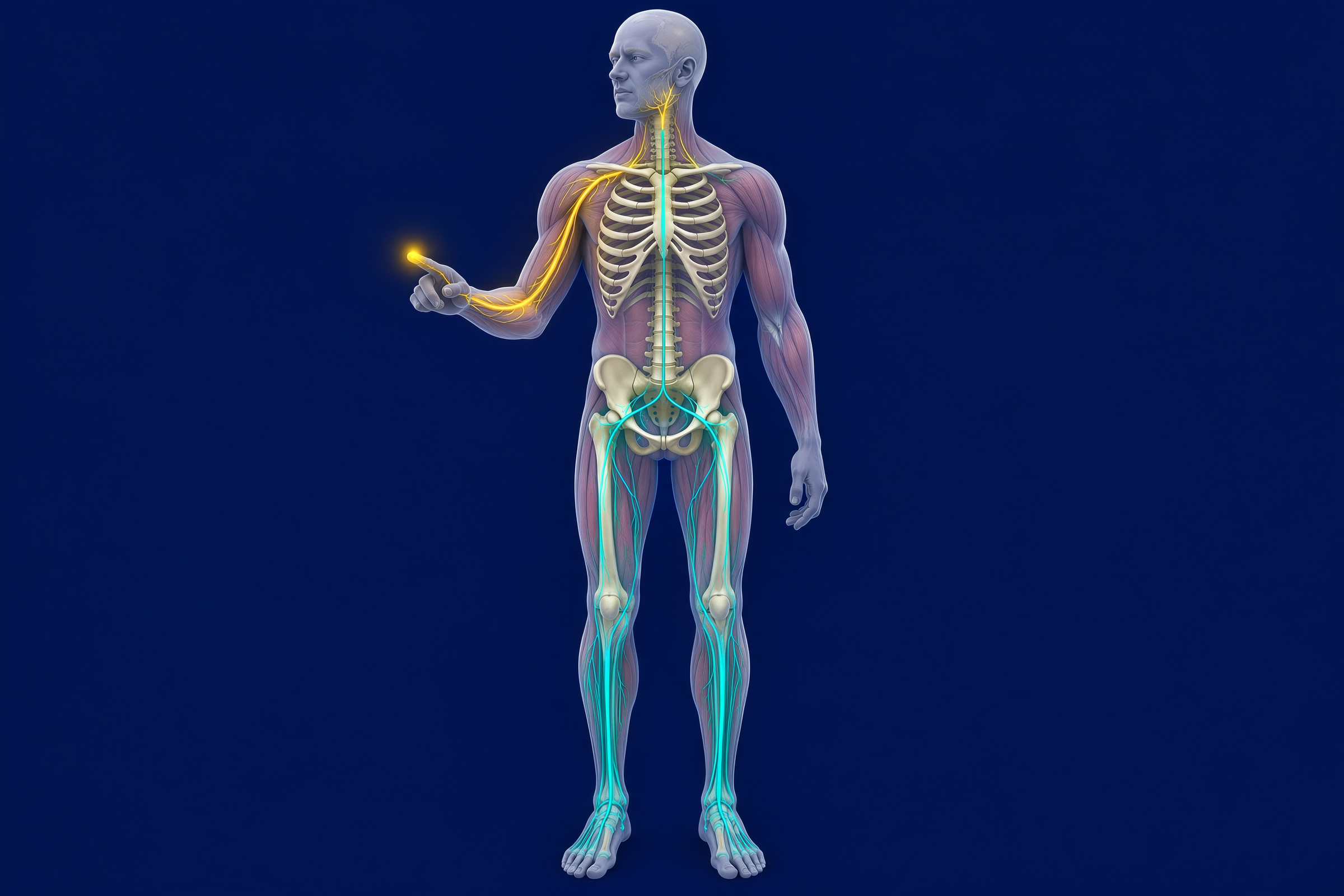
A pathway from the hand to the ankle muscles has also been measured. Toth, Fenrich, Jones, and Misiaszek (2022) recorded single cutaneous afferents in the median nerve and looked at their relationship to ankle-muscle activity. Thirty-four of 42 afferents, or 81%, modulated electromyographic activity in tibialis anterior or soleus at latencies between 40 and 119 ms, including slow- and fast-adapting receptors and muscles in both legs. The same class of afferents also responded when a light-touch contact was displaced across their receptive fields. The authors concluded that cutaneous receptors in the hand can alter the excitability of motoneuron pools that matter for stance, at latencies consistent with spinal pathways and relevant for rapid responses. The coupling itself was measured. The suggestion that this pathway supports everyday balance corrections is an interpretation of those latencies and connections.
The contact can also be another person. Ishigaki, Yamamichi, Ueta, and Morioka (2022) compared no touch, light fingertip contact with a fixed object, and light interpersonal contact during closed-eyes tandem stance. Both the fixed contact and the partner contact reduced sway, but the fixed contact produced greater stability. When two people were in contact, their sway was generally coordinated in the slower component of motion, at or below 0.4 Hz, rather than in the faster component.
Johannsen, Wing, and Hatzitaki (2012) studied eight pairs standing with the eyes closed, in a usual two-footed stance or a tandem stance, with light finger-to-finger or shoulder-to-shoulder contact, or with no contact. Interpersonal light touch usually reduced motion of the upper trunk compared with no contact, and the reduction was generally greater with shoulder contact than with finger contact. In two stance-and-contact combinations, however, sway increased. Partner touch, then, is not a uniform substitute for a fixed surface, and the site of contact and the stance of each person can change the result.
Ikawa, Miura, Miyata, and Kudo (2026) had people stand quietly in pairs and separately manipulated interpersonal touch and whether the partner was visible. Both tactile contact and seeing the partner were associated with reduced sway, with no significant interaction between the two, which the authors described as additive. Touch and vision were also associated with different changes in the temporal organization of the sway signal.
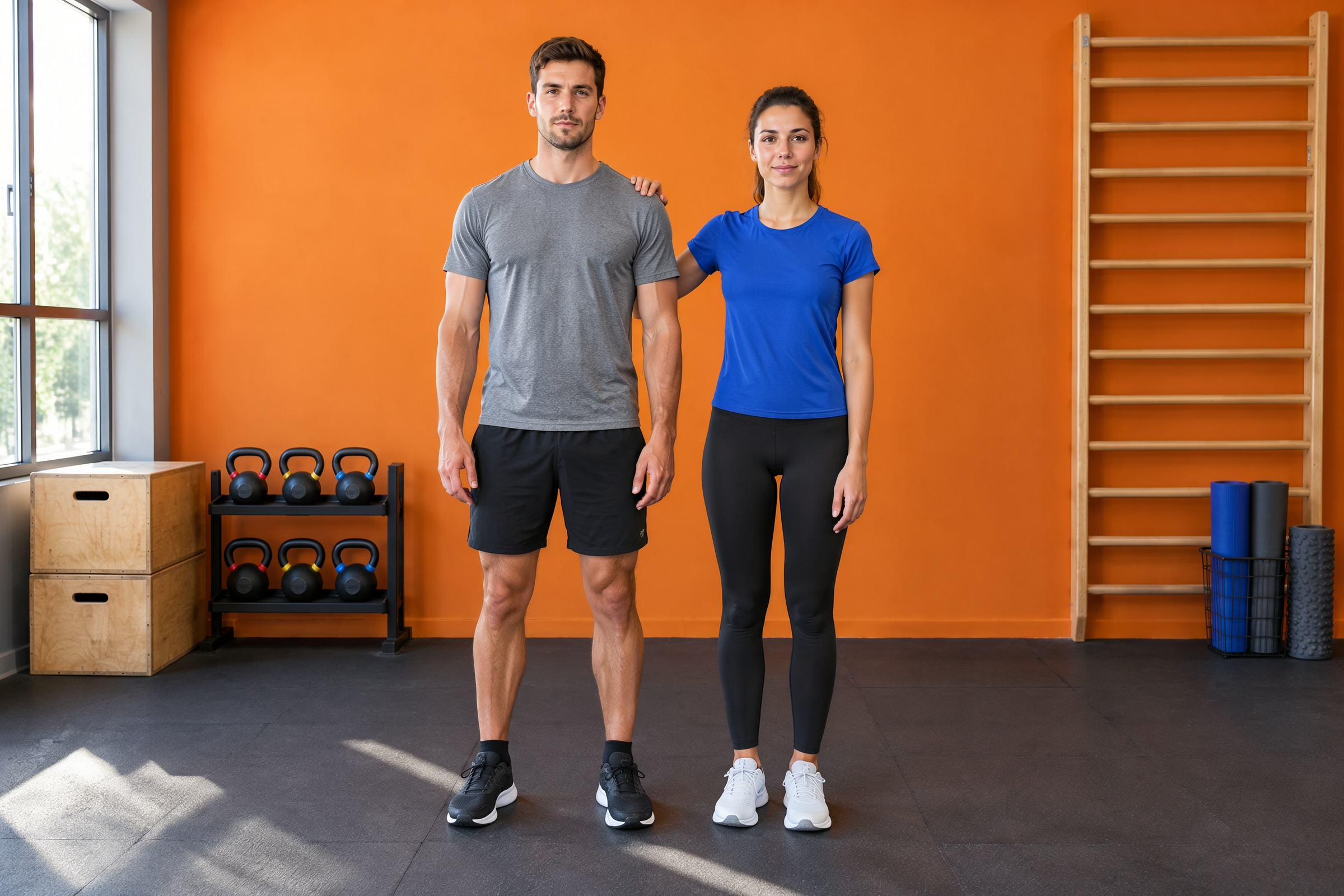
We read this work as evidence that a light contact can inform the nervous system during quiet standing. We do not read it as evidence that table work, or a hands-on session in general, improves balance.
In practice, that distinction changes how we use contact. When a person is organizing a stance, a fingertip on a surface or a light hand at the shoulder can be a temporary source of information. It is not a brace. The force in these studies was small enough that the person still had to control the position. We watch for the difference between a cue the person can use and a support the person begins to lean on.
We also treat the contact as something to fade. The laboratory effects were measured while the touch was present. There is no evidence in this set of studies that the same reduction in sway carries over once the contact is removed, or that it appears in a reach, a step, or a walk. After a brief period with a light cue, we ask the person to organize the same stance without it, and then to use that control in movement. That sequence is how we apply the principle. It is not a protocol tested by these papers.
Physiokinetix is a professional education and movement system built on the view that movement comes from interacting systems, including sensory information, motor control, and joint mechanics. A light contact is one example of how sensory input can change the way a position is organized, even when the contact does not hold the person up.
The Self-Care framework progresses through Mobility, Stability, Power, and Performance. Those levels are a guide, not a rigid protocol. Stability is the level most directly involved here: the ability to control a position, including while a sensory condition changes. A light cue may help a person sense a stance more clearly. Removing the cue, and then taking that control into a step or a reach, is how the session moves from a quiet position toward control in movement, and later toward the speed and specificity of Power and Performance. Progressive loading belongs at every level. The point is not to turn fingertip contact into a formula. It is to treat sensory information as part of how movement is organized, and to let the person keep that organization when the cue is gone.
This is a narrower question than a general account of proprioception, and it is distinct from training a person to catch a loss of balance. It is also distinct from asking whether a reach test and a quiet stance show the same short-term change after table work. The channel in these studies is a light point of contact during standing, and the finding is about that channel.
In healthy adults, a very light fingertip or partner contact during quiet standing reduces postural sway. The effect appears at forces too small to serve as a support, a measured pathway links cutaneous afferents in the hand to ankle-muscle activity, and partner contact can stabilize stance while remaining different from contact with a fixed surface. These are acute effects in standing. They were not tests of table work, and they do not show carry-over to dynamic tasks. We use them to treat light contact as information, to keep that contact from becoming a brace, and to ask the person to organize the same stance, and then movement, without it.