

Clinical context
Reaching to a high shelf, looking over a shoulder before changing lanes, throwing a ball, or simply sitting tall at a desk all involve more than the shoulder joint or the neck alone. Each depends on the middle of the spine, the thoracic region, moving with them. The thoracic spine has twelve vertebrae, each linked to a pair of ribs, and it sits between the neck above and the lower back below. When it extends, rotates, and bends to the side freely, the shoulders and neck have a mobile base to work from. When it does not, those regions often have to find their range somewhere else.
At Temple Human Performance, we combine massage and osteopathic-based manual therapy with movement training and physical preparation in one plan. The upper back is one of the clearest places to see why. Hands-on work can change how the thoracic spine moves, and training teaches the shoulders and neck to use that movement in reaching, turning, and lifting.
Scientific background
The shoulder is a system of joints. The upper arm moves on the shoulder blade, the shoulder blade glides and rotates on the rib cage, and the rib cage moves with the thoracic spine. When the arm rises, all of these move together.
Crosbie and colleagues (2008) measured this coordination in 32 healthy women as they raised one or both arms forward, to the side, and in the plane of the shoulder blade. Motion of the upper arm, the shoulder blade, and the thoracic spine was consistent and synchronous, and raising one arm produced different patterns of spinal motion from raising both. The authors concluded that assessment of the shoulder should include the upper back.
Posture of the upper back changes what the shoulder can do. Kebaetse and colleagues (1999) seated 34 healthy adults in an erect and then a slouched posture. In the slouched position, the shoulder blade rode higher during the first part of arm elevation and tilted back less near the top. Active range of arm elevation was on average 23.6 degrees less, and force with the arm held out horizontally was 16.2 percent lower. A single change in thoracic position, without any change at the shoulder itself, altered both range and strength.
The neck is linked in a similar way. The upper thoracic vertebrae sit directly beneath the cervical spine, and turning or tilting the head draws on movement at the junction between them. Thoracic mobility is therefore one of the factors that shapes how much the neck has to do in daily tasks.
Researchers often describe these links under the heading of regional interdependence: the idea that movement in one region can influence comfort and function in another. Within Physiokinetix, the same idea runs through the way we assess the kinetic chain.
What the research shows
Much of the research on the upper back and shoulder comes from trials that added hands-on thoracic work to exercise or compared it with a placebo. Two reviews by the same group summarize this work, and they answer slightly different questions.
Yu and colleagues (2025) pooled 10 randomized trials with 444 participants with shoulder pain classified as subacromial impingement. Thoracic manual therapy, either added to exercise or compared with placebo, produced a large short-term effect on pain (standardized mean difference negative 0.83, rated high-quality evidence by the authors) and improved disability at intermediate follow-up (negative 0.82). Moderate evidence supported improved internal and external rotation of the shoulder.
In a second review, Yu and colleagues (2026) looked at 12 trials with 508 participants with shoulder pain and asked which type of thoracic technique mattered. Gentle, graded oscillating mobilization, the Maitland approach, showed greater improvement than control interventions in pain and disability in the impingement group. High-velocity thrust techniques did not show significant effects in either impingement or adhesive capsulitis, and there were too few trials of the Mulligan approach to judge. The difference between the two reviews is mainly one of focus: the first asked whether thoracic hands-on work helps at all, and the second asked which forms helped most.
A recent trial shows how the hands-on work and exercise fit together. Calik and colleagues (2026) randomized 32 adults aged 25 to 50 with impingement-type shoulder pain to a home program of rotator cuff and shoulder blade exercises, with or without six weeks of added thoracic mobilization. The group that also received mobilization showed a greater increase in the space between the top of the arm bone and the acromion when the arm was raised to 60 and 90 degrees, a larger reduction in thoracic kyphosis angle, less pain, and better shoulder function at both 6 and 12 weeks.
For the neck, results follow the same pattern with an important caution. Masaracchio and colleagues (2019) reviewed 14 trials of thoracic thrust manipulation for mechanical neck pain. It outperformed thoracic or cervical mobilization and standard care in the short term for pain and disability, but was no better than cervical manipulation or a placebo thoracic manipulation, and the overall evidence was rated very low to moderate. The placebo comparison suggests that much of the short-term change comes from effects that are not specific to the exact technique.
Active approaches to the upper back also help. Cho and colleagues (2017) compared four weeks of upper thoracic mobilization with thoracic mobility exercise against upper cervical mobilization with stabilization exercise in 32 adults with forward head posture. The thoracic group showed greater improvements in head and neck alignment, cervical extension, neck pain, and neck disability at six weeks. Sun and colleagues (2024) randomized 30 adults with chronic neck pain to six weeks of deep neck flexor and shoulder blade stability training alone or combined with self-mobilization of the neck or of the neck and upper back. Adding self-mobilization produced better gains in neck extension, side bending, rotation, and quality of life than exercise alone.
These studies have limits. Most are small, most follow people for weeks rather than months, blinding is difficult, and the populations are people with shoulder or neck pain rather than healthy movers. The trend across them is consistent, though: improving thoracic movement tends to improve how the shoulder and neck move and feel, especially when it is paired with active exercise.
Functional significance
Three points shape how we use this research.
The upper back is part of every arm movement. Thoracic motion is coordinated with shoulder blade and arm motion during elevation, and thoracic position alone changed arm range by more than 20 degrees and arm strength by about 16 percent. When the shoulder lacks range or strength, the thoracic spine is one of the first places to look.
Gentle, graded hands-on work fits the evidence best. In the shoulder review that compared techniques, graded mobilization helped while thrust techniques did not show significant effects, and in neck pain, thrust manipulation was no better than placebo. This supports approaches that are comfortable, controlled, and paired with movement rather than relying on a single forceful input.
Movement finishes the job. The trials with the clearest benefits added thoracic work to exercise, or used mobility exercise and self-mobilization themselves. The change created on the table is most useful when it is put straight into active movement.
Application at Temple Human Performance
In our sessions, we look at the upper back whenever the shoulder or neck is the area of concern. We watch how a client raises both arms and one arm, how the rib cage and spine move as the arms go overhead, how far the trunk rotates in sitting, and how the head turns. A shoulder that runs out of range early, a neck that does most of the turning, or a rib cage that does not move under a rising arm all point toward the thoracic region.
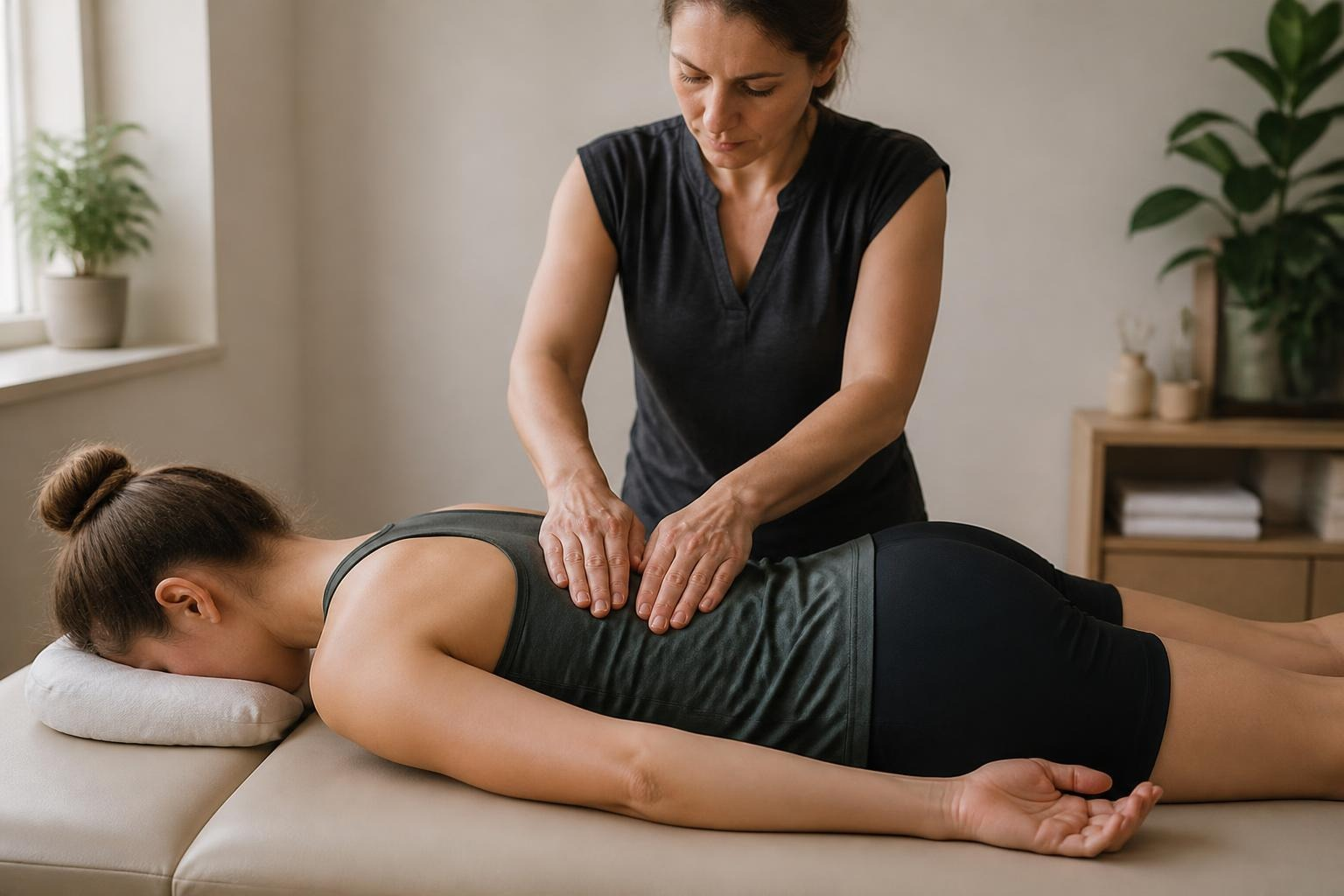
On the table, the hands-on work for the upper back is graded and comfortable: gentle mobilization of the thoracic segments and ribs, soft-tissue work around the shoulder blades, and positioning that lets the spine extend and rotate. We then ask for active movement while that change is fresh. A client might raise the arms while lying on the table, rotate the trunk with the knees bent, or breathe into the upper back while the shoulder blades move.
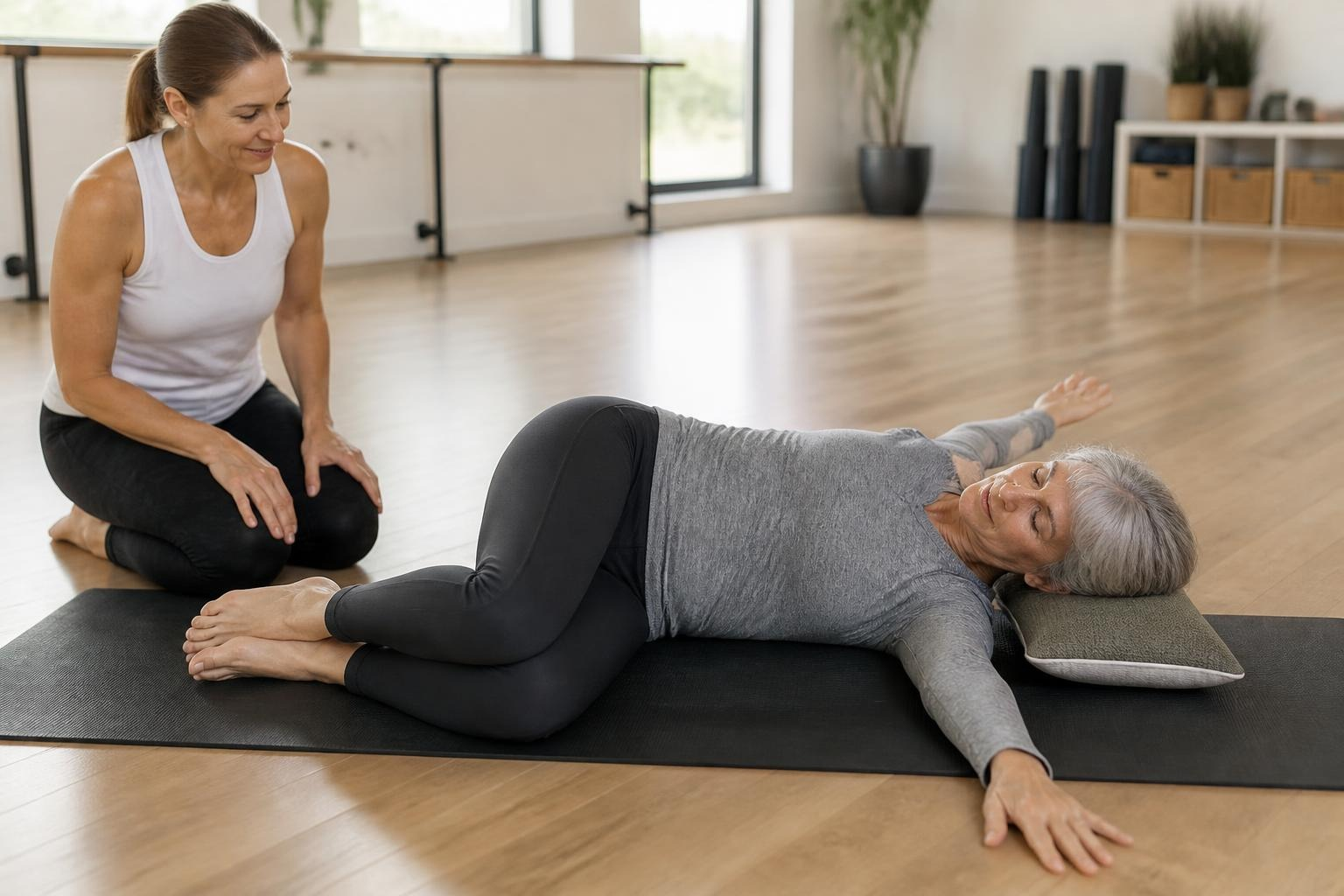
Off the table, mobility work for the upper back becomes part of the client's practice. Side-lying open-book rotation, extension over a roller or the edge of a bench, quadruped rotation, and half-kneeling reaches overhead all give the thoracic spine a chance to move under the client's own control. We then link that range to the shoulder blades and arms with reaching and rowing against a light band such as the PKT X-Lite resistance bands, pressing, and carrying, so the shoulders learn to use the mobility under load rather than leaving it in a stretch.
The progression continues into strength and speed. Rotational pulls and presses, overhead carries, and throwing or swinging patterns ask the upper back to rotate and extend while the arms produce force. Self-mobility drills remain part of the plan between sessions, because the research suggests that short-term changes hold best when they are practiced.
The Physiokinetix perspective
Physiokinetix organizes training through four progressive levels: Mobility, Stability, Power, and Performance. Mobility gives the body movement options, and the upper back is a region where those options directly shape what the shoulder and neck can do. Stability is the ability to control movement, such as holding the shoulder blades and rib cage in good positions while the arms move. Power builds force and load tolerance through presses, pulls, and rotational work. Performance applies those capacities to throwing, lifting, swimming, desk work, and daily life. The levels build on one another but are not a rigid protocol.
The PKT education on the 5 Key Links and on Spinal Kinematics both apply here. The 5 Key Links address relationships through the kinetic chain, including how one region can influence or be influenced by its neighbors, and Spinal Kinematics treats the spine as a coordinated movement system rather than a stack of isolated segments. Both encourage practitioners to look beyond where a person feels a problem. A stiff upper back that limits the shoulder is a clear example of a nearby region shaping how another moves.
Table Neuro Training, the flagship PKT professional workshop, was developed to complement the Mobility and Stability levels of PKT Self-Care. It teaches practitioners to use the table as a place where hands-on input is combined with active movement and sensory input, much as we pair thoracic hands-on work with arm and trunk movement before a client stands. PKT Self-Care then gives clients simple positions and tools to keep their upper back moving between sessions.
Conclusion
The thoracic spine moves with the shoulder blade and arm during every reach overhead, and its position alone can change shoulder range and strength. Trials and reviews in people with shoulder and neck pain show that improving thoracic movement, particularly with gentle mobilization combined with exercise or with active self-mobilization, improves shoulder and neck range, comfort, and function in the short term, while forceful thrust techniques have not shown clear advantages. Within our approach, we assess the upper back alongside the shoulder and neck, use comfortable hands-on work to open movement, put that movement straight into active practice, and build it into strength, rotation, and the tasks that matter to each client.
References
- Crosbie J, Kilbreath SL, Hollmann L, York S. Scapulohumeral rhythm and associated spinal motion. Clin Biomech (Bristol). 2008;23(2):184-192. https://doi.org/10.1016/j.clinbiomech.2007.09.012
- Kebaetse M, McClure P, Pratt NA. Thoracic position effect on shoulder range of motion, strength, and three-dimensional scapular kinematics. Arch Phys Med Rehabil. 1999;80(8):945-950. https://doi.org/10.1016/s0003-9993(99)90088-6
- Yu S, Chen S, Yang Z, Ma X, Huang J, Yang L. Effectiveness of thoracic spine manual therapy in treating subacromial impingement syndrome: a systematic review and meta-analysis. Arch Phys Med Rehabil. 2025;106(12):1886-1898. https://doi.org/10.1016/j.apmr.2025.07.008
- Yu S, Chen S, Yang Z, Ma X, Gou L, Yang L. The effects of different types of thoracic manual therapy for shoulder dysfunction: a systemic review with meta-analysis. Musculoskelet Sci Pract. 2026;84:103565. https://doi.org/10.1016/j.msksp.2026.103565
- Calik M, Kara D, Terzi MM, Bezirgan U, Misirli S, Kaya Utlu D. Effect of thoracic mobilization on acromio-humeral distance, thoracic kyphosis angle, pain and shoulder function in patients with subacromial impingement syndrome: a randomized controlled trial. Eur Spine J. 2026;35(2):354-367. https://doi.org/10.1007/s00586-025-09144-w
- Masaracchio M, Kirker K, States R, Hanney WJ, Liu X, Kolber M. Thoracic spine manipulation for the management of mechanical neck pain: a systematic review and meta-analysis. PLoS One. 2019;14(2):e0211877. https://doi.org/10.1371/journal.pone.0211877
- Cho J, Lee E, Lee S. Upper thoracic spine mobilization and mobility exercise versus upper cervical spine mobilization and stabilization exercise in individuals with forward head posture: a randomized clinical trial. BMC Musculoskelet Disord. 2017;18:525. https://doi.org/10.1186/s12891-017-1889-2
- Sun X, Chai L, Huang Q, Zhou H, Liu H. Effects of exercise combined with cervicothoracic spine self-mobilization on chronic non-specific neck pain. Sci Rep. 2024;14:5298. https://doi.org/10.1038/s41598-024-55181-8