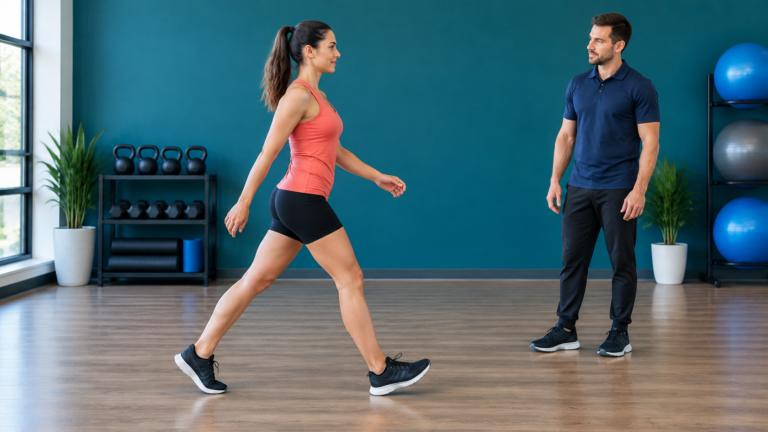
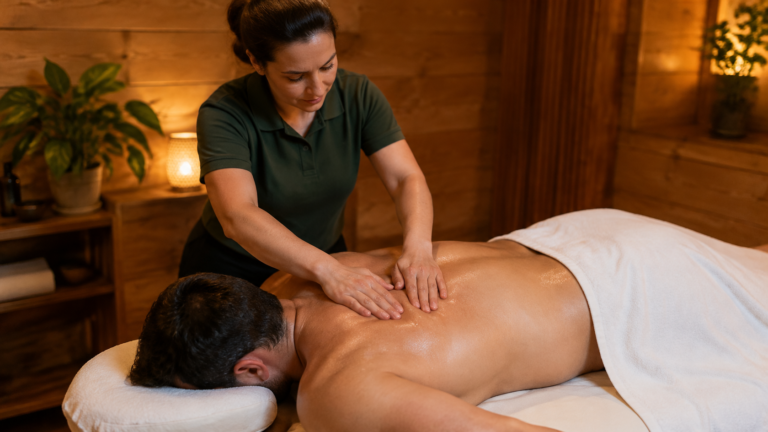
Training load and recovery belong to the same plan. At Temple Human Performance, our work combines massage and osteopathic-based manual therapy with movement training and physical preparation, and the recovery technology in our Repair space follows that same logic: it is used with the hands-on work and the movement work, not in place of either. The full-spectrum light table is one of those tools. Our light table covers a full spectrum, including red light, and the research we lean on most when we talk about it concerns red and near-infrared wavelengths and a set of outcomes that can be measured: performance during exercise, muscle fatigue, and blood markers collected after exercise.
Photobiomodulation therapy is defined in the literature as non-thermal electromagnetic irradiation delivered through laser or light-emitting diode (LED) sources. The word non-thermal matters. The light is not used to heat the body, which separates it from the infrared sauna work we covered earlier. Older papers use other labels for the same family of interventions: phototherapy, low-level laser therapy (LLLT), and LED therapy (LEDT). The reviews below use those terms interchangeably with photobiomodulation, and we keep each review’s own wording when we describe it.
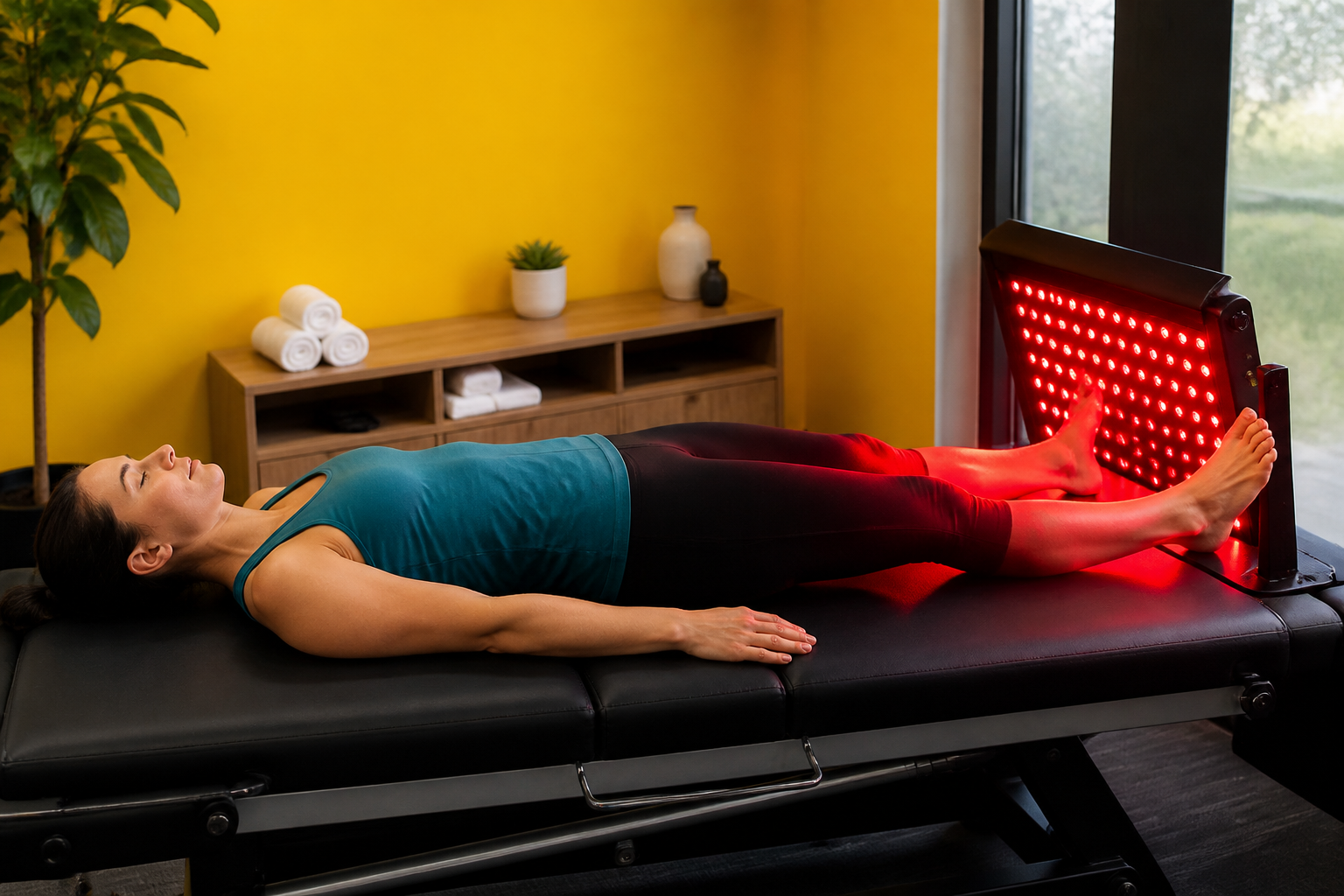
Leal-Junior and colleagues set out to test whether phototherapy applied before, during, or after exercise changes muscle performance and markers of exercise recovery. They searched for randomized controlled trials published from 2000 through 2012 and scored quality with the ten-item PEDro scale. Sixteen trials were found. Three were set aside for low quality scores, which left 13 trials with acceptable methodological quality. Twelve of those 13 applied light before exercise, and ten trials reported significant improvement in the main performance measures.
The pooled results were specific. Compared with placebo, time until exhaustion increased by 4.12 seconds (95% CI 1.21 to 7.02) and the number of repetitions increased by 5.47 (95% CI 2.35 to 8.59). For creatine kinase (CK), a blood marker used to track exercise-induced muscle damage, the trials differed too much in design for a pooled analysis, so the authors compared them directly: 13 of 16 comparisons showed positive results.
The authors also described where the findings were strongest. The most significant and consistent results came with red or infrared wavelengths, with light applied before exercise, power outputs between 50 and 200 mW, and doses of 5 and 6 J per point. Their conclusion was that phototherapy with lasers and LEDs improves muscular performance and accelerates recovery, mainly when applied before exercise.
Vanin and colleagues widened the lens. Their systematic review and meta-analysis of healthy people searched five databases through March 2017 and included 39 randomized trials with 861 participants. Twenty-eight of those trials compared phototherapy with placebo in the meta-analysis, which covered four variables: time until exhaustion, number of repetitions, isometric peak torque, and blood lactate. The authors reported some effect in favor of phototherapy, with the quality of evidence ranging from very low to moderate.
The review also mapped the parameters behind the positive results. In general, positive results were found with low-level laser, with LED, or with both combined, across a wavelength range from 655 to 950 nm. Most positive results were observed at energy doses of 20 to 60 J for small muscle groups and 60 to 300 J for large muscle groups, with a maximum power output of 200 mW per diode. Because the trials varied so much in light parameters and exercise protocols, those ranges are the review’s own summary of where the positive results clustered.
Two later meta-analyses help locate the finding within exercise types.
Dutra and colleagues pooled 37 placebo-controlled crossover studies, 78 exercise performance measurements in 586 healthy young adults, all testing photobiomodulation as a preconditioning method before exercise. In single-joint exercise, photobiomodulation improved muscle endurance performance (SMD 0.27, 95% CI 0.12 to 0.41). In cycling, it improved time to exhaustion (SMD 0.35, 95% CI 0.10 to 0.59). Muscle strength in single-joint exercise, all-out cycling sprints, running, and swimming time trials did not change in that analysis, so the benefit it describes belongs to endurance-type work.
Aguirra and colleagues narrowed in on repetitions to failure in resistance exercise. Twelve studies with 346 healthy young adults showed a mean difference of 3.87 repetitions in favor of photobiomodulation compared with placebo (95% CI 1.06 to 6.69). Laser and LED sources performed similarly. The effect was larger in upper-limb exercise (5.87 repetitions, 95% CI 3.11 to 8.63) than in lower-limb exercise (1.17 repetitions, 95% CI 0.03 to 2.32). The authors rated the certainty of the evidence as low or very low, which is the right frame for reading those numbers.
Recovery is the second half of the question, and Ferlito and colleagues addressed it directly by comparing photobiomodulation with cryotherapy after exercise. Their meta-analysis included four randomized trials with 66 healthy volunteers, with certainty of evidence rated moderate to very low. Relative to cryotherapy, photobiomodulation was estimated to improve muscle strength (SMD 1.73, 95% CI 1.33 to 2.13), to lower delayed onset muscle soreness (mean difference -25.69%, 95% CI -34.42 to -16.97), and to lower concentrations of biomarkers of muscle damage (SMD -1.48, 95% CI -1.93 to -1.03). Oxidative stress and inflammatory levels did not differ between the two. The authors concluded that photobiomodulation after high-intensity exercise appears beneficial and that its effect was clinically important.
That last point about inflammatory markers is worth keeping in view. The measured effects across these reviews sit in performance outcomes, soreness ratings, and markers such as CK and lactate. That is the set of outcomes the research supports talking about.
Time until exhaustion and repetitions to failure are measures of work capacity inside a single session. Isometric peak torque describes force output. Lactate and CK are acute markers that researchers use to follow the metabolic and mechanical cost of a bout. When a review reports small gains across those measures in healthy participants, it describes a modest shift in the work a muscle group can do and in how post-exercise markers behave.
That scale of effect fits how we think about recovery technology in general. A few extra repetitions or a few seconds more to exhaustion will not rebuild a training plan, but across a block of sessions where volume and quality of work matter, small margins are part of the picture.
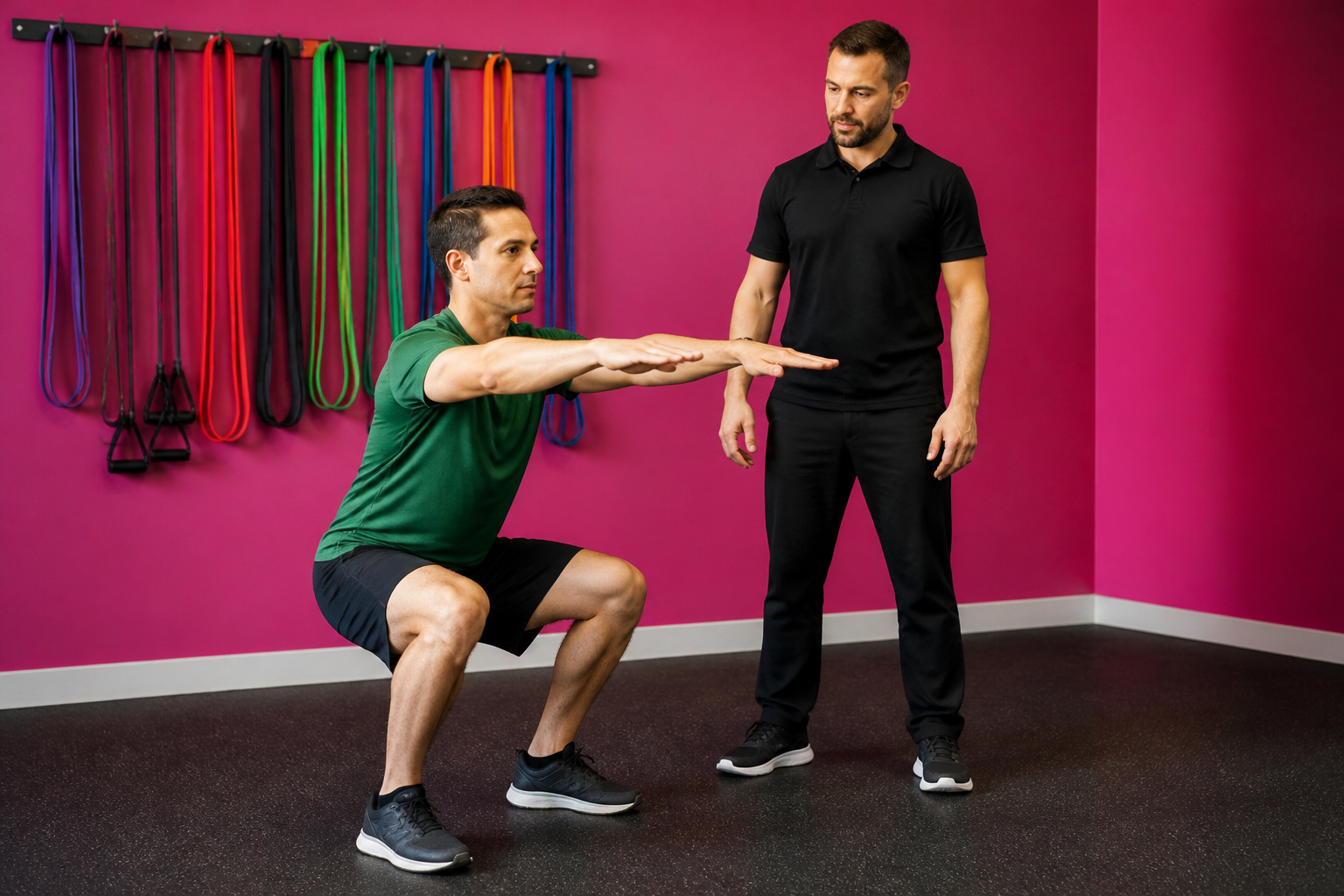
The light table sits in the Repair side of our work, next to the hands-on sessions, and it is used with them. The full-spectrum light therapy system we offer spans four spectrums, blue, yellow, red, and near-infrared, with nine wavelengths from 480 to 1060 nm and 1,152 LEDs per unit. Five of those wavelengths, 660, 670, 810, 830, and 850 nm, fall inside the 655 to 950 nm range that Vanin’s review associated with positive results. The performance and recovery literature summarized above is a red and near-infrared literature, and that is the portion of the spectrum we point to when we explain what the research shows. The system is described on its shop page.
Timing follows the research. The 2015 analysis drew its strongest results from light applied before exercise, and the Dutra analysis was built on preconditioning. We therefore treat light as an input that can sit ahead of a training session when the plan calls for it, and as part of recovery work around table sessions. It is one input among several, and it works alongside the loading, the movement quality, and the hands-on work in the same session plan.
Within the Physiokinetix framework, Mobility, Stability, Power, and Performance describe a progression, not a rigid protocol. Power and Performance work asks for repeatable quality under load, and that depends on how well a client recovers between sessions. Light-based recovery technology belongs to the supporting layer of that progression. It is part of how we keep a client in a position to train well, and it sits alongside Educate, Perform, and Nourish in Temple’s broader model, where Repair covers the recovery side of the work.
The research gives that supporting layer a defined place. Red and near-infrared photobiomodulation has been studied with enough randomized trials to be pooled repeatedly, and the pooled results point toward modest improvements in endurance-type performance and in post-exercise recovery markers. We read those results as they are written and use them to decide where light fits in a session.
Across 2015 to 2025, systematic reviews of randomized trials have reported that red and near-infrared photobiomodulation, delivered by laser or LED, improves performance measures such as time until exhaustion and repetitions to failure, and that recovery markers including CK, lactate, and muscle soreness move in a favorable direction. The largest and most consistent effects were reported when light was applied before exercise, in the red and near-infrared range, and the effect belongs mainly to endurance-type tasks. The parameters behind those results are specific, and the authors of each review say so. Taken together, the work gives a clear and measurable account of what light can add to a training and recovery plan, and it is the account we build on when the light table is part of a session.